


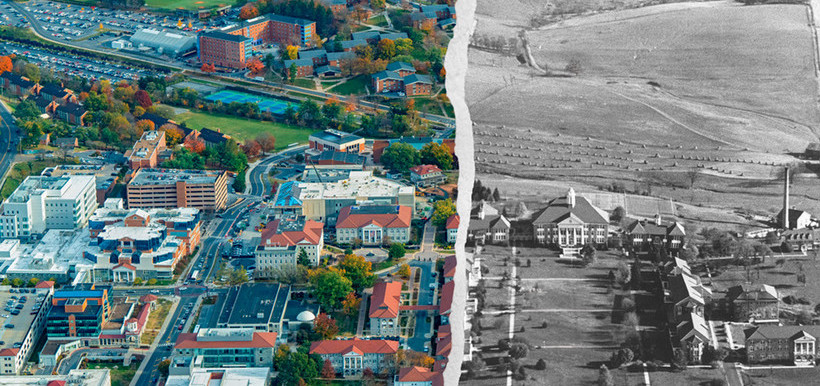
Discover the history of our Residence Halls
The Bluestone Area
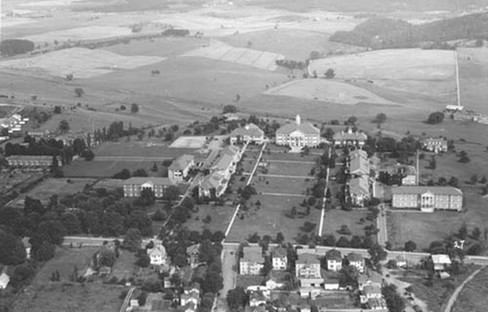
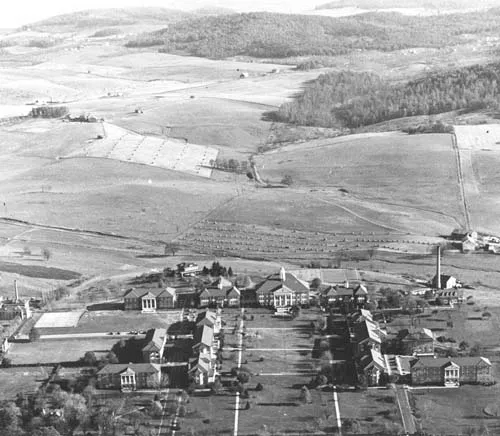
The Bluestone Area, also known as the Quad was the original campus for James Madison University, when it was founded in 1908, as “The State Normal and Industrial School for Women at Harrisonburg.”
The first original dormitories, now known as Residence Halls, were here along with the acedemic buildings.
The fifth major building on campus, Spotswood Hall, known originally as Dormitory No. 3, was completed in 1917 at a cost of over $50,000 and housed 76 students. Shortly after completion, the building was named for Colonial Governor Alexander Spotswood who led the first English expedition into the Shenandoah Valley. Located on the Quad, Spotswood residents in the 1960s had the luxury of a “pressing room equipped with electric irons and ironing boards.”
Spotswood Hall began renovations in 2025 and will reopen in August 2026 as the new home of the James Madison Center for Civic Engagement and the Civic Leadership Residential Learning Community for first year students.
The building will reopen with the new name of Alger Hall in honor of JMU’s 6th President, Jonathan R. Alger (July '12 – June '24) who championed civic engagement at JMU.
When it was first built in 1935, Converse Hall housed senior students and was called, appropriately, “Senior Hall.” It was given a less generic name in 1957 when it was named for former registrar, professor and head of the mathematics department, Henry A. Converse.
The residence hall underwent extensive renovation around 2001.
One of a pair of student residences built to the southwest of the quad, Gifford Hall, along with Wayland Hall, opened in 1958, and renovated in 2002.
The residence hall, which it remains today, was named for Dr. Walter J. Gifford, former dean and head of the education department.
Perhaps an omen of JMU's later popularity, Ashby Hall, the school's second dormitory was built in 1911 to accommodate a burgeoning enrollment, then over 300 students. Originally called Dormitory No. 2, it was renamed in 1917 for Confederate General Turner Ashby, who was killed during the Civil War a few miles east of campus. In addition to housing space, the new dorm provided a basketball court and a badly needed gymnasium replete with Indian clubs and dumbbells.
It was renovated in 2000 and renamed to Harper Allen-Lee Hall in 2021, in honor of Doris Harper Allen and Robert Walker Lee, both dedicated staff members and unsung heroes in dining services and maintenance respectively, as well as active members of the Harrisonburg and Rockingham County communities.
Hoffman Hall opened as a residence hall in 1964 and renovated in 2008. It was named for Margaret Vance Hoffman a member of the English faculty for 43 years. Over the years, in addition to students, Hoffman Hall has housed faculty and staff offices.
Built early in President G. Tyler Miller's administration in 1951, Logan Hall construction was plagued by a shortage of stone masons, a national steel strike and ballooning construction costs which required borrowing from the State Retirement Fund. When built, however, Logan added 53 student rooms to the campus. Its placement behind Jackson Hall resulted in improvements to the campus traffic pattern and general layout. Named for Conrad T. Logan, former English Department head, Logan remains a residence hall.
The building was renovated in 2004.
The most recent bluestone addition to the Quad, Wampler Hall was built in 1994. Named for Rockingham County businessman and former member and rector of the JMU Board of Visitors, Charles H. Wampler Jr., the building serves as a residence hall.
Built during a flurry of construction on campus in the 1950s, Wayland Hall was built as part of the largest two-year construction program – to that date – in the College's history.
Named for historian John W. Wayland, a member of the school's first faculty and former department head in history and social science, Wayland Hall opened in 1958 and provided housing for a growing enrollment.
In 2011, Wayland Hall became the first renovated residence hall in the country to receive the Leadership in Energy and Environmental Design Platinum Award.
The Hillside Area
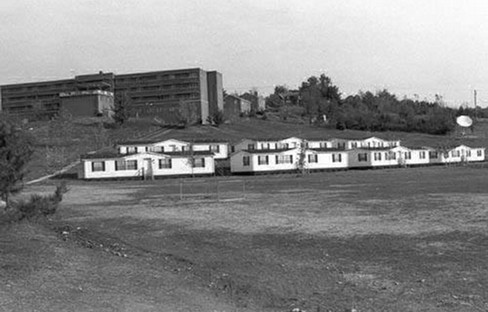
The Hillside area was and remains today, a large gathering area for students. In the 1970's, groups of students and young alumni flocked to the hillside just beyond the west end of the stadium. They brought blankets and lawn chairs, and thus "The Hillside Gang" was born.
The Hillside Gang was primarily made up of students and recent alumni – a great combination both for a cheering section and for a good time. The only thing that stood between the fans and the field was a small chain-link fence. The crowds covered the entire Hillside and extended down to the railroad tracks that run beside the football stadium. “We would bring lawn furniture and set it up between the tracks,” recalls Andy Perrine ('86).
On the hill behind Carrier Library, Bell Hall is one of three Hillside dormitories built in the 1980s to accommodate an exploding enrollment driven by a new spirit and a new name. Opened in the fall of 1982, the residence hall was named for Francis Bell, Jr., a Harrisonburg banker who served on the JMU Board of Visitors from 1972 to 1980, and as rector from 1974 to 1980.
Named for the hill where it stands and where local children sledded for decades, Hillside Hall, a coeducational residence hall, was built in 1987 on the site of a complex of modular homes used to ease a housing crunch in the 1970s.
One of the Hillside residence halls, McGraw-Long Hall was completed in 1984 at a time when excitement among prospective students was reaching a fever pitch and the need for housing was still growing.
The student residence was named for Richmond attorney and former member, vice rector and rector of the JMU Board of Visitors Walter J. McGraw and for Nellie L. Long, a member of the class of 1949 and former board member.
The Lake Area
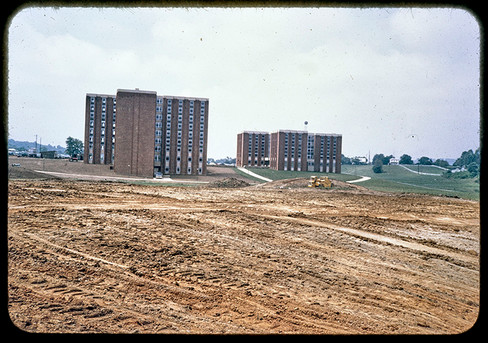
The tallest building on campus, eight-storied Eagle Hall was built above Newman Lake in 1970 as part of the men's campus. Along with Shorts Hall and The original Chandler Hall (demolished), Eagle housed a growing population of men which began with residential coeducation in 1966.
When Chandler Hall opened in 1974, JMU was bucking a nationwide trend by increasing on-campus housing. Joining Eagle and Shorts Hall near Newman Lake, Chandler housed 230 students and served as the center for Madison 's alumni activities as well as a “mini campus center.”
On July 1, 1977, Chandler was the site of a midnight celebration, replete with a huge birthday cake, to ring in the era of the newly-renamed James Madison University. Named for Wallace L. Chandler of Richmond, member of the JMU Board of Visitors from 1964 to 1974 and rector from 1972 to 1974, today Chandler Hall also houses “Mrs. Greens,” a popular campus eatery.
This building was demolished in June 2018 due to the expansion of the College of Business. Potomac Hall on the east side of campus was renamed Chandler Hall.
The tallest building on campus, eight-storied Eagle Hall was built above Newman Lake in 1970 as part of the men's campus. Along with Shorts and Chandler Halls, Eagle housed a growing population of men which began with residential coeducation in 1966.
Eagle Hall was name for Alfred Eagle, former education professor and director of guidance, counseling and placement.
Constructed during the Miller Administration, Shorts Hall was the first building on campus built to house men. When it opened in 1968, Shorts provided dormitory space for 200. Up until that time, men were housed across Main Street in Shenandoah, Lincoln and Zirkle houses. Named to honor former education professor, Clyde P. Shorts, Shorts Hall was the inaugural building on what would become the Lake area of the campus.
The Skyline Area
In 1989, 110-acres of land across Interstate 81 and east of the main campus was purchased by the University under President Carrier to expand the continously growing campus. In the late 1990's, residence halls expanded to East Campus and continue to do so today.
Built in 1998, Potomac Hall was the first student residential building constructed across Interstate 81 on the CISAT campus. Named for the Potomac River, the five-story dormitory can accommodate 430 students.
Potomac Hall was renamed Chandler Hall in 2018.
Chandler Hall is named in honor of Wallace L. Chandler of Richmond, a former rector for the JMU Board of Visitors. Chandler Hall was completed in 1998.
To meet a continuing need for housing and a facing a reluctant state legislature, President Duke persuaded a group of citizens to form a corporation to build an apartment across from the campus, with the understanding the school would rent it.
To that end, Shenandoah Hall was completed in 1922. Named for the valley and river, the school leased it until 1948 when it was purchased. In the 1940s, Shenandoah Hall housed one of the first sororities on campus, Pi Kappa Sigma, and in the 60s housed some of the first men on campus. Before it was razed in 2006, Shenandoah was home to the Office of Public Safety.
The current Shenandoah Hall, built in 2009, resides on East Campus as part of the Skyline Residential area.
This hall is named after Paul Jennings, President James Madison's enslaved personal servant. This hall was completed in 2019.
"Jennings' story is one of relentless perseverance, being born into slavery but ending his life as a devoted father, property owner, abolitionist and respected community member. His story is intellectually engaging, inspirational, and important to know to have a more complete and honest understanding of our shared history. I hope that the generations to come will reflect on his life and gain new perspectives as they come of age and begin to navigate their own worlds and challenges." - Raleigh Marshall, a descendant of Paul Jennings and 2005 alumnus of James Madison University
Community Hours
For access to the Paul Jenning Exhibit contact Residence Life Business Operations Office:
540-568-7576
Monday–Friday between 8:00 a.m. – 5:00 p.m.
Closed for lunch from noon – 1:00 p.m.
The Village Area
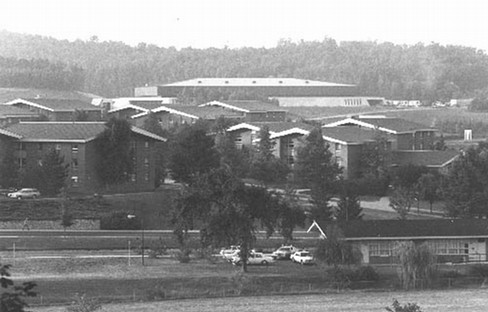
The first of the nine Village residence halls opened in 1966 as part of an effort to increase on-campus housing. This full residential area would be built on “Back Campus” in less than a decade and later be known as the center of campus.
The grounds of JMU's campus have long been admired and perhaps some of the credit goes to this hall's namesake, George W. Chappelear During his tenure at Madison College, Chappelear headed the department of biology and agriculture and, when the need arose, managed the campus grounds.
Built as a residence hall in 1968, Chappelear Hall joined Hanson Hall on the “Back Campus” making up the Village area of the college.
If there is one name which appears more often than Madison in the annals of the University, it probably is Dingledine, which makes a hall named Dingledine almost a given. Built in 1968 as one of the village dormitories, the building was named to honor Agness Dingledine, former executive secretary of the Alumnae Association and both the wife and mother of heads of the history department. Mrs. Dingledine also served as a housemother in 1949, earning her the affectionate nickname “Mama Ding.”
Frederikson Hall was built in 1967 as part of the residential Village on the “Back Campus” of Madison College. The hall was named for Dr. Otto F. Frederikson – “Dr. Freddy” to his students – who taught history for 27 years until retiring in 1957.
When Garber Hall opened as a women's residence hall in 1969, it honored a woman whose association with the University was fourfold. A graduate of the State Teachers College in 1920, Dorothy Garber taught chemistry and science for several years and served as a long time secretary for the alumnae association. As dean of women during the 1940s and 1950s, Dean Garber looked after “her” girls, the women of Madison College.
One of two student residences opened in the Village area of campus in 1968, Hanson Hall was named for former professor of geography Raus M. Hanson, who first came to the State Teachers College in 1928 and taught for 31 years. An avid rock collector, Hanson also initiated a class in geology in the 1940s.
Opening in 1966, Huffman Hall was the first of the nine Village residences which would be built on “Back Campus” in less than a decade. It is named for Dr. Charles H. Huffman, a former English professor.
Named for Dr. J. Emmert Ikenberry, former vice president for academic affairs, dean and math department head and his wife Katherine, formerly of English faculty, Ikenberry Hall opened in 1972 as a residence hall in the Village area of campus.
With the opening of Weaver Hall in 1971, on-campus housing was beginning to catch up with demand. For the first time in more than a decade, Main Streets houses were not listed among residences in the college 1972 catalog. Weaver Hall, a dormitory in the Village area of campus, was named for Harrisonburg attorney Russell M. Weaver, a member of the JMU Board of Visitors from 1964 -1972 who served as rector from 1966 to 1972.
Built in 1973, White Hall is the last dormitory constructed in the Village area of campus. The building was named for 1925 alumna, Helen Mugler White, a Newport News journalist and educator. White served as a member of the JMU Board of Visitors from 1964 to 1974 and vice-rector from 1966-74. One of the founding members of the Richmond alumni chapter, White was also named the 1962 Virginia Press Woman of the Year.

