


The National Institutes of Health supports a wide variety of research programs, including research projects (small, large, exploratory, pilots), conferences and meetings, and more.
NIH research grants generally have activity codes that start with R. Examples include R01 (Research Projects), R03 (Small Research Grants), and R15 (Research Enhancement Awards).
Do you need assistance in identifying which research grant to apply to? Check out the NIH Preliminaries part of our toolkit.
NIH proposals are prepared in ASSIST, the NIH's proposal development system. If you do not have access to ASSIST, please reach out to OSP who must create credential for you and/or associate your credentials with JMU. The NIH has a detailed guide to using ASSIST, including screenshots of where to upload materials.
NIAID provides samples of successful research grants, including R01, R03, R15, R21, and R21/R33.
Are you preparing an NIH proposal? We offer personalized assistance, including developing checklists for your particular solicitation and a suggested timeline. As time and staffing allows, we also can review proposal materials. Let us know how we can assist via our request assistance form. Your college-based Research Development Associate or Manager will follow up with you.
Research Proposal Forms
NIH proposals are organized by forms. Most research grant proposals require the same set of forms; below you'll find resources the Office of Research Development have gathered for these forms. Always use the forms identified in your NOFO.
Research Forms: The PHS 398 Research Plan is where PIs describe their proposed research project. The primary components of it are the specific aims and research strategy.
Senior/Key Personnel Forms: The senior/key personnel form collects information from all PIs and other key personnel associated with the project. For each person, this is also where you will upload their biosketch and their current & pending support documents, which must be created using SciENcv.
Budgeting Forms: Depending on the amount of money you are requesting, you will use either the R&R Budget Form or the PHS 398 Modular Budget Form. Your budget justification is attached to whichever of these forms you use. If your proposal is using the R&R budget form and involves a subaward or a funded consortium, you will also need the R&R Subaward Budget Attachment(s) Form.
Cover Forms & Other Information Forms: The NIH has a number of forms which collect based information about the applicant (JMU), the project, etc. These include:
- SF 424 (R&R) Form
- PHS 398 Cover Page Supplement
- Project/Performance Site Location(s) Form
- R&R Other Project Information Form
- PHS Human Subjects and Clinical Trials Information
(Note that if your study includes a clinical trial, this form requests a significant amount of information about your planned study, even though IRB approval can wait until later following NIH's Just-In-Time procedures.) - PHS Assignment Request Form (always optional)
Not all of these may be required for your proposal.
Full Form List: If your NOFO calls for another form beyond those listed above, please see our full list of NIH forms (under construction).
Other: The same ORCID ID must be associated with your eRA Commons Profile and your SciENcv-created biosketch or your proposal will not be considered. The NIH has a written guide on how to do this as well as a video guide. We have also included this within our video guide.
PHS 398 Research Plan Form
Description: An "Introduction to Application" attachment is required only if the type of application is resubmission or revision or if the NOFO specifies that one is needed. An introduction is not allowed for new or renewal applications. The page limit is typically one page or three pages (see NIH page limit guidance).
Forms Guidance and ASSIST Guidance (with screenshots)
Resources: ORD-Developed Template* (Remember to save as PDF before uploading into ASSIST.)
*: Requires JMU Log-In
Description: A one-page document that concisely states the goals of the proposed research and summarizes the expected outcome(s), including the impact that the results of the proposed research will have on the research field(s) involved. (See NIH page limit guidance.)
Forms Guidance and ASSIST Guidance (with screenshots)
Resources:
- ORD-Developed Template* (Remember to save as a separate PDF file before uploading into ASSIST.)
- Some specific institutes have general guidance which may be useful even if you are applying to another institute:
- If you need visuals, the NIH has a free collection available at BioART, including animals, plants, people, and shapes in addition to specialized visual art for medicine and biology.
*: Requires JMU Log-In
Description: The research strategy is the key section of the proposal, in which you outline what you'll do, how you'll do it, and why it is important. Unless your NOFO says differently, this has three sections, in this order: Significance, Innovation, and Approach. Most of the time, this is either 6 or 12 pages long; see NIH page limit guidance for your specific activity code.
We strongly recommend working on your bibliography document as you complete this section; although uploaded on the R&R Other Project Information Form, this ensures that no references are missed. Please see the bibliography template provided there.
Forms Guidance and ASSIST Guidance (with screenshots)
Resources:
- ORD-Developed Template* (Remember to save as a separate PDF file before uploading into ASSIST.)
- Some specific institutes have general guidance which may be useful even if you are applying to another institute:
- NIAID guidance (includes samples)
- NINDS guidance
- If you need visuals, the NIH has a free collection available at BioART, including animals, plants, people, and shapes in addition to specialized visual art for medicine and biology.
*: Requires JMU Log-In
Description: Required only for renewal applications, this describes all appropriate publications, manuscripts accepted for publication, patents, and other printed materials that have resulted from the project since it was last reviewed competitively. You are allowed to cite interim research products.
Forms Guidance and ASSIST Guidance (with screenshots)
Resources:
- ORD-Developed Template* (Remember to save as a separate PDF file before uploading into ASSIST.)
*: Requires JMU Log-In
Description: This file is required only if you are answering "Yes" to the question "Are Vertebrate Animals Used?" on the R&R Other Project Information Form.
Forms Guidance and ASSIST Guidance (with screenshots)
Resources:
- ORD-Developed Template* (Remember to save as a separate PDF file before uploading into ASSIST.)
*: Requires JMU Log-In
Description: Include this if your proposed activities involve the use of select agents at any time during the proposed project period, either at the applicant organization or at any performance site.
Select agents are hazardous biological agents and toxins that have been identified by HHS or the U.S. Department of Agriculture (USDA) as having the potential to pose a severe threat to public health and safety, to animal and plant health, or to animal and plant products. The Centers for Disease Control and Prevention (CDC) and the Animal and Plant Health Inspection Service (APHIS) Select Agent Programs jointly maintain a list of these agents. See the Federal Select Agent Program website.
Forms Guidance and ASSIST Guidance (with screenshots)
Resources:
- ORD-Developed Template* (Remember to save as a separate PDF file before uploading into ASSIST.)
*: Requires JMU Log-In
Description: This must be completed whenever multiple PD/PIs are designated in the proposal. The governance and organizational structure of the leadership team and the research project should be described, including communication plans, processes for making decisions on scientific direction, and procedures for resolving conflicts. The roles and administrative, technical, and scientific responsibilities for the project or program should be delineated for the PD/PIs and other collaborators.
If budget allocation is planned, the distribution of resources to specific components of the project or the individual PD/PIs should be delineated in the Multiple PD/PI Leadership Plan.
Important: Note that before JMU can submit your proposal, the AOR MUST confirm that all proposed consortium participants to the following statement:
The appropriate programmatic and administrative personnel of each organization involved in this grant application are aware of the agency's consortium agreement policy and are prepared to establish the necessary inter-organizational agreement(s) consistent with that policy.
Therefore, it is important to finish this component early and circulate among the programmatic and administrative personnal at the consortium institutions. Please share all communication indicaing agreement with your assigned grants specialist.
Forms Guidance and ASSIST Guidance (with screenshots)
Resources:
- ORD-Developed Template* (Remember to save as a separate PDF file before uploading into ASSIST.)
*: Requires JMU Log-In
Description: The NIH generally considers subawards to be a type of consortium agreement. Thus, the most common scenario in which this is included is when JMU is issuing a subaward to another institution or group of institutions.
Explain the programmatic, fiscal, and administrative arrangements to be made between the applicant organization and the consortium organization(s). If consortium/contractual activities represent a significant portion of the overall project, explain why the applicant organization, rather than the ultimate performer of the activities, should be the recipient.
Forms Guidance and ASSIST Guidance (with screenshots)
Resources:
- ORD-Developed Template* (Remember to save as a separate PDF file before uploading into ASSIST.)
*: Requires JMU Log-In
Description: In this section, include any letters necessary to demonstrate the support of consortium participants and collaborators such as Senior/Key Personnel and Other Significant Contributors included in the grant application. Letters of Support should describe terms of a collaboration or consultation and also are not de facto letters of reference from persons not actively participating in the project.
All letters of support must be combined into a single PDF.
Things letters should do:
- Letters should stipulate expectations for co-authorship.
- If a collaborator is providing cell lines, samples, or other resources, the letter should describe whether these are freely available to other investigators in the scientific community or will be provided to the particular investigators only.
- For consultants, letters should include rate/charge for consulting services and level of effort / number of hours per budget period anticipated.
- Letters from collaborators that ensuring access to core facilities and resources should stipulate whether access will be provided as a fee-for-service.
- Material Transfer Agreements may be included in this section.
Things letters should not do:
- Letters must not contain data / figures / tables / graphs, preliminary data, methods, background and significance details that are expected to be found in Research Strategy section of the application.
Letters are not required for personnel (such as research assistants) not contributing in a substantive, measurable way to the scientific development or execution of the project.
Forms Guidance and ASSIST Guidance (with screenshots)
As letters should generally be on official letterhead of the collaborator's institution, we do not provide a template for these letters.
Description: Note that Data Management and Sharing Plans do NOT go in this section; it goes in "Other Plans" below. This section refers to the sharing of research tools and/or sharing model organisms.
Research tools: NIH considers the sharing of unique research resources developed through NIH-sponsored research an important means to enhance the value and further the advancement of the research. When resources have been developed with NIH funds, and the associated research findings published or provided to NIH, it is important that they be made readily available for research purposes to qualified individuals within the scientific community.
Sharing Model Organisms: Regardless of the amount requested, all applications where the development of model organisms is anticipated are expected to include a description of a specific plan for sharing and distributing unique model organisms or state why such sharing is restricted or not possible.
Forms Guidance and ASSIST Guidance (with screenshots)
Resources:
- ORD-Developed Template* (Remember to save as a separate PDF file before uploading into ASSIST.)
- Some specific institutes have general guidance which may be useful even if you are applying to another institute:
Informational Links:
- NIH Research Tools Policy Website
- NIH Grants Policy Statement, Section 8.2.3: Sharing Research Resources
- NIH Grants Policy Statement, Section 8.2.3.2: Sharing Model Organisms
*: Requires JMU Log-In
Description: Applicants proposing to conduct research that will generate scientific data must attach a Data Management and Sharing (DMS) Plan. Scientific data is defined as the recorded factual material commonly accepted in the scientific community as of sufficient quality to validate and replicate research findings, regardless of whether the data are used to support scholarly publications. Scientific data includes any data needed to validate and replicate research findings. Scientific data does not include laboratory notebooks, preliminary analyses, completed case report forms, drafts of scientific papers, plans for future research, peer reviews, communications with colleagues, or physical objects such as laboratory specimens.
If you are seeking funding for research that generates large-scale human or non-human genomic data, you must provide a plan for sharing of these data as part of their DMS Plan. The single plan must address both the NIH Data Management and Sharing Policy and the NIH Genomic Data Sharing Policy.
Forms Guidance and ASSIST Guidance (with screenshots)
NOTE: For proposals due on or after May 25, 2026, a NEW DMS Plan format will apply! (See the NIH Notice NOT-OD-26-046.) The new format can be PREVIEWED- please note that two page limit. For due dates on or after May 25th, 2026, we recommend using this format instead of the DMPTool, at least until the DMPTool has been updated to include it.
Resources:
- Through JMU Libraries, JMU subscribes to DMP Tool, which assists PIs in developing compliant data management plans. You can log-in with your JMU email address.
- ORD has partnered with JMU Libraries to record a training on using the DMP Tool.
- NIH-provided Data Management and Sharing Plan Format (template)- for due dates before May 25, 2026. We recommend using the DMPTool, but this is an alternative.
- Sample plans are avaiable from the NIH (scroll down)
Informational Links:
- NIH Data Management and Sharing Policy and research subject to the NIH Data Management and Sharing Policy
- NIH Genomic Data Sharing Policy and research subject to the NIH Genomic Data Sharing Policy
How to Start your Data Management Plan with DMPTool:
- After you have logged in, select "Create plan".
- After entering the title of your project and JMU as the primary research organization, enter "National Institutes of Heatlh" for the Primary Funding Organization.
- Select the default DMSP Template, unless you are applying to NIMH, in which case, please select NIMH: National Institute of Mental Health
- Click create plan.
- Enter the information for your plan.
DMP Collaborators are invited to edit the plan within DMP Tool. You may request feedback from a member of the JMU Libraries staff on your data management plan from within the tool. When outputting your data management plan, we recommend not including the question text or a coversheet. It is frequently necessary to download in docx or a similar form to edit (for example, to add an introductory or concluding sentence) prior to submitting to ASSIST. Remember to convert it to a PDF before uploading to to ASSIST.
Description: If applicable, briefly describe methods to ensure the identity and validity of key biological and/or chemical resources used in the proposed studies. Key biological and/or chemical resources are characterized as follows:
- Key biological and/or chemical resources may or may not have been generated with NIH funds and: 1) may differ from laboratory to laboratory or over time; 2) may have qualities and/or qualifications that could influence the research data; and 3) are integral to the proposed research. These include, but are not limited to, cell lines, specialty chemicals, antibodies, and other biologics.
- Standard laboratory reagents that are not expected to vary do not need to be included in the plan. Examples are buffers and other common biologicals or chemicals.
A maximum of one page is suggested.
Forms Guidance and ASSIST Guidance (with screenshots)
Resources:
- ORD-Developed Template* (Remember to save as a separate PDF file before uploading into ASSIST.)
*: Requires JMU Log-In
Description: The only allowable appendix materials are:
- Blank data collection forms, blank survey forms, and blank questionnaire forms - or screenshots thereof
- Simple lists of interview questions
Include other items only if they are specified in the NOFO as allowable appendix materials. Some NOFOs may have different instructions for the Appendix. Always follow the instructions in your NOFO if they conflict with these instructions.
A maximum of 10 PDF attachments is allowed in the Appendix. If more than 10 allowable appendix attachments are needed, combine the remaining information into attachment #10.
NIH Senior/Key Personnel Form
The R&R Senior/Key Person Profile (Expanded) Form allows the collection of data for all senior/key persons associated with the project. When you go to complete this form, some of the information may be already present as it is drawn from the SF424 (R&R) form. This form can accomodate up to 100 senior/key personnel.
If there are multiple PIs/PDs, the "contact" PI should be listed first, and this person must be affiliated with the institution submitting the proposal.
Unless otherwise specified in a NOFO, senior/key personnel are defined as all individuals who contribute in a substantive, meaningful way to the scientific development or execution of the project, whether or not salaries are requested. Consultants should be included if they meet this definition.
Other significant contributors are individuals who have committed to contribute to the scientific development or execution of the project, but are not committing any specified measurable effort (i.e., person months) to the project. These individuals are typically presented at "effort of zero person months" or "as needed". Individuals with measurable effort may not be listed as Other Significant Contributors (OSCs). Consultants should be included if they meet this definition.
This "Profile - Senior/Key Person" section to list any other significant contributors (OSCs). OSCs should be listed after all other senior/key persons.
Other significant contributers are required to submit biosketchs but are not required to submit current and pending support documents.
Description: This document outlines an individual's education and training, their appointments and positions, and other information that helps NIH assess how well qualified the individual is to conduct the proposed activities. This form is required for all senior/key personnel as well as all other significant contributors.
As of January 2026, all NIH biosketchs must have an ORCID ID included to comply with NSPM-33.
The same ORCID ID must be associated with your eRA Commons Profile or your proposal will not be considered. The NIH has a written guide on how to do this as well as a video guide. We have also included this within our video guide.
Forms Guidance & Updates to Accomodate Common Forms
ASSIST Guidance (with screenshots)
Resources:
- Biosketches prepared using the Common Forms on SciENcv; note that the NIH required supplement is incorporated if you select "NIH Common Form". The NIH has a leniency policy through May 2026 where it will not automatically withdraw proposals that use the older form.
- A short ORD how-to video on how to use SciENcv, including how to link it and eRA Commons to ORCID
- A longer NSF-focused training on how to use SciENcv. (Note: The method of linking SciENcv and ORCID has changed; please see the video above.)
- Some specific institutes have general guidance which may be useful even if you are applying to another institute:
Steps to start your biosketch:
- Register or sign-in to ORCID and ensure your publication list is up-to-date.
- Register or sign-in to SciENcv; we recommend using your eRA credentials.
- As of January 2026, you must link your ORCID ID for your biosketch to be compliant.
Check that your ORCID ID is linked and, if not, link it:- Click on your email address/user name in the upper right corner.
- Select account settings.
- Scroll to linked accounts and see if ORCiD is listed. If not, use "Add account" to add it.
- To return to SciENcv, scroll to the top of the page, and click SciENcv in the row under the blue bar.
- In the lower right, select "+ New Document".
- Under Document Type, select "NIH Biographical Sketch Common Form".
- For data source, choose to use an external source and then select ORCID.
- Name your document as appropriate.
You will likely need to edit/revise portions of your biosketch, which can be done using the edit button.
To add publications: Your "My Bibliography" may be blank. However, you should see a tab next to it which says ORCID, as shown below.
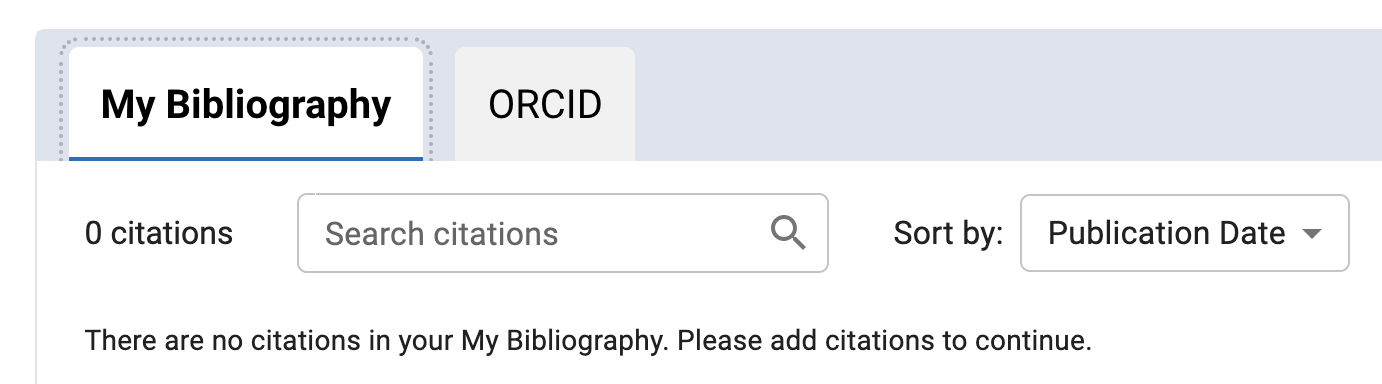
If you click on that tab, your list of publications from ORCID will appear. Select the checkbox next to the publications you wish to include.
Description: This document contains a list of an individual's proposed and active projects and sources of support. It is used by NIH to assess the capacity of the individual to carry out the research as proposed and helps assess any potential scientific and budgetary overlap or duplication, as well as overcommitment with the project being proposed. Current and Pending (Other) Support documents are required for all senior/key personnel, but are not required for other significant contributors.
Please consult with OSP at grants@jmu.edu as to whether this is required as part of the proposal process or as part of the just-in-time process before an award is issued.
NIH requires all senior/key personnel to undergo a training on required Current and Pending (Other) Support disclosures. Please contact OSP at grants@jmu.edu if necessary to arrange this training.
Forms Guidance & Updates to Accomodate Common Forms
ASSIST Guidance (with screenshots)
Resources:
- Current and Pending (Other) Support documents must be prepared using SciENcv.
- A short ORD how-to video on how to use SciENcv, including how to link it and eRA Commons to ORCID
- An NSF-focused ORD training specifically on current and pending (other) support documents, including what need to be disclosed and when you should complete them.
Steps to start your Current and Pending Support:
- Register or sign-in to SciENcv; we recommend using your eRA credentials.
- In the lower right, select "+ New Document".
- Under Document Type, select "NIH Current and Pending (Other) Support Common Form".
- Name your document as appropriate.
Supporting Documentation:
The NIH's Grants Policy Statement requires:
- If submission include foreign activities and resources, we are required to submit copies of contracts, grants, or any other agreement as supporting documentation. If they are not in English, we must provide translated copies.
- JMU is also required to establish and maintain effective internal controls (e.g. policies and procedures) to ensure that individuals designated in applications as senior/key personnel fully disclose all Other Support information to their institution as soon as it becomes known. For more information, please see JMU Policy 2213 and OSP-AS's related SOP.
What Needs to be Disclosed?
The NIH maintains a disclosure table of what needs to be disclosed in which sections of the proposal. The NIH does expect the current proposal to be listed as pending support. Therefore, this document cannot be finalized until you have finalized your budget.
R&R Budget Form
There are two primary types of NIH Budget Forms: detailed R&R and PHS 398 modular. Generally, you must use the R&R Budget Form if you are applying for more than $250,000 per budget period in direct costs, and you must use the Modular Budget Form if you are applying for less than $250,000. However, some grant mechanisms or programs may use different thresholds or specify that a particular form must always be used. Refer to your NOFO and to the following instructions for guidance on which Budget Form to use.
Overview: The introductory fields are generally pre-populated with information from the cover sections of the proposal. The R&R budget form is also known as the detailed budget, and contains line-item information.
The budget section details how much money the proposer is requesting, by category, to complete the project. This information must be provided across each year of support requested. The Office of Sponsored Programs-Administrative Services (OSP-AS) assists JMU faculty with developing budgets for sponsored programs, ensuring that they comply with JMU, state, and sponsor regulations. You can request a grants specialist to assist you in developing your budget through their Interest Form. Once you have finalized a budget with your grants specialist, you can enter that information in the relevant budget section of ASSIST.
Forms Guidance and ASSIST Guidance (with screenshots)
Resources:
- OSP-AS maintains an R&R budget template*
- List of frequently asked budgeting questions
- NIH guide to developing your budget
- Some specific institutes have general guidance which may be useful even if you are applying to another institute:
*: Requires JMU Log-In
Description: The budget justification gives details as to the nature of each cost and explains why it is necessary to accomplish the project described on the Research Plan form. If you have a quote for a specific cost, you may include it here.
The following budget categories must be justified, where applicable: equipment, travel, participant/trainee support, and other direct cost categories. Additionally, also include a justification for any significant increases or decreases from the initial budget period. You must also explain any exclusions applied to the F&A base calculation.
If your application includes a subaward/consortium budget, a separate budget justification must be submitted.
If your proposal includes a data management and sharing plan: Within the budget justification, you must clearly label a section as "Data Management and Sharing Justification" which must be followed by the estimated dollar amount (total direct costs) associated with these costs.
- In this section, you must provide a brief summary of type and amount of scientific data to be preserved and shared and the name of the established repository(ies) where they will be preserved and shared.
- Indicate general cost categories such as curating data and developing supporting documentation, local data management activities, preserving and sharing data through established repositories, etc., including an amount for each category and a brief explanation.
- Specify in the justification if no costs will be incurred for Data Management and Sharing, if applicable.
The recommended length of the justification should be no more than half a page. For more information, see Budgeting for Data Management & Sharing on the NIH Scientific Data Sharing website.
Forms Guidance and ASSIST Guidance (with screenshots)
Resources:
- OSP-AS maintains an R&R budget justification*
- An ORD training on how to prepare budget justifications, including how they contribute to proposal competitiveness.
- NIH guide to developing your budget
- NIH guide to budgeting for data management & sharing
*: Requires JMU Log-In
R&R Subaward Budget Attachment(s) Form
This form is required only if:
- You are using the R&R Budget Form
- AND you have subaward or consortium, where funding will be going to another institution.
Each subaward recipient or consortium recipient organization that performs a substantive portion of the project must complete an R&R Subaward Budget Attachment, including the Budget Justification section. Please work with OSP-AS to gather the necessary materials and upload them into ASSIST.
Forms Guidance and ASSIST Guidance (with screenshots)
We do not provide templates for these as this material should be provided by the subaward or consortium institution(s).
PHS 398 Modular Budget Form
There are two primary types of NIH Budget Forms: detailed R&R and PHS 398 modular. Generally, you must use the R&R Budget Form if you are applying for more than $250,000 per budget period in direct costs, and you must use the Modular Budget Form if you are applying for less than $250,000. However, some grant mechanisms or programs may use different thresholds or specify that a particular form must always be used. Refer to your NOFO and to the following instructions for guidance on which Budget Form to use.
Overview: In a modular budget, you request a certain number of modules ($25,000 increments) to fund your project, without providing specifics to the NIH on how the funds will be used. Despite this, it is still important to work with OSP-AS on preparing your budget. The Office of Sponsored Programs-Administrative Services (OSP-AS) assists JMU faculty with developing budgets for sponsored programs, ensuring that they comply with JMU, state, and sponsor regulations. You can request a grants specialist to assist you in developing your budget through their Interest Form.
While the modular budget is a shorter form with less information provided to the NIH, it's important to note that the process of creating the budget is frequently longer:
- As detailed on the NIH's modular budgets page, it is recommended to create a detailed budget for your own institution's use including salaries, equipment, supplies, graduate student tuition, etc. for every year of funds requested. OSP-AS follows this recommendation and therefore you will need to first work with a grants specialist to create a detailed line-item budget.
- You will also need the detailed line-item budget to route your proposal for internal approval.
- Then, after removing any consortium/subaward F&A from the total direct costs, you round to the nearest $25,000 increment. More specifically, you should determine the number of modules you will need annually. Your grants specialist will asssist with this.
- Finally, this information is entered into the modular budget form in ASSIST.
Forms Guidance and ASSIST Guidance (with screenshots)
Resources:
- OSP-AS maintains an R&R budget template*. This is the usually the budget form that will be used to create the internal detailed budget.
- List of frequently asked budgeting questions
- NIH guide to developing your budget (includes modular budget examples)
- Some specific institutes have general guidance which may be useful even if you are applying to another institute:
*: Requires JMU Log-In
Description: A modular budget justification should include the following sections:
- Personnel Justification: The Personnel Justification should include the name, role, and number of person-months devoted to this project for every person on the project. Do not include salary and fringe benefit rate in the justification.
- Consortium Justification: If you have a consortium/subcontract, include the total costs (direct costs plus F&A costs), rounded to the nearest $1,000, for each consortium/subcontract. Additionally, any personnel should include their roles and person months; if the consortium is foreign, that should be stated as well.
- Additional Narrative Justification: Additional justification should include explanations for any variations in the number of modules requested annually. Also, this section should describe any direct costs that were excluded from the total direct costs (such as equipment, tuition remission) and any work being conducted off-site, especially if it involves a foreign study site or an off-site F&A rate.
If your proposal includes a data management and sharing plan: Within the budget justification, you must clearly label a section as "Data Management and Sharing Justification" which must be followed by the estimated dollar amount (total direct costs) associated with these costs. If no cost will be incurred, enter "0" for the estimated dollar amount.
- In this section, include a brief justification of the proposed activities that will incur costs.
- Provide a brief summary of type and amount of scientific data to be preserved and shared and the name of the established repository(ies) where they will be preserved and shared.
- Indicate general cost categories such as curating data and developing supporting documentation, local data management activities, preserving and sharing data through established repositories, etc., including an amount for each category and a brief explanation.
The recommended length of the justification should be no more than half a page. For more information, see Budgeting for Data Management & Sharing on the NIH Scientific Data Sharing website.
Forms Guidance and ASSIST Guidance (with screenshots)
Resources:
- NIH guide to developing your budget
- NIH guide to budgeting for data management & sharing
- OSP maintains sample budget justifications.
*: Requires JMU Log-In
NIH SF 424 (R&R) Form
This form is required for all applications and collects basic information about the applicant (JMU) and the project. You may not be able to enter all of the reuqired information into this form until other sections have been completed (e.g., you may not know the estimated funding until you have completed the budget).
Much of the required information for the cover form can be found in OSP's Submission FAQ.
In particular note that:
- The applicant information is information about JMU.
- The person to be contacted on matters involving this application must be one of JMU's Authorized Organizational Representative (AOR). If you are unsure whose information to enter, please reach out to OSP at grants@jmu.edu.
- Your information would go under Project Director/Principal Investigator (PD/PI) Contact Information
You may also want to refer to NIH's guide to types of applications. Most applications are new, resubmissions, or renewal applications.
The NIH currently instructs all applicants to mark "No" for this question.
The NIH does not generally use pre-applications. Unless your NOFO explicitly instructs you to enter something here, this should be left blank.
Cover letter attachments are not usually required. Here are some scenarios in which one is submitted:
- Your NOFO instructs you to.
- For late applications, this is where you can explain the relevant extenuating circumstances. See the NIH's policy.
- If the application is changed or corrected after the due date, that must be explained here.
- If there are subawards that are active for only certain budget periods of the grant, these must be explained here.
- When videos are included as part of the proposal.
- If the research will generate large-scale human or non-human genomic data as detailed in the NIH Genomic Data Sharing Policy.
- When the proposed studies involve human fetal tissue obtained from elective abortions (HFT).
This list is not exhaustive and the forms guidance should be consulted. If a cover letter attachment is included, it should include the application title as well as the title of the NOFO (or PA or RFA).
PHS 398 Cover Page Supplement Form
This form is required for all applications except fellowships. It collects basic information about whether human embryonic stem cells or human fetal tissue are used and whether vertebrate animals are euthanized. (Use of human subjects and vertibrate animals is disclosed on the R&R Other Project Information form.)
This form also indicates whether inventions and patents are involved (renewals) or whether the PI or organization has changed.
NIH Project/Performance Site Location Form
The Project/Performance Site Location(s) Form is used for all grant applications. It is used to report the primary location and any other locations at which the project will be performed. The form allows for multiple performance sites; if you need to add even more project/performance site locations than the form allows, enter the information in a separate file and add it to the "Additional Locations" section.
Generally, the primary location should be that of the applicant organization or identified as off-site in accordance with the conditions of the applicant organization's negotiated Facilities and Administrative (F&A) agreement. Please consult with OSP if you are unsure as to what use for the primary location.
If you are submitting a multi-project proposal, the overall component includes only the primary site for the entire applications, while the other components list hte primary site for each component.
Much of the required information for the this form can be found in OSP's Submission FAQ.
Do not check the box for "I am submitting an application as an individual, and not on behalf of a company, state, local or tribal government, academia, or other type of organization" unless otherwise specified by the NOFO.
Since JMU is the applicant, you will need to put the address for OSP at JMU, etc.
NIH R&R Other Project Information
This form is a bit of a catch-all that gathers key project information. This includes:
- Questions about the research project, such as whether human subjects or invertibrate animals are involved.
- Information that will be public if the project is funded: the project summary/abstract and narrative.
- Ancilliary information, particularly the bibliography as well as facilities and equipment.
Q1: Are Human Subjects Involved?
The NIH defines human subjects as:
A living individual about whom an investigator (whether professional or student) conducting research:
- Obtains information or biospecimens through intervention or interaction with the individual, and uses, studies, or analyzes the information or biospecimens; or
- Obtains, uses, studies, analyzes, or generates identifiable private information or identifiable biospecimens
If you are not sure if you are doing human subjects research, you may use the NIH's Decision Tool. The NIH has extensive resources on human subjects research, including inclusion policies. If your project involves vertebrate animals, you will need to work with JMU's Office of Research Integrity and Compliance.
If your answer is yes, you will need to provide further information. JMU's Federalwide Assurance (FWA) number is available on OSP's website. Note that The Office of Research Integrity & Compliance (ORIC) reviews and approves all exemptions claimed for research conducted at the James Madison University.
You may also want to look at NIH resources on whether your project is a clinical trial, Basic Experimental Study Involving Humans (BESH), or an Observational Study Involving Humans; this page includes checklists and case studies to help you make the appropriate call. There is an NIH decision tool specifically to assist you with determining whether your study is a clinical trial.
Q2: Are Vertebrate Animals Used?
If activities involving vertebrate animals are planned at any time during the proposed project at any performance site, check "Yes." If animal involvement is anticipated within the period of award but plans are indefinite, check "Yes." Note that the generation of custom antibodies constitutes an activity involving vertebrate animals, according to the NIH.
If your answer is yes, you will need to provide further information. JMU's Animal Welfare Assurance number is available on OSP's website. Note that IACUC committee, managed by the Office of Research Integrity & Compliance (ORIC) on behalf of the president, reviews and approves all research involving laboratory animals at JMU.
Q3: Is proprietary/privileged information included in the application?
If the answer is yes or you are unsure, please consult with Research2Impact regarding intellectual property. JMU has specific policies and procedures about intellectual property disclosure.
Q4: Does this Project Have an Actual or Potential Impact - positive or negative - on the environment?
If the answer is yes, you will need to explain. Please see the nine cases where you must answer yes in the forms guidance.
Q5: Is the research performance site designated, or eligible to be designated, as a historic place?
If yes, you will need to explain.
Forms Guidance and ASSIST Guidance (with screenshots)
Q6: Does this project involve activities outside of the United States or partnerships with international collaborators?
Note that currently the NIH only allows foreign collaborators to receive funding on applications to a NOFO that is specifically designated for funded foreign collaborations (see NOT-OD-25-104). These would have activity codes PF5, UF5, RF2, or UL2. Note that the structure of these is that the NIH makes a separate, but linked, award to the foreign collaborator. PA-26-002 is an example of a NOFO that funds foreign collaborations.
Note that the answer is yes if the project involves activities outside of the United States or partnerships with international collaborators, even if they are unfunded. If you mark yes, you must include a "Foreign Justification" attachment in Field 12, Other Attachments. Please see the template available in this section below.
Description: The project summary/abstract is 30 lines of text that describes the project. If funded, this information will become public. Note that despite the short length, this still must be uploaded as a separate file.
Forms Guidance and ASSIST Guidance (with screenshots)
Resources:
- ORD-Developed Template* (Remember to save as a separate PDF file before uploading into ASSIST.)
*: Requires JMU Log-In
Description: Describe the relevance of this research to public health in, at most, three sentences. Note that despite the short length, this still must be uploaded as a separate file.
Forms Guidance and ASSIST Guidance (with screenshots)
Resources:
- ORD-Developed Template* (Remember to save as a separate PDF file before uploading into ASSIST.)
*: Requires JMU Log-In
Description: This bibliography collects all of the references for the rest of your proposal. This would include those in the PHS Human Subjects and Clinical Trials Information form (if included) as well as:
- For research proposals, the PHS 398 Research Plan Form
- For career development proposals, the PHS 398 Career Development Award Supplemental Form
- For training grants, the PHS 398 Research Training Program Plan Form
- For fellowships, the PHS Fellowship Supplemental Form
We strongly recommend developing the bibliography as you write these sections to ensure that no entries are missed.
Forms Guidance and ASSIST Guidance (with screenshots)
Resources:
- ORD-Developed Template* (Remember to save as a separate PDF file before uploading into ASSIST.)
*: Requires JMU Log-In
Description: This document describes how the scientific environment in which the research will be done contributes to the probability of success (e.g., institutional support, physical resources, and intellectual rapport). This does not include equipment, which is detailed in a separate document below.
Forms Guidance and ASSIST Guidance (with screenshots)
Resources:
- ORD-Developed Template* (Remember to save as a separate PDF file before uploading into ASSIST.)
*: Requires JMU Log-In
Description: List major items of equipment already available for this project and, if appropriate, identify the equipment's location and pertinent capabilities. Based on JMU's NICRA, Equipment is defined as tangible property with a useful life over one year and a per-unit acquisition cost that meets or exceeds $5,000.
Forms Guidance and ASSIST Guidance (with screenshots)
Resources:
- ORD-Developed Template* (Remember to save as a separate PDF file before uploading into ASSIST.)
*: Requires JMU Log-In
Include attachments only when instructed to do so by the NOFO and/or agency-specific instructions.
The primary usage is to include a"Foreign Justification" attachment when question 6 is marked yes. This document should describe special resources or characteristics of the research project (e.g., human subjects, animals, disease, equipment, and techniques), including the reasons why the facilities or other aspects of the proposed project are more appropriate than a domestic setting.
In the body of the text, begin the section with a heading indicating "Foreign Justification" and ensure the filename contains "ForeignJustification" (i.e., the phrase without quotation marks and ensuring no spaces between the words in the pdf file name).
Forms Guidance and ASSIST Guidance (with screenshots)
Resources:
- ORD-Developed Foreign Justification* (Remember to save as a separate PDF file named "ForeignJustification" (no quotation marks) before uploading into ASSIST.)
*: Requires JMU Log-In
PHS Human Subjects and Clinical Trials Information
You must complete the R&R Other Project Information before you can complete this form. Your answers from that form will appear on this form and will affect what sections are available for completion.
This form collects detailed information about research involving human participants so reviewers can assess participant protections and regulatory compliance. It also determines whether a study qualifies as a clinical trial; if so, the NIH will then ensure appropriate oversight and reporting requirements are met when an award is issued.
Career Development Awards cannot be used to fund clinical studies. If you are applying for a grant with a K activity code, and you are doing human subjects research, please make sure that at least one answer in the clinical trial questionaire (in Section 1 of the Study Record) is marked no. If you determine that your research necessarily involves a clinical study, please apply for a Research Grant instead.
Q: Does any of the proposed research in the application involve human specimens and/or data?
If the answer is NO, then there are no further questions to complete on this form.
If the answer is YES, then the next consideration is whether ALL of the human specimens/data usage are considered to be human subjects research. The NIH provides a flowchart to determine when usage of human specimens or data is human subjects research. The NIH also has significant information on human subjects research.
If the answer is no, then you'll need to upload an explanation of why the human specimens and/or data that you are using is NOT human subjects research. If you also have specimens or data that is human subjects research, do not discuss that here- you'll discuss that below.
Forms Guidance and ASSIST Guidance (with screenshots)
Resources:
*: Requires JMU Log-In
Description: Upload a file here only if your NOFO specifically says to OR one of the following applies:
- In a renewal application, you can use this attachment to provide a list of ongoing studies or ClinicalTrials.gov identifiers.
- You are required to as part of a multi-project study proposal; see details in the forms guide.
Forms Guidance and ASSIST Guidance (with screenshots)
Resources:
*: Requires JMU Log-In
Description: If you plan on doing human subjects research, you must include either study record(s) or delayed onset study(ies). You should feel out a separate record or delayed onset study entry for each study. A delayed onset study is one where you anticipate doing the study during the period of the award, but definite plans are not known yet so the study cannot be described. These are frequently used when aspects of the study will be finalized based on some initial research that is to be done at the beginning of the award.
If specific plans for your study involving human subjects can be described in the application but will not begin immediately (i.e., your study has a delayed start), you must still add a Study Record (not a Delayed Onset Study entry) for that study.
Additionally, you will need to complete a study record for public health surveillance activities (as defined in Uniform Guidance).
Study records should be entered using the "Add New Study" button within ASSIST. The study record then asks you to upload information in six sections.
Forms Guidance and ASSIST Guidance (with screenshots)
Section 1: Basic Information
This collects basic information on the study. At JMU, the IRB determines whether a study is exempt. Please consult with ORIC before marking that a study is exempt.
The clinical trial questionnaire is key here. Generally speaking, if you answer yes to all of the clinical trial questionnaire questions, then your study is a clinical questionnaire, and you'll need to complete sections 2, 3, and 4 of the study record, as well as section 5 if required by the NOFO. On the other hand, if you answer no the any of the clinical trial questionnaire questions, then you'll need to complete sections 2 and 3, but not 4 and 5. However, there are specific instructions for R25 and some other application types in the Forms Guidance.
Forms Guidance and ASSIST Guidance (with screenshots)
Section 2: Study Population Characteristics
This section is required for all human subject studies, unless exemption 4 (only) applies. This section primarily collects charatistics of the population you will be studying. In addition to completing the fields, you will need to submit a number of files:
- Inclusion of Individuals Across the Lifespan
- Inclusion of Women and Members of Racial and/or Ethnic Minority Groups
- Recruitment and Retention Plan
- Study Timeline
Recruitment status: You will need to complete the recruitment status question unless you selected only exemption 4 above. This question asks you the current status of your study (e.g., not yet recruiting, recruiting, active but not recruiting, completed, etc.)
Enrollment of first participant: You do NOT need to complete this question if EITHER of these apply to you:
- You will answer that you are using an existing data set in the Inclusion Enrollment Report.
- You selected only exemption 4 above.
If you have to complete this section, enter the date of the enrollment of the first participant into the study. From the dropdown menu, select whether this date is anticipated or actual.
Inclusion Enrollment Report (IER): These are required for all human subjects studies unless you selected only exemption 4 above. Each proposed study must have at least one IER; it may have more than one. These are NOT a separate file that needs to be uploaded; the NIH has provided a guide on how to create an IER. As you go through your study and add more participants, you will provide updated IERs to the NIH. In this report, you must select whether you are using an exsiting data set/resources or not, which is relevant to the enrollment of first participant question above. The main component of this report is a data table which records data about the gender, race, etc. of the study participants.
Forms Guidance and ASSIST Guidance (with screenshots)
Resources:
- ORD-Developed "Inclusion of Individuals Across the Lifespan" Template*
- ORD-Developed "Inclusion of Women and Members of Racial and/or Ethnic Minority Groups" Template*
- ORD-Developed "Recruitment and Retention Plan" Template*
- ORD-Developed "Study Timeline" Template*
*: Requires JMU Log-In
Section 3: Protection and Monitoring Plans
This section describes the steps taken to ensure that human participants are protected in the study. Generally there are several attachements you will need to include; templates are below.
Protection of Human Subjects: If your human subjects research falls under any exemptions, explain why the research meets the criteria for the exemption(s) that you have claimed. As mentioned above, be sure to consult with JMU's IRB to make sure the study is in fact exempt. If it is not exempt, then you will need to follow the required structure to demonstrate how you are protecting your subjects.
Is this a multi-site study that will use the same protocol to conduct non-exempt human subjects research at more than one domestic site?: Answer yes or no. If you mark yes, you are expected to use a single IRB to review all of the research activities (at all sites), unless doing so would violate a federal, tribal, or state law, regulation, or policy. You may answer N/A only if one of these applies:
- You answered yes to the question on whether the study is exempt from federal regulations in section 1 above.
- You are a training grant applicant.
For NIH Applicants, the single IRB plan is no longer required. Do not provide an attachment. The applicant must provide a statement naming the single IRB of record in the Just-in-Time submission prior to award. For AHRQ applicants, a single IRB plan is required.
Data and Safety Monitoring Plan: This is generally required if you answered "Yes" to all the questions in the Clinical Trial Questionnaire; otheriwse it is typically optional for all other human subjects research, although always follow any specific guidance in your NOFO.
For AHRQ Applicants, this is required in all non-exempt research applications when support is sought to study the effect of a health-related intervention on outcomes in human subjects where there is greater than minimal risk.
Data Safety and Monitoring Board: Answering this question is required if you answered "Yes" to all the questions in the clinictal trial questionnaire section; otherwise, it is optional for all other human subjects research.
Overall Structure of the Study Team: This attachment is usually optional unless indicated otherwise in your NOFO. It provides a brief overview of the organizational/administrative structure and function of the study team, particularly the administrative sites, data coordinating sites, enrollment/participating sites, and any separate laboratory or testing centers. The attachment may include information on study team composition and key roles (e.g., medical monitor, data coordinating center), the governance of the study, and a description of how study decisions and progress are communicated and reported.
Forms Guidance and ASSIST Guidance (with screenshots)
Resources:
- ORD-Developed "Protection of Human Subjects" template (exempt) Template*
- ORD-Developed "Protection of Human Subjects" template (non-exempt) Template*
- ORD-Developed "Data Safety Monitoring Plan" Template*
- ORD-Developed "Overall Structure of Study Team" Template*
- ORD-Devleoped "Single IRB Plan" Template* (use ONLY if applying to AHRQ and NOT NIH).
*: Requires JMU Log-In
Section 4: Protocol Synopsis
This section is required if you answered yes to all of the questions in the Clinical Trial Questionaire; otherwise, you may skip this section unless specified in the NOFO. Note that generally if you answered no to one of the questions and you put information here, it will cause an error and prevent your application from being accepted.
You do NOT need to have a fully-approved IRB protocol prior to submitting your proposal. This section collects a lot of information that will inform your IRB protocol when you prepare it. You will need to type in a short description of your study design. This is also where you will give specific information about your intervention(s) as well as your outcome measures.
For more information about formatting text entry fields, see NIH's Rules for Text Fields page.
This has several sections:
Study Design: Many of these are textbox entries or dropdown menus.
Detailed Description: Enter a narrative description of the protocol. Describe your plans for assignment of participants and delivery of interventions. You will also need to show that your methods for sample size and data analysis are appropriate given those plans. For trials that randomize groups or deliver interventions to groups, special methods are required; additional information is available at the Research Methods Resources webpage. The narrative description is limited to 32,000 characters (but typically needs only 5,000 characters), should be written in layperson's terms, and may repeat some of the information in the Research Strategy.
Questions you will answer by drop down include: Primary purpose, Interventions (you will also need to provide a name and description), Study Phase, Intervention Model, Masking (blinding), and Allocation.
Outcome Measures: You will need to enter a new measure for each primary, secondary, and other important measures to be collected during your proposed clinical trial. Describe each measure, including by giving the required information.
Statistical Design and Power: Specify the number of subjects you expect to enroll, the expected effect size, the power, and the statistical methods you will use with respect to each outcome measure you listed. You will need to show that your methods for sample size and data analysis are appropriate given your plans for assignment of participants and delivery of interventions. For trials that randomize groups or deliver interventions to groups, special methods are required; additional information is available at the Research Methods Resources webpage.
Subject Participation Duration: Enter the time (e.g., in months) it will take for each individual participant to complete all study visits. If the participation duration is unknown or not applicable, write "unknown" or "not applicable."
Will the study use an FDA-regulated intervention?: Select yes or no as appropriate; see the definition of "FDA Regulated Intervention" under the Oversight section of the ClinicalTrials.gov Protocol Registration Data Element Definitions for Interventional and Observational Studies page. If yes, you must describe the availability of Investigational Product (IP) and Investigational New Drug (IND)/Investigational Device Exemption (IDE) status via a PDF upload.
Is this an applicable clinical trial under FDAAA?: Select yes or no to indicate whether the study is an applicable clinical trial (ACT) under the Food and Drug Administration Amendments Act (FDAAA). For more information, see the FAQs on the ClinicalTrials.gov & FDAAA.
Dissemination Plan: Although one Dissemination Plan per application is sufficient, you must include a file for each study within your application. All filenames within your application must be unique. You may either attach the same Dissemination Plan to different studies or attach a file that refers to the Dissemination Plan in another study within your application. For example, you may attach a file that says "See Dissemination Plan in the 'My Unique Study Name' study."
Forms Guidance and ASSIST Guidance (with screenshots)
Resources:
- ORD-Developed "Statistical Power and Design" Template*
- ORD-Developed Availability of Investigational Product (IP) and Investigational New Drug (IND)/Investigational Device Exemption (IDE)" Template*
- ORD-Developed "Dissemination Plan" Template*
*: Requires JMU Log-In
Section 5: Other Clinical Trial-Related Attachments
This section appears only for clinical trial study records and only when an attachment is specifically requested in the Notice of Funding Opportunity (NOFO) to which you are applying. Please refer to the Forms Guidance as including this in some application types will cause errors.
If these are required, they must be submitted as PDFs. Generally speaking, the NOFO will specify a specific filename (although not necessarily always). If a specific filename is not given in the NOFO, use a meaningful filename since it will become a bookmark in the assembled application image. If the NOFO requires a specific filename, and you have more than one study and hence need to upload more than one file, add unique numbers at the end of the filenames for each study record (e.g. study_filename1, study_filename2).
Forms Guidance and ASSIST Guidance (with screenshots)
Section 6: Clinical Milestone Plan
This section appears only after submission and is not relevant to proposal preparation.
Description: If you plan on doing human subjects research, you must include either study record(s) or delayed onset study(ies). You should feel out a separate record or delayed onset study entry for each study. A delayed onset study is one where you anticipate doing the study during the period of the award, but definite plans are not known yet so the study cannot be described. These are frequently used when aspects of the study will be finalized based on some initial research that is to be done at the beginning of the award.
For each delayed onset study, you will need to provide:
- The study title
- Whether the study is anticipated to be a clinical trial
- A justification explaining why human subjects study information is not available at the time of application. If NIH's Policy on the Dissemination of NIH-Funded Clinical Trial Information will apply to your study, this justification must also include the dissemination plan.
Note: if you are applying for a career development award and you are proposing to gain clinical trial experience under a mentor's supervision- so you will not be leading an independent clinical trial- do NOT check the "anticipated clinical trial" box.
Forms Guidance and ASSIST Guidance (with screenshots)
Resources:
*: Requires JMU Log-In
PHS Assignment Request Form (Optional)
The PHS Asisgnment Request Form is always optional. Use it only if you wish to communicate specific awarding component assignments or review preferences. There is no requirement that all fields or all sections be completed. You have the flexibility to make a single entry or to provide extensive information using this form.
You may enter up to three preferences for primary assignment in the boxes in the "Suggested Awarding Component(s)" row. Descriptions of the scientific areas covered by all NIH ICs and links to other PHS agency information can be found on the PHS Assignment Information website. To facilitate accurate communication of any assignment preferences to NIH referral and review staff, use the short abbreviation (e.g., NCI for the National Cancer Institute).
You do not need to make entries in all three boxes of the "Awarding Component Assignment Suggestions" section.
Note: Your application will be assigned based on the most appropriate match between it, the terms of the NOFO, and the mission of each possible awarding component, with your preference(s) taken into consideration when possible.
All assignment suggestions will be considered; however, not all assignment suggestions can be honored. Applications are assigned based on relevance of your application to an individual awarding component mission and scientific interests in addition to administrative requirements such as IC participation in the funding opportunity used to submit your application.
You may enter up to three preferences for SRGs/SEPs in the boxes in the "Suggested Study Sections" row. Use one box per individual SRG/SEP preference suggestion. All suggestions will be considered; however, not all assignment suggestions can be honored.
To facilitate accurate communication of any review assignment preferences to NIH referral and review staff, use the short abbreviation of the SRG/SEP you would prefer. For example, enter "CAMP" for the NIH Cancer Molecular Pathobiology study section or enter "ZRG1HDMR" for the NIH Healthcare Delivery and Methodologies SBIR/STTR panel for informatics. Be careful to remove all hyphens, parentheses, and spaces when you type in the suggestion. Freeform text (such as "special emphasis panel" or "member conflict SEP") should not be entered. More information about how to identify CSR and NIH SRGs and SEPs, including their short abbreviations, can be found on CSR Study Sections and Special Emphasis Panel. A list of all NIH SRGs and SEPs is also available.
You do not need to make an entry in all three boxes of the "Study Section Assignment Suggestions" section.
Note: Your application will be assigned based on the most appropriate match between it, the terms of the NOFO, and the guidelines for each SRG/SEP, with your preference(s) taken into consideration when possible.
While the majority of NIH research grant and fellowship applications are reviewed by CSR, some are assigned to individual IC review groups and some are clustered for review in SRGs/SEPs, depending on existing locus of review agreements within NIH and other PHS agencies. This limits flexibility for honoring assignment preferences.
This information is not applicable if you are submitting an application to an RFA.
Enter the rationale (i.e., why you think the assignment is appropriate) for your Awarding Component and Study Section suggestions.
You may list up to five general or specific types of expertise needed for the review of your application. Limit your answers to areas of expertise - do not enter names of individuals you would like to review your application.
You may list specific individuals, if any, who should not review your application and why they should not review your application. Provide sufficient information (e.g., name, organizational affiliation) so that the SRO can correctly identify the individual. Be prepared to provide additional information to the SRO if needed. Simply stating "Dr. John Smith is in conflict with my application" is not helpful.