
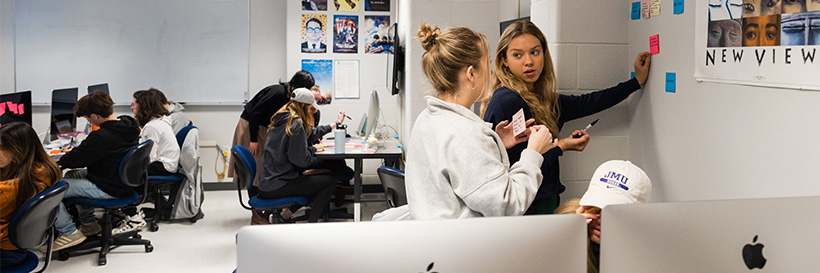
When a website or an app looks amazing and is helpful and intuitive to use, that's Interactive Design in action.
The Interactive Design concentration prepares students to create and manage digital media in the areas of interactive design and user experience. The concentration is designed for students interested in careers that combine web design, digital management and user experience in a society ever more reliant on digital media.
Skill development and experiences:
- Web design
- User research
- User experience design
- Information architecture
- Wireframes and mockups
- Hi- and lo-fidelity prototypes
- Ethical and appropriate use of AI in interactive design
- CSS and HTML coding
- Digital management
Frequently Asked Questions About the SMAD Program
While our introductory course has more than 100 students, this is the only “large” class in SMAD. Most of our production classes are at or near 16 students per class.
SMAD majors must complete 42 credit hours of required SMAD classes, which include core Media Arts and Design and concentration-specific courses. Students choose a concentration in either Creative Advertising, Digital Video and Cinema, Interactive Design, or Journalism.
Students can only have one concentration — either Creative Advertising, Digital Video and Cinema, Interactive Design or Journalism. Students select their preferred concentration when applying to the major.
Students should plan for at least four semseters to complete SMAD.
It’s always a good idea to speak with an academic advisor regarding individual timelines. Most students admitted prior to the start of their junior year, who are “on track” with credit hours, have completed most of General Education and Major Requirements, should be able to complete SMAD coursework “on time.”
Yes! The relatively low number of credit hours (42) in the SMAD major means some students will choose a second major. Many SMAD students also choose a minor or two, but double-majoring or completing a minor is NOT required.
Timely completion of JMU coursework requires careful planning, ideally in a student’s first year. Speak with your advisor(s) about developing a long-term plan for double-majoring.
SMAD students cover the full range of minors because creating media and developing storytelling skills pairs with just about everything.
Some students choose interdisciplinary minors, such as Civic Leadership, Sport Communication, Digital Studies, American Studies, Political Communication and Nonprofit Studies.
Other frequently selected minors include: Art, British Communication & Media, Creative Writing, Educational Media, Film Studies, General Business, Music Industry, Political Science, History, and Theatre. However, students should not feel limited by these choices. If you are interested in storytelling, then think about what kind of stories you want to tell. The answer to that question might be the answer to this one. Here's JMU's full list of undergraduate minors.
Applications for most students are once a year at the end of the third week of the Spring semester. Incoming transfer students will apply during their first fall or spring semester at JMU. You can find details on the application process on SMAD's "Our Program" page.
That percentage fluctuates with the number of applicants that SMAD receives in a particular year and according to the number who apply to each concentration. Generally, SMAD has accepted around 80-85% of applicants each year.
Demonstrating enthusiasm for creating media through the SMAD admissions application cover letter, showing solid academic potential, and getting involved in creating media through student-run media organizations or communications-related roles in other jobs or organizations on campus are among the most important steps applicants can take to increase their chances of admission into SMAD.
Many SMAD majors have a Mac, and the SMAD department has only Mac labs, but student ownership of a Mac is not a requirement for success in the major. SMAD labs are available for student use and provide access to all necessary hardware and software for student projects. You can find specific SMAD computer recommendations on this page.
Our students are involved in many different types of clubs, organizations, and media outlets on campus. You can find the most common media-related organizations on this page.
No. Many of our students complete internships, but they are not a requirement for graduation. Students interested in internships should contact SMAD’s internship coordinator.
Most study abroad opportunities are available to all students. Students can complete SMAD coursework in London, Ireland, Italy, Vietnam, Mexico City, New York, and Los Angeles, and cover the national political conventions during U.S. presidential races. You can find details on those programs through JMU's Center for Global Engagment.
