


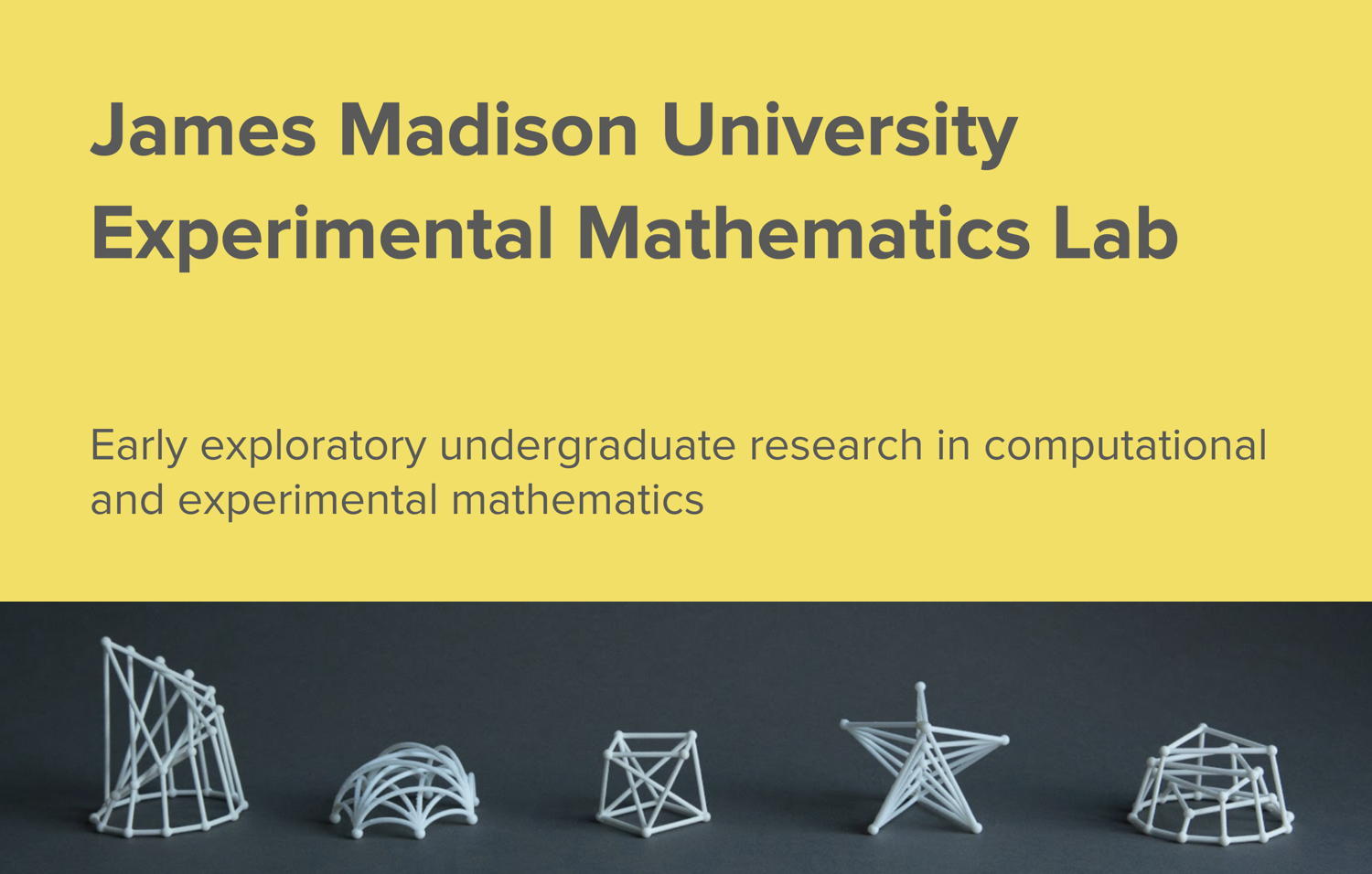
Welcome to the JEM Lab
The JMU Experimental Mathematics Lab offers opportunities for experimental and exploratory research in mathematics to students who are early in their undergraduate careers. To this date more than 75 undergraduates and 10 faculty mentors have completed collaborative mathematical research projects in the JEM Lab.
Current areas of focus:
- Using AI agents to create exploratory apps to make and test mathematical conjectures
- 3D printing and digital fabrication
- Fiber arts
- Cellular automata and generative patterns
The JEM Lab is supported by the Department of Mathematics & Statistics and the College of Science & Mathematics at James Madison University, and was founded in 2013 by Dr. Laura Taalman. In 2021 the JEM Lab became a member of Geometry Labs United, a consortium of technology research labs at national and international research universities. We are proud to be the first Geometry Lab at a primarily undergraduate institution.
Computational exploration
Students who work in the JEM Lab leverage a wide variety of computational tools and resources to explore mathematics, including AI coding tools. In 2026 the JEM Lab joined Claude Team for Scientists, which provides access to Claude Code for student members; our current projects involve using AI to produce interactive apps and tests for exploring mathematical conjectures. Past projects have used software such as Mathematica, MATLAB, Knot Plot, Processing, and the Online Encyclopedia of Integer Sequences to conjecture and test mathematical ideas. To visualize mathematical objects we use 3D design software such as OpenSCAD, Fusion 360, Meshmixer, TopMod, Sketchfab, and Grasshopper.
JEM Lab students are usually first-year or second-year undergraduates, with no previous experience with any mathematical or design software packages, and that is how we like it! Everyone in the JEM Lab learns what they need to learn, when they need to learn it.

3D printing
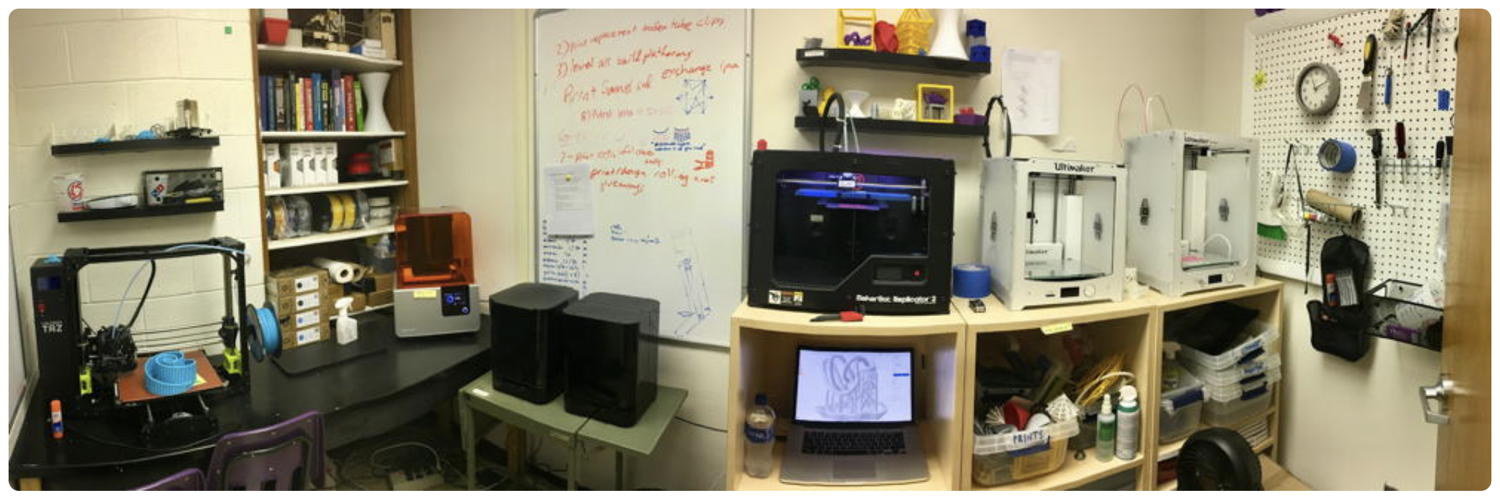
The JMU Experimental Mathematics Lab started out as a 3D printing MakerLab. Over time our 3D modeling and printing capacity has increased significantly, though funds from the JMU College of Science & Mathematics, the JMU Department of Mathematics & Statistics, and a small equipment sponsorship from 3D printing company Ultimaker. Our equipment now includes a multi-material dual-nozzle 3D printer, a large-nozzle 3D printer, a small off-site loan printer, and a resin printer with post-processing station. We also explore laser cutting and fiber arts such as crochet, knitting, and weaving. Students in the JEM Lab are able to produce physical mathematical visualizations with fine detail, multiple colors, and/or in large size.
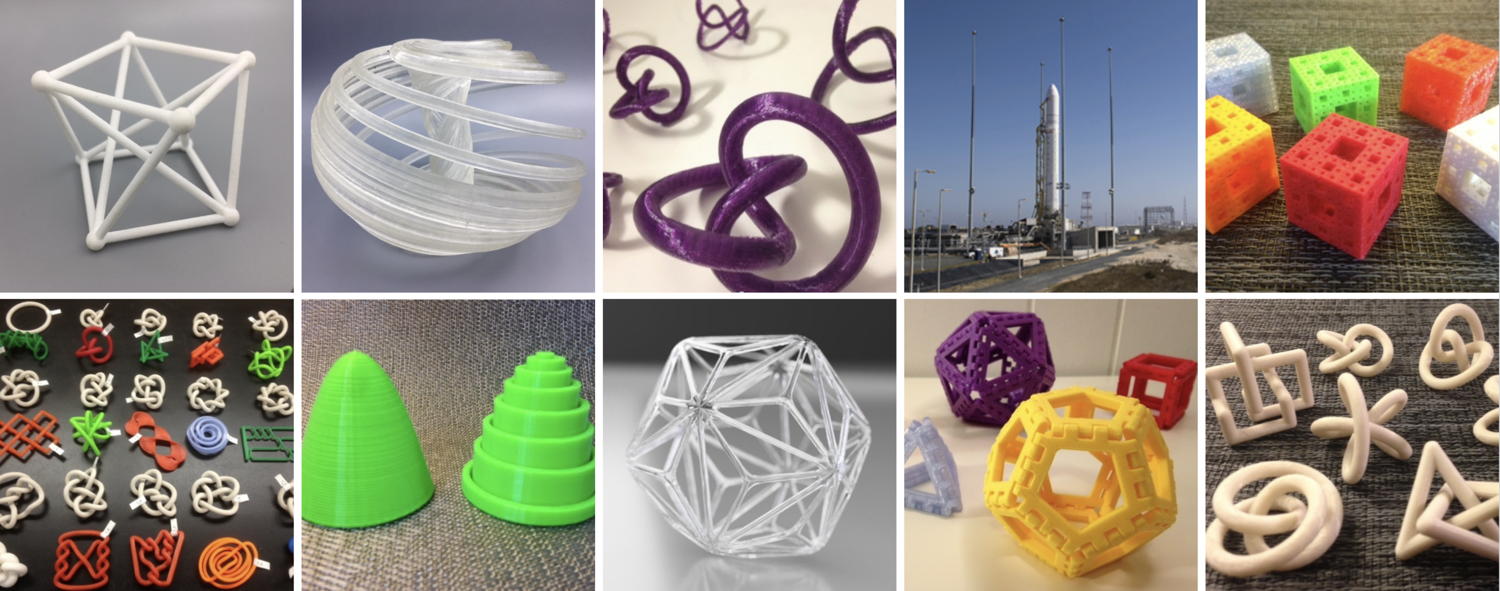
Many of our student projects cultimate in the production of 3D visualizations of mathematical objects. Understanding, designing, and then actually producing such visualizations is a way for early undergradate students to pursue their own creative mathematical explorations. In addition, the resulting visualizations support outreach projects and inspire new students to ask questions and get involved with JEM Lab projects.

A selection of past projects
Student projects in the JEM Lab have covered a wide range of topics, under the mentorship of faculty mentors Laura Taalman, Elizabeth Arnold, Steven Lucas, John Bowers, Rebecca Field, Caroline Lubert, Minah Oh, Roger Thelwell, David Duncan, and Eva Strawbridge:
- AI Apps for Cellular Automata Conjectures (Dr. Arnold and Dr. Taalman)
Alexa Elvir, Charonne Berthiaume, Chase Renert, Daniella Aklilu, Gabbie Janer, Gerald Torrez Rojas, Kyle Helm, Linden Kayes, Mia Jones, Ruben Lopez Hernandez, Songhang Lin, Tj Johnson, Umar Bhatti, Valery Loayza Pena, Ursulajean Sagayno (the 2026 Haynes Scholars), and Devran Turson (senior Lab Tech)
- Crochet & Code (Dr. Taalman)
Cameron Barb, Kae Birch, Jared Gonzalez, Claire Jones, Josh Makela, Abigail McClennan, Lauren Wiermanski
A characterization of three desirable planned pooling pattern families; published research paper Predicting Planned Pooling Patterns, presented at Bridges Richmond - Polygons and Potential Geodesics (Dr. Duncan)
Michael Glover
Time-evolutions of locally distance-minimizing paths in the space of fixed-area polygons - Menger Slices and Volume by Shells (Dr. Taalman)
Carolyn Angelillo (senior Lab Tech for the JEM Lab)
Math club models and classroom manipulatives - Firefly Synchronization (Dr. Oh and Dr. Thelwell)
Dhanshree Atre, Gerardo Cruz Mejia, Rafael Dietsch, Izzy Dionne, Treya Gunn, Bryce Jennings, Janefer Lobo Funez, Ellona Macmillan, Carolina Moscote Rodriguez, Juan Resendiz-Perez, Sahara Sania, Micari Turner, Trey Vaughn (the 2022 Haynes Scholars), and Carolyn Angelillo (senior Lab Tech)
Using Robotics to mimic flash synchronization of the Photinus Carolinus firefly, presented at VSU Undergraduate Research Sympsium - Stick Knot Conformations (Dr. Arnold and Dr. Taalman)
Alexis Alston, Bryce Anderson, Brevin Bugauisan, Mikiela Campbell, Eliana Diaz-Aceituno, Marvin Fuentes, Amaya Hamilton, Jada Marie Herrera, James Love, Jordan Milton, Valeria Moscote Rodriguez, Derrell Plair, Sukriti Sharma, Jayme Stevenson, Chayse Tucker, Jasmine White, and Jada White (the 2021 Haynes Scholars), and Carolyn Angelillo (senior Lab Tech for the JEM Lab)
Minimal conformations of stick knots through seven crossings, presented at VSU Undergraduate Research Sympsium - Intrinsically Knotted Graphs (Dr. Lucas and Dr. Taalman)
Seeking future students!

- Spatial Graphs (Dr. Lucas and Dr. Taalman)
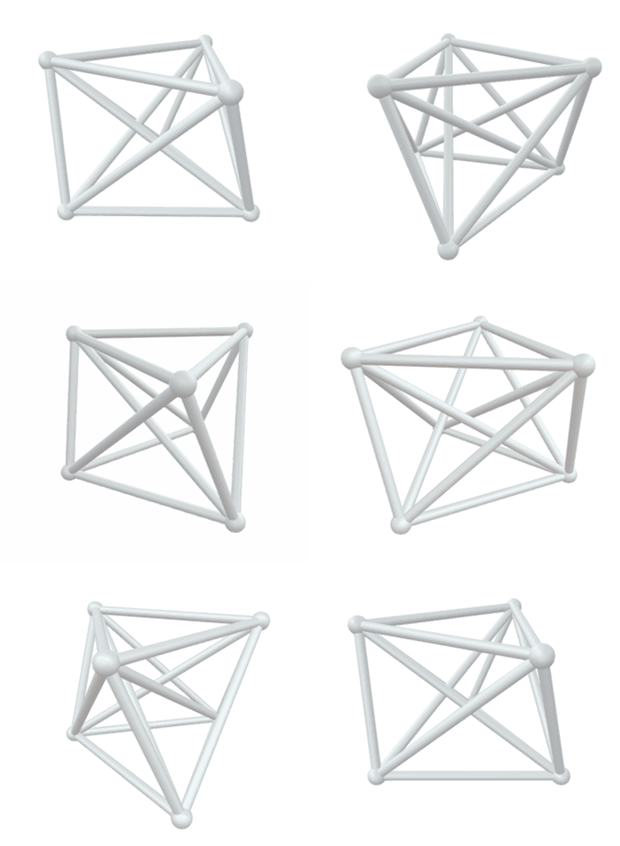 Hannah Critchfield, Abigail Eget, Benjamin Flint, William Nettles, and Becky Wild
Submitted research paper: Ideal Spatial Graph Configurations
Interactive visualizations and downloadable models: Catalog of 3D-Printable Spatial Graphs - Optimized Tritangentless Knots (Dr. Lucas and Dr. Taalman)
Abigail Eget, Harley Meade, and William Nettles
Published research paper: Optimizing Morton's Tritangentless Knots for Rolling - Rocket Exhaust Trench Modelling (Dr. Lubert)
Lyndon Swarey
Collaboration with Dr. Caroline Lubert's Aeroacoustics Lab - Praxinoscope Knot Isotopy (Dr. Taalman)
Jonathan Gerhard
With support from a $1000 Education grant from Shapeways - Ars Geometrica Seminar (Dr. Bower and Dr. Taalman)
Xiang Chen, Quincy Mast, and Adam Slattum
Collaboration with Dr. John Bowers' Ars Geometrica Lab - Strongly Regular Graphs (Dr. Taalman)
Jonathan Gerhard
Blog post at Mathematical ADD: Visualizing the difference between Rook and Shirkhande graphs - Spiral Knot Determinants (Dr. Taalman)
Charlie Kim and Ryan Stees
Published research paper: Sequences of Spiral Knot Determinants - Knot Conformations (Dr. Taalman)
Jonathan Gerhard, Gregory Houchins, Kirill Korsak, Taylor Meador, and Patrick Moran
Descriptions and downloadable models: 3D-printed Conformations of Knots Through 7 Crossings - Multi-material 3D Printing (Dr. Taalman)
Zev Woodstock
Experimental hardware with the 3D Systems CubeX Trio - C-elegans Worm Locomotion (Dr. Strawbridge)
Jeff Kopsick
JMU article about this project: Cross-disciplinary locomotion study - Finite Element Method (Dr. Oh)
Brock Crook
Final REU Report: Finite Element Methods for the Poisson Equation and its Applications - Afinia Engineering and 3D Prototyping (Dr. Taalman)
Brandon Lancaster and Ryan Moneymaker
Original MakerLab blog: jmumakerhome.blogspot.org
Courses and Programs
Some of the student projects in the JEM Lab take place through informal independent study, and some run as listed semester courses. The JEM Lab also supports student work in other semester research courses. The following JMU courses and research programs have been supported by the JEM Lab:
- Spring 2026 - Haynes Scholars Research Seminar: AI Apps for Cellular Automata Conjectures
- Spring 2025 - UNST 300: Interactive Patterns
- Spring 2024 - UNST 300: Generative Design
- Spring 2023 - Haynes Scholars Research Seminar: Firefly Synchronization
- Spring 2022 - Haynes Scholars Research Seminar: Minimal Stick Knot Conformations
- Spring 2020 - UNST 300E: Fabrication and Analysis of 3D Puzzles
- Spring 2018 - UNST 390: Representing the World in 3D
- Fall 2017, Spring 2018 - Ars Geometrica Seminar: 3D Graphs and Discrete Geometry
- Fall 2017 - MATH 297: Spatial Graphs and 3D Printing
- Spring 2017 - Ars Geometrica Seminar: Pushing 3D Printing Boundaries
- Spring 2017 - MATH 297: Homotopy and 3D Printing
- Spring 2014, Fall 2014, Spring 2015 - Honors Thesis: Spiral Knots
- Spring 2014 - MATH 297: Knot Theory and 3D Printing
- Fall 2013, Spring 2014 - Star Student Program: Multimaterial 3D Printing
- Summer 2013 - Internal Math/Stat REU: 3D Printing Laboratory
- Spring 2013 - MATH 167: Mathematical 3D Fabrication
- Summer 2012 - Internal Math/Stat REU: Knot Determinant Patterns
Related links
- Claude Teams for Scientists
- Geometry Labs United
- Original JMU MakerLab blog
- Previous JMU MakerLab projects site
- Our sister facility, the JMU 3SPACE Classroom
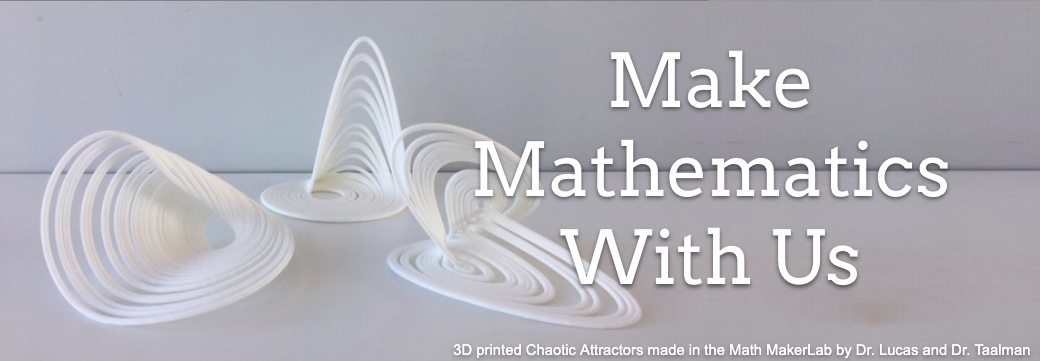
Photo Credits
Black and white graph photo from Rebecca Horne Photography
Stick knot images from knotplot.com
wilkinbs@jmu.edu
540-568-6408
Finance and office matters:
ominioi@jmu.edu
540-568-6184


