Our office has begun providing Preliminary Financial Aid Offers to accepted prospective students with official 2026-27 FAFSA's on file. This information can be accessed through a student's "Applicant Center" in their MyMadison account.

How to View a Preliminary Aid Offer

  • Log into MyMadison
  • Click on the “Applicant” tab
  • Select the “Applicant Center”
  • Click on the “View Preliminary Award Notice" link.  The PDF document will open in another window.
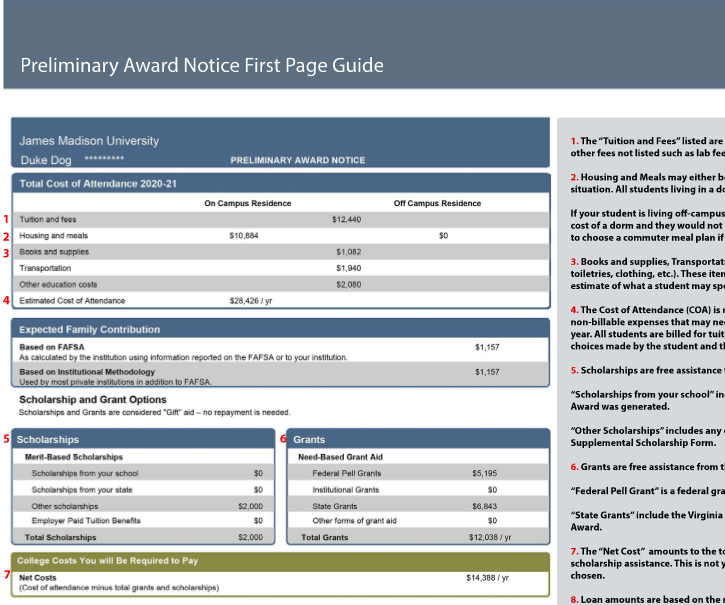
 

image for Preliminary Aid Offer Example Guide
Preliminary Offer Walk Through
Video Play Button A walk through of the Preliminary Aid Offer
This video is intended to help prospective students review their Preliminary Aid Offer. This guide will focus on the first page of the offer, and highlight some areas that students and parents often ask questions about. The Preliminary Aid Offer s purpose is to break down certain costs of attending JMU and explaining your options for paying those costs. Prospective students will be notified of this offer through the email address used on their admissions application. Once available the Preliminary Aid offer can be accessed through their Applicant center on MyMadison.
I want to start out by saying that the Cost of Attendance is not a bill for a student. It is an estimate of billable and non-billable costs, broken down between the items below, that may need to be paid while attending JMU over the academic year. These numbers are based on this current year and may change for next year. 
All students are billed for tuition and fees. This offer makes the assumption that the student will be full time (12+ credits) for the academic year. It is important to note that there may be other fees not listed here, such as lab fees or course differentials that may be added to the bill depending on the courses taken by the student. 
Now let's talk Housing and Meals. Housing and meals is the average cost for living in a dorm on campus with a standard meal plan. Both of these items are billable expenses. Any students living on campus are required to purchase a meal plan.
Students that live off-campus will have the same estimates for this section, however, their actual bill with JMU may be lower depending on their personal choices.  Any student living off-campus does not have any housing billed to them by JMU, yet they are able to use financial aid to pay for their apartment, commuter meal plan, and food they may purchase outside of JMU. If a student living off-campus would like to purchase a commuter meal plan they would need to do so through Card Services and the cost could be added to their semester bill with JMU. 
For students living at home or with family, if they would also like to purchase a commuter meal plan for when they are on campus, they are able to do so with card services and the cost could be added to their semester bill.
Moving to Books and Supplies, this is just an average cost for students, not specifically what you are expected to pay. This number will not show up on a bill from JMU, but a student will need to purchase these items themselves. Students should purchase or rent their books before each semester.
 
Transportation and other educational costs are built into every students Cost of Attendance. These are not billable charges. This part of the Cost of Attendance estimates the cost for things needed like having a car on campus, any kind of tickets for buses or planes, as well as, toiletries and other miscellaneous items needed throughout the year. Again, you will not have a bill for these items from JMU directly, but they may be necessary outside purchases. These costs will vary by student.
Grants and Scholarships are free assistance from the federal, state, university, or outside means. This section includes any merit based JMU scholarships offered at the time the Preliminary Aid Offer is issued to a student.
Other scholarships are outside scholarships that you apply for on your own.  These will only be listed here if you reported the amount to our financial aid office through the Supplemental Scholarships form.
To break down the grants section, a Pell Grant is a federal grant offered to lower income students whether in-state or out of state. Your FAFSA is used to determine the amount of Pell Grant offered. A Pell Grant should be the same between all schools a student applies to since the federal government determines the offered amounts.
State grants include VGAP (Virginia Guaranteed Assistance Program) or Commonwealth Award. These grants are for in-state students that filed their FAFSA by the March 1st priority filing date. JMU uses the FAFSA's Student Aid Index, or SAI, to determine your state grant eligibility. Your SAI is calculated by the Department of Education when they receive your FAFSA. State grants can vary between schools depending upon the amount of funding they receive from the state. Each school has the right to use their state grant funding how they see fit and no two schools will have the same state grant amount offered to your student. 
I would like to start this next section by saying that this form is a standardized form prepared by the government and this section of it can sometimes be misleading. The Net Cost  is a technical term that amounts to the total Cost of Attendance minus any grant or scholarship assistance. This number is not your remaining bill and does not include any loan options chosen to help pay. 
To add up your true net cost, add up your tuition and fees and your housing and meals, subtract any free assistance in the grants and scholarships section, and this would be your net cost you or your student would need to pay. 
If you have an amount for federal-work study listed on your preliminary aid offer, a student can apply for a federal work-study position on campus by going to the JMU website under the JMU jobs section. Work-study is not deducted from your JMU bill. The student would receive a paycheck, like they would if they were working at home, that would help offset any personal needs. 
Please keep in mind though, that all students have the opportunity to work through institutional employment. JMU actually offers a larger number of institutional employment positions than they do federal work study positions. These positions can be found under the JMU jobs section.
So, moving on to Loans, this section details the student s Federal Direct loan amounts they are able to borrow. Loan amounts are based on the total number of credit hours at the time of awarding. Incoming freshmen are offered up to $5,500 for the academic year, with that amount increasing to $6,500 as a sophomore and $7,500 as a Junior and Senior. The loan total is split between two loan types: subsidized, or unsubsidized. For subsidized loans, the government will pay the interest while the student is in school. While for unsubsidized loans, interest is accruing. All loans are 10-year loans. The loan will go into repayment 6 months after the student graduates or drops below half time (6 credits). 
This section details other means of paying for a student s education and includes institutional payment plans, 529 college saving plans, and Parent PLUS loans. Parent Plus Loans are federal direct loans that parents can use to assist with the cost of student s attendance. These are also considered 10-year loans for repayment purposes. 
 
And that s it, we made it through the first page. Remember, every university aid offer may look different. When comparing schools, it s important to pick out your billable charges and subtract any free assistance to find the more accurate out of pocket cost. Also, please remember you need to file a FAFSA every year starting October 1st. Hopefully this video has helped answer your questions about the Preliminary Aid Offer, but if you have further questions please contact our office.
 
Keep In Mind
  • The offers are an estimate based on the Cost of Attendance from the 2025-2026 academic year as the 2026-2027 year's rates have not been established at this time.
  • The information shown is a good indication of what a student may expect to pay while attending JMU for one year.
Changes to the Parent PLUS Loan
Video Play Button Changes to the Parent PLUS Loan Program
00;00;03;17 - 00;00;27;01
Speaker 1
Important changes are coming to the federal Parent Plus direct loan program changes that will affect all new borrowers across the country, including families here at JMU. Let's walk through what's new and what parents need to know before borrowing. The One Big Beautiful Bill act, signed into law on July 4th, 2025, made major updates to the Parent Plus loan program.

00;00;27;03 - 00;00;51;20
Speaker 1
These new rules apply to all new borrowers after July 1st, 2026, which includes parents borrowing for students who begin college. As of that date, and parents of current students who have not already borrowed a federal direct loan. Even if the parent has borrowed Parent Plus loans for other children in prior years. Under the updated rules, the borrowing limit is associated with each student, not each parent.

00;00;51;22 - 00;01;17;23
Speaker 1
That means for a student's education, the amount borrowed can be up to $20,000 per year and no more than $65,000 for total lifetime in parent plus loans. Regardless of how many parents want to borrow on the student's behalf, here's something important. Parents of first year students who borrow the full $20,000 each year will only have $5,000 left for the student's fourth year.

00;01;17;26 - 00;01;44;01
Speaker 1
This has the potential to create real financial strain near the end of a student's degree. If the goal of a first year parent is to borrow the full $65,000 but spread it evenly. Borrowing no more than $16,250 per year allows for four years of consistent funding. Just remember, in this example of the first year student, once that fourth year is done, parent plus eligibility for that student ends.

00;01;44;06 - 00;02;13;02
Speaker 1
So staying on track to graduate in four years is essential to help families avoid running out of eligibility. JMU will typically include no more than $16,250 in the initial parent plus loan amount on financial aid offers. Depending on the student's overall aid, the amount offered may be lower when it's time to borrow. Parents will complete the Direct Plus loan application from the Federal Direct Loan Program.

00;02;13;05 - 00;02;48;29
Speaker 1
JMU will send instructions to parents via email when it's time to apply. The application gives parents two choices. One. Request the maximum loan, or two enter a specific amount to borrow. Here's the key thing to understand if a parent selects maximum, JMU is required to process the full $20,000 as long as the student is eligible. Even if the financial aid offer shows $16,250, this means parents who select the maximum amount may use up all loan eligibility before the student completes their program of study.

00;02;49;02 - 00;03;09;17
Speaker 1
To keep borrowing steady across all four years, parents of first year students should enter a specific amount, such as $16,250 or less. These new rules make it more important than ever to borrow carefully. If you have questions, JMU was here to help you understand your options and make the best financial decisions for your students college journey.

When comparing the cost of JMU and other schools, we recommend you focus on the net costs versus any particular scholarship offers. For example, it's possible in some situations that the net cost of JMU without a scholarship offer could be less expensive than the net cost of another school with a scholarship offer. 

Aid Offer

Prospective students that were accepted for Fall 2026 should be able to access their Preliminary Financial Aid Offers through the "Applicant Center" in their MyMadison account if they have an official 2026-27 FAFSA on file with JMU.

Preliminary Aid Offers should include any scholarship offers made by departments that our office is notified of.

Preliminary Aid Offers are viewable within a student’s MyMadison account within the Applicant Center.

There may be various reasons why an aid offer is not showing in a student’s MyMadison. These can include:

  • A FAFSA was not submitted to JMU - If a student wishes to receive financial aid, they will need to complete a FAFSA through Studentaid.gov.
  • A student’s social security number in the JMU system is either incorrect or not in the JMU system at all. If a student did not include their social security number on their JMU application they should be able to update that information in their MyMadison account. But if the social is incorrect the student should contact our office to have that information updated so we can receive a student’s FAFSA.
  • We also suggest using Firefox or Chrome on a computer and not a mobile device such as a phone or tablet as there are sometimes issues viewing a Preliminary Aid Offer this way.
FAFSA

A FAFSA should be completed through Studentaid.gov.

Yes, a FAFSA can be completed throughout the academic year. However, we do suggest that a student complete their FAFSA as soon as they can since the FAFSA opened October 1st.

Scholarships

JMU houses our scholarship applications through the Madison Scholarships Hub. There is a general application that prospective students can complete here. The Madison Scholarship Hub can be accessed through a student’s MyMadison account.

A department offering a scholarship should be in direct contact with the awarded student through the email provided on the student’s JMU Admissions application. This email notification would come from scholarships@jmu.edu. In most situations, a student would be notified of the scholarship offer prior to our office being notified. Any scholarships offered at the time the Preliminary Aid Offer is generated should be included on a student’s aid offer.

Unfortunately, if a scholarship is not shown on a students aid offer JMU was unable to offer a scholarship.

Grants

JMU can potentially offer a student a Federal Pell Grant and/or a State Grant. Both are need based programs and require a FAFSA to determine eligibility.

Grant eligibility is determined by a students calculated Student Aid Index (SAI) from their FAFSA and their Need. Financial Aid Need is calculated by taking the student’s Cost of Attendance minus their SAI.

Loans

By completing the FAFSA a student has potential eligibility for a Federal Subsidized and/or Unsubsidized Loan. The type of loan is determined by a student’s financial need using the FAFSA. The amount offered is also dependent on a student’s academic level shown below.

Freshman: $5,500

Sophomore: $6,500

Junior/Senior: $7,500

A student can only be offered an Additional Unsubsidized Loan if their parents are denied for a Parent PLUS Loan based on the credit check done within the PLUS loan application and choose not to pursue an endorser. Freshman and Sophomores can be offered up to $4,000 per academic year, while Juniors and Seniors can be offered up to $5,000.

No, only parents of the student are able to apply for a Parent PLUS Loan to help pay for a student’s education. Though a biological or adoptive parent does not necessarily need to be included on a FAFSA to be eligible to apply. We suggest that parents also take time to review the changes that are being implemented on July 1st, 2026 to this program by viewing this video and visiting the Parent PLUS Changes webpage.

Other loan options include a private educational loan through a third-party lender such as a bank or credit union. It is up to the discretion of the student to whom they choose to complete an application with and borrow from. Our office will work with any lender a student should choose to have the money applied to their account. Visit our Private/Alternative Loan webpage for more information.

Appeals

Students can only appeal for extenuating circumstances not reflected on their FAFSA through a process called Professional Judgment. For more information regarding appealable situations and the process visit our Professional Judgment page.

Unfortunately, no. JMU does not offer any scholarships through an appeal process.

JMU does not match scholarships offered by other universities. We unfortunately do not have the endowment funding available to match.

A student with an extenuating circumstance not reflected on their FAFSA should submit a Professional Judgment request to our office. Please visit our Professional Judgment page for appealable situations and to understand the process.

What is Next?

Students are unable to accept a Preliminary Aid Offer. Once a student makes the decision to come to JMU based on their Preliminary Aid Offer, our office will work to generate Official Aid Offers in late June. This is when a student can accept their aid for the upcoming academic year through their MyMadison account.

Yes, students can complete job applications through the JMU Jobs section. Please understand that Federal Work Study employment is not guaranteed but requires an application, interview, and hiring process should a student be selected for a position by a department.

PLUS loan and Private loan applications should not be completed until after the student has been official awarded in late June. Once a student is officially awarded a student is able to determine any remaining amount needed to pay for their educational expenses for the upcoming academic year.

Fall semester bills are usually sent to students in July. For billing questions please contact the University Business Office.

Yes, the University Business Office does offer semester payment plans. For questions regarding payment plans please contact the University Business Office.

Back to Top