


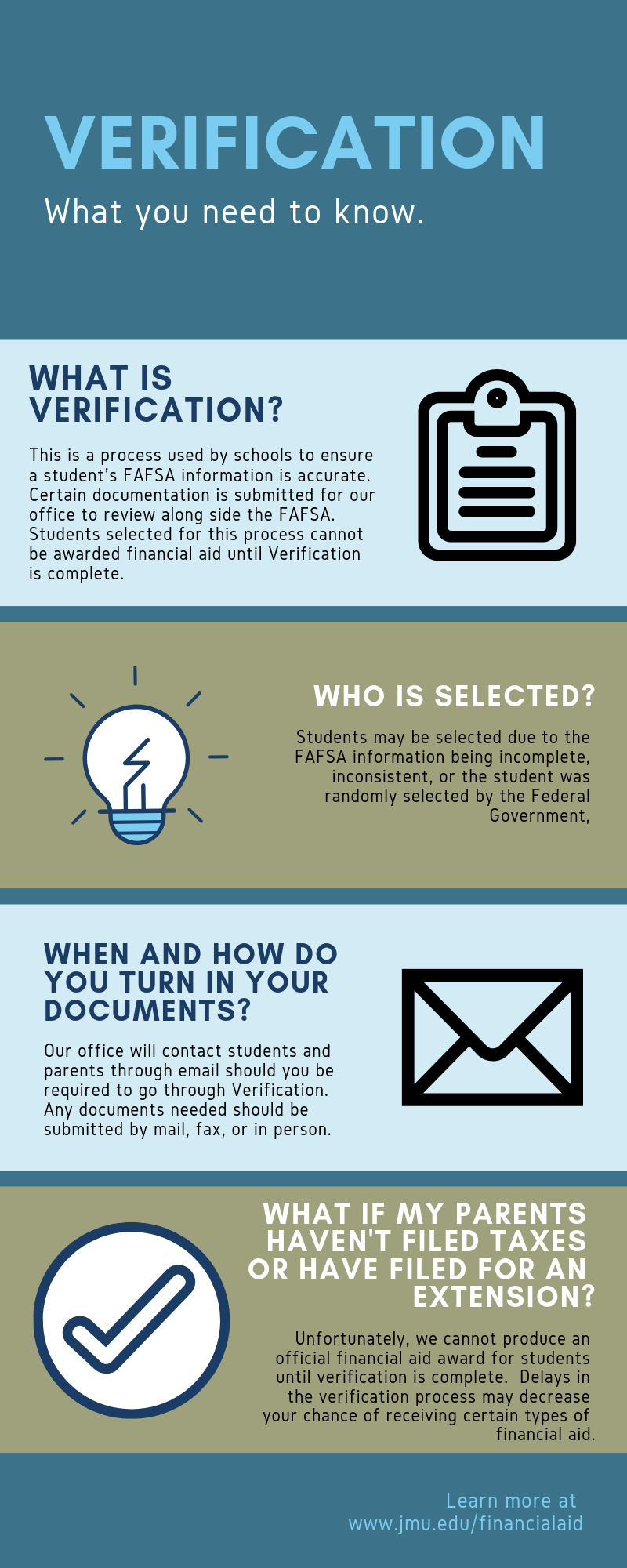
Verification is a federal process used to confirm the accuracy of information submitted on the Free Application for Federal Student Aid (FAFSA). Students selected for verification must provide additional documentation, such as tax records or proof of household information, before financial aid eligibility can be finalized.
Aid cannot be awarded until all required materials are submitted and reviewed.
Verification Forms

Frequently Asked Questions
Verification is a normal process that all colleges and universities are required to complete. There may be information on the FAFSA the Department of Education requires that we review.
No. Our office will be in contact with you if we require you to go through the Verification process. We communicate with students through their JMU Dukes email and parents via the parent email listed on the FAFSA.
You should submit your documents as soon as possible after they are requested. Verification must be completed before we can finalize and award your financial aid. Turning documents in early helps prevent delays with disbursement, refunds, and your ability to resolve any account balances before the start of the semester.
If you miss the document deadline, your financial aid may be delayed or canceled. This may mean:
- You may need to pay your bill out-of-pocket until verification is completed.
- Your classes could be dropped if balance deadlines are not met.
- Certain aid programs with limited funding could no longer be available.
We can still complete verification after missing a deadline, but your aid cannot be processed until all required documents are submitted.
It’s normal for your Student Aid Index (SAI) to change once verification is completed. If your SAI increases or decreases:
- Your financial aid package may be adjusted.
- You may become eligible—or ineligible—for certain grants, such as the Pell Grant.
- Any aid changes will be updated in your financial aid portal, and you will be notified.
Students will receive an updated Aid Offer reflecting the change.
If your parent did not file taxes, they must complete a non-filer statement and provide any W‑2s or income documentation for that year.
In rare cases where a parent truly cannot access tax information due to special circumstances (such as separation, abandonment, or legal restrictions), contact our office. We can advise you on alternative documentation or the federal guidelines for unusual circumstances.
Identity Verification is required when a student’s FAFSA application is flagged by the U.S. Department of Education’s federal processing system. Reasons may include:
- Missing or inconsistent identifying information on the FAFSA
- Use of estimated or incomplete Social Security or citizenship information
- A match issue with federal agencies during FAFSA processing
Being selected does not mean you did anything wrong. Some students are selected every year due to the way their information matches (or does not match) with federal databases.
The safest and fastest option is to upload all forms and documents using our secure online upload portal. Uploading:
- Protects your personal information
- Ensure faster processing
- Reduces the chance of lost or incomplete documents
We strongly recommend not emailing sensitive documents such as tax returns or Social Security numbers. If needed, you may also bring documents to our office in person or mail them, but online upload will result in the quickest review.
Mon - Fri 8 a.m. - 5 p.m.
Summer Hours of Operation:
Mon - Thur 8 a.m. - 5 p.m.
Fri 8 a.m. - 12 p.m.

