


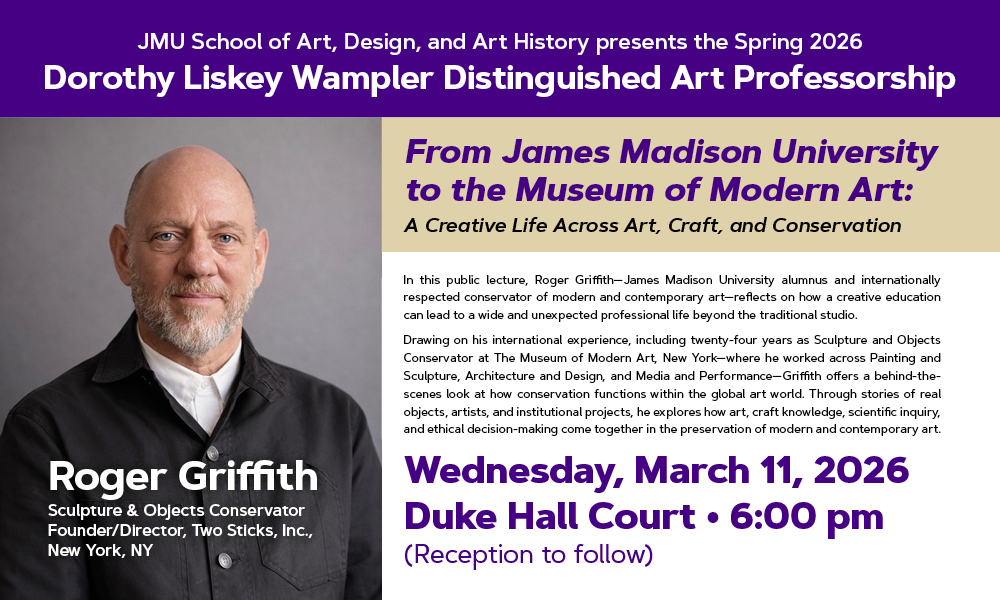
JMU School of Art, Design, and Art History presents the Spring 2026 Dorothy Liskey Wampler Distinguished Art Professorship
From James Madison University to the Museum of Modern Art:
A Creative Life Across Art, Craft, and Conservation
Speaker: Roger Griffith, JMU Alumnus, Sculpture & Objects Conservator
Wednesday, March 11, 2026 | 6:00 pm
Duke Hall Gallery Court
Reception to follow
In this public lecture, Roger Griffith—James Madison University alumnus and internationally respected conservator of modern and contemporary art—reflects on how a creative education can lead to a wide and unexpected professional life beyond the traditional studio.
Beginning with his studies at JMU, Griffith traces a path shaped by curiosity, mentorship, and a sustained interest in how things are made. He began his university studies as a pre-med student, but in his second year made the decision to shift to fine art, studying graphic design and ceramics. What initially felt like a change in direction ultimately became foundational to his later career, combining creative thinking with technical problem-solving and an understanding of materials. This early transition would later inform his approach to conservation, where scientific thinking and artistic sensitivity meet. His interests continued to develop through training in fine woodworking and cabinetmaking, and later through graduate study in conservation at the Royal College of Art and the Victoria and Albert Museum in London, leading to a career working at the intersection of art, craft, and material science.
Early professional experience at institutions including The Metropolitan Museum of Art and the Victoria and Albert Museum introduced Griffith to the technical and ethical challenges involved in preserving historic and modern objects. He later joined the Museum of Modern Art in New York, where he worked for more than two decades as a Sculpture and Objects Conservator, collaborating with artists, curators, scientists, and fabricators on works ranging from design objects and architectural installations to contemporary sculpture and experimental materials.
Drawing on his international experience—including work at the Stedelijk Museum in Amsterdam and collaborations with museums and universities in Europe and Asia—Griffith offers a behind-the-scenes look at how conservation functions within the global art world. Through stories of real objects, artists, and institutional projects, he explores how art, craft knowledge, scientific inquiry, and ethical decision-making come together in the preservation of modern and contemporary art.
In reflecting on his own path—from pre-med student to conservator—Griffith describes conservation as a form of care, where artworks become patients and treatment decisions carry long-term consequences. The lecture closes with a reflection on how choices made early in life rarely determine a single destination, and how curiosity, adaptability, and responsibility can lead to unexpected and meaningful careers. For students and alumni alike, the talk offers an invitation to think broadly about creative practice, and about how a life in art is not something planned in advance, but something shaped over time through curiosity, care, and the choices we make along the way.


