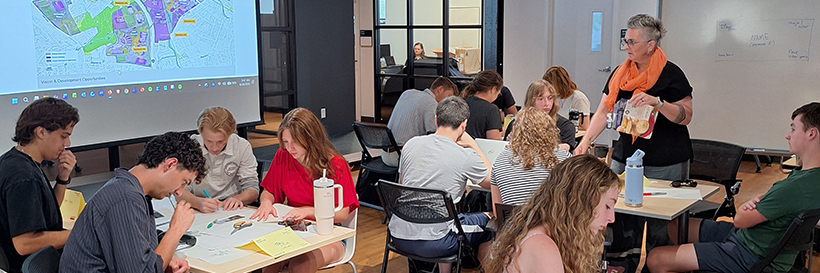
Integrative Arts Courses: The Office of Creative Propulsion supports the development of integrative arts courses that connect disciplines, methodologies, creative practices, and communities in meaningful ways. These courses encourage students and faculty to explore complex ideas through collaboration, experimentation, and creative inquiry that extends beyond traditional disciplinary boundaries. Some of these courses may use the IART course prefix, while others remain housed within an existing department or program. OCP supports both approaches.
IART is a course prefix housed within OCP and the College of Visual and Performing Arts. The IART designation provides a home for new, experimental, interdisciplinary, arts-centered courses that may not fit neatly within a single department or academic unit. The IART prefix allows faculty to create courses that are housed outside of their home discipline.
IART Course Proposal Process: Fall 2026 Proposals due September 15, 2026.
Faculty who are interested in proposing a course for development or implementation with the IART prefix can apply for support through the IART Course Proposal Process.
Collaborative Teaching Support Request*
For: requsting logistical support or workload credit for collaborative teaching initiatives. Faculty may request:
- Full workload credit for a collaborative class
- Release from a course or service duty to teach a collaborative course
- Scheduling consideration to align collaborating classes
- Dedicated space for collaboration
Requests are due annually on September 1 and January 20.
IART Course Proposal Process*
For: creating and leading a new integrative arts courses (interdisciplinary, community engaged, or otherwise beyond the scope of your home unit alone). Participants may receive stipends, design coaching, peer feedback and partner matching. There are two pathways:
- Development: supports new couse design without a commitment to teach it in a specific semester.
- Implementation: supports launching a course in a specific semester.
Proposals are due annually on September 15 and February 15.
Integrative Arts Courses Beyond the IART Prefix
Not every integrative arts course needs to be an IART course. Many faculty members are doing interdisciplinary, collaborative and community-engaged teaching within existing departmental courses, and OCP is committed to supporting that work as well.
CVPA Collaborative Teaching Support Request
Also available to support faculty interested in collaboration is the CVPA Collaborative Teaching Support Request, which was designed to support the implementation of collaborative teaching arrangements. Faculty may use this process when a course and teaching partnership are already established and support is needed to make the collaboration possible. OCP is available as a resource for understanding this process of seeking support or developing collaborations.
Courses
This course provides students with opportunities to meet and connect with newcomers in Harrisonburg for various cultural exchange activities, discussion sessions, and improvisation workshops. While everyone in the class deepens their understanding of the diverse cultures of new arrivals, they also will learn and celebrate each other's ethnic heritages. Taught by Masa Ishikawa (School of Music) and Rachel Rhoades (STAD)
Hear about the course from the instructors.
IART412E Integrative Arts and Environmental Problem Solving
This course draws from journalism, studio art, and environmental policy to grow the investigative abilities of students regarding the complexities of environmental problems and how they and those influencing or influenced by these problems relate to them individually. In the class, students will elicit, construct, and share different story-based perceptions and representations of these problems utilizing multi-media tools. Taught by Rob Alexander (Political Science), Tim Thomas (Educational Foundations and Exceptionalities) and Lisa Tubach (Art Foundations).
IART411E and IART511E: Sustainable Cities
This course uses JMU's proposed shift to a residential campus as a real-world design problem. Students will examine three aspects of that transformation: shifts in movement and infrastructure on campus, ecological resilience, and how those changes will affect the surrounding area. Utilizing the expertise each student brings to the class, they will research existing conditions, identify pressure points, and develop proposals for a more sustainable campus and community. Taught by Rob Alexander (Political Science) and Trace Wile (Architectural Design).
Celebration of Cultures through Community Engagement
This course provides students with opportunities to meet and connect with newcomers in Harrisonburg for various cultural exchange activities, discussion sessions, and improvisation workshops. While everyone in the class deepens their understanding of the diverse cultures of new arrivals, they also will learn and celebrate each other's ethnic heritages. Taught by Masa Ishikawa (School of Music) and Rachel Rhoades (STAD)
IART480: Arts Education for Diverse Learners
Meets T/Th 12:45-2 pm.
This course is designed to provide students an understanding of disability categories, special education law, and models of disability as they apply to the arts and broader settings. Universal Design for Learning, building collaborative relationships with colleagues, serving disability communities, assistive technology, and instructional strategies also will be discussed. This course requires a community service project that will be discussed and developed in class.
Taught by Rachel Grimsby (School of Music) with collaboration from Daisy Brenneman (Justice Studies).
Dance 303 / ENGR 490: Movement, Motion Capture & Machines
Meets T/Th 12:45-2 pm.
This collaborative, project-based course invites students to explore how movement and machines co-create. Working with motion capture, sensors, and interactive systems, students will create kinetic sculptures, responsive wearables, and machine-learning “partners” that move, react, and improvise alongside the human body. Through studio practice and performance experiments, students investigate embodiment, interactivity, and co-creation with technology. By the end of the semester, students will produce original works that highlight how choreography and engineering generate new forms together.
Taught by Tara Lee Burns (School of Theatre and Dance) and Dr. Jason Forsyth (Department of Engineering)
This course will be located in both ENGEO and FORBES. Students will be required to meet in both locations throughout the semester. Please email burnstl@jmu.edu or forsy2jb@jmu.edu with questions or concerns about location and accomodations.

IART451E / CIS498 / SRM498: New Models for Project Management in Live Entertainment / Systems Thinking, Design Thinking, and Agile Development] / Reimagining the Production of Live Entertainment
Meets Mondays 3:25-4:15 and Wednesdays 3:25-5:05
Students will explore novel approaches, mindsets, and skills for problem-solving and project management for live entertainment events by working hands-on in multidisciplinary teams in JMU X-Labs. In this course, students will dive into systems thinking, design thinking, and agile development to tackle real-life challenges with innovative solutions. This course equips students with the skills to excel in creative, collaborative, and fast-paced environments. Join us to bring ideas to life and make a tangible impact in the world of live entertainment. This is a collaborative course taught between faculty in the Department of Computer Information Systems and Business Analytics, the Hart School, and the School of Theatre and Dance.
- Students Eligible to Enroll: This course is available to all JMU students and is well suited for those interested in project management, sport management, production leadership, arts education and administration. CIS and SRM courses are open to majors and minors only.
- How to Register: Register in MyMadison. CIS 498 course enrollment requires permission of the instructor. IART 451E and SRM 498 are open to enroll.
Teaching Team from:
- College of Visual and Performing Arts School of Theatre & Dance
- College of Business Department of Computer Information Systems & Business Analytics
- College of Business Hart School of Hospitality, Sport, and Recreation Management
Instructors:
- Simon Marland, Assistant Professor of Sound Design
- Brian Smallwood, Production Manager, Associate Professor of Theatre: Production Management, Technical Direction
- Dmytro Babik, Associate Professor, Computer Information Systems and Business Analytics
- Angela Hayslett, Lecturer, Sport, and Recreation Management
In development:
Integrated Motion Capture and Performance, Tara Burns (Dance) and Jason Forsyth (Engineering) - expected Spring 2026
This project-based course invites students from multiple disciplines to experiment with motion capture in creative physical applications highlighting concepts such as movement analysis, real-time object tracking, converting movement to sound, live performance, and device art.
New Models for Project Management in Live Entertainment - expected Spring 2026
This new X-Labs course is tasked to rethink the current approach to theatre production that generally prioritizes speed and trends to burnout. The cross-disciplinary cohort will generate new production models for theatre using design thinking and agile development to elevate creativity and collaboration practices within theatre production systems.
IART401E and IART501E Time and Art: Theory and Practice for Interdisciplinary Collaboration
This course is designed to grow learner’s confidence in 1) philosophical and aesthetic understanding of time and change; 2) latest methods in visual and performing arts; and 3) interdisciplinary collaboration for time, and change, and other abstract notions. No previous experience is required to take this course; students with a passion for interdisciplinary collaborations are welcomed. Students will have opportunities to engage their creative activities with digital media, design projects, live performance, and events.