


Bring a program to your class, organization, or event!
Well Dukes provides interactive, student-facilitated programs and tabling events on a variety of topics, including substance misuse prevention, sexual health, healthy relationships, sleep health, and digital thriving.
Learn more about your options and request a program by completing the form linked below.
Wellness Programs
Student Learning Outcomes:
After participating in this program, students will be able to:
- Recall standard serving sizes as it applies to alcohol.
- Identify ways to use protective behaviors in regard to substance use.
- Recall the 3 Ds of bystander intervention.
- Decide on a plan of action to respond to scenarios involving alcohol use.
Content:
- Bartender activity – shows serving sizes of beer and wine
- PUBS – alcohol poisoning identification acronym (Puking, Unresponsive, Breathing, Skin)
- 3 D’s – Direct, Distract, Delegate
- Active bystander – describes ways individuals can be active bystanders
Participants can test their knowledge as it applies to alcohol and other drugs through an interactive 45-60 min game of Jeopardy.
Student Learning Outcomes:
After participating in this program, students will be able to:
- Recall standard serving sizes as it applies to alcohol and cannabis.
- Identify different categories of drugs and nicotine.
- Recall social norms surrounding substance usage.
- Recognize the signs of alcohol poisoning.
Jeopardy Categories:
- Alcohol
- Cannabis
- Nicotine
- Social norms
- Other drugs
Student Learning Outcomes:
After participating in this program, students will be able to:
- Recall two ways STIs can be transmitted.
- Identify key parts of the reproductive system
- Identify different contraceptives and their effectiveness.
- Correctly list the steps to apply an external condom.
- Identify resources on JMU’s campus for sexual and reproductive health.
Jeopardy Categories:
- Anatomy
- STIs
- Condoms
- Birth Control
Student Learning Outcomes:
After participating in this program participants will be able to:
- Differentiate between the pros and cons of technology.
- Describe digital thriving and its key components
- Learn at least two new digital thriving strategies
Content:
- Check actual screen time usage
- Your relationship with technology
- Finding Phone Free Moments
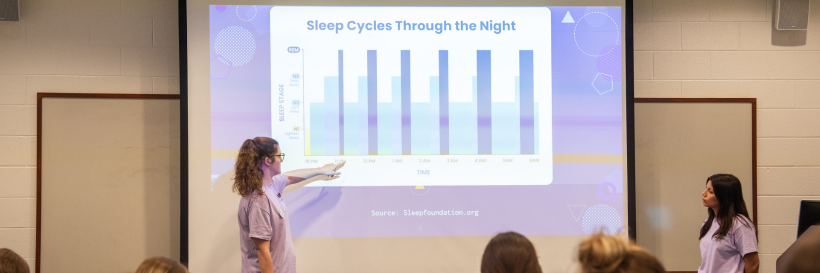
Participants explore common sleep myths and facts, assess their current sleep habits, and learn practical strategies for improving sleep hygiene in a 60 min program. Through an interactive board game and discussion, students discover how sleep affects overall well-being and become familiar with campus resources available for sleep support.
Student Learning Outcomes:
After participating in this program participants will be able to:
- Accurately differentiate between at least 70% of the myths and facts about sleep challenges experienced by college students, including: substance use, poor sleep hygiene, and environmental disturbances
- Reflect on their current sleep habits and consider at least one way in which they can positively change their sleep hygiene
- Recall at least two appropriate campus and community resources for sleep support
Content:
- Importance of sleep
- Brief overview of sleep cycle
- Strategies to get better sleep
- Sleep board game
Participants learn how to recognize situations where they can safely support others and practice practical bystander intervention strategies. Through discussion and realistic scenarios, students explore the CARE framework and the 3 Ds of bystander intervention, build confidence in responding to situations of concern, and discover how small actions can help create a safer, more caring campus community.
This program is available in 10–60 minute formats. The depth of content, discussion, and activities varies based on the length of the session.
Student Learning Outcomes:
After participating in this program, students will be able to:
- Identify the steps of CARE
- The 3Ds of bystander intervention
- Apply the 3Ds in a realistic bystander intervention scenario
- Feel more confident intervening in future potential bystander intervention scenarios
Content:
- Defining bystander intervention
- Overview of CARE steps (Check in around you, Acknowledge your role, Respond with action, Engage in follow up) and 3 Ds (Direct, Distract, Delegate) with strategies on how to do each
- How to Shape a Community of CARE
- Bystander Intervention scenarios
- Self-care as a bystander