

JMU X-Labs courses challenge students with wicked problems
Dukes generate innovative ideas in the face of real-world needs
Featured Stories


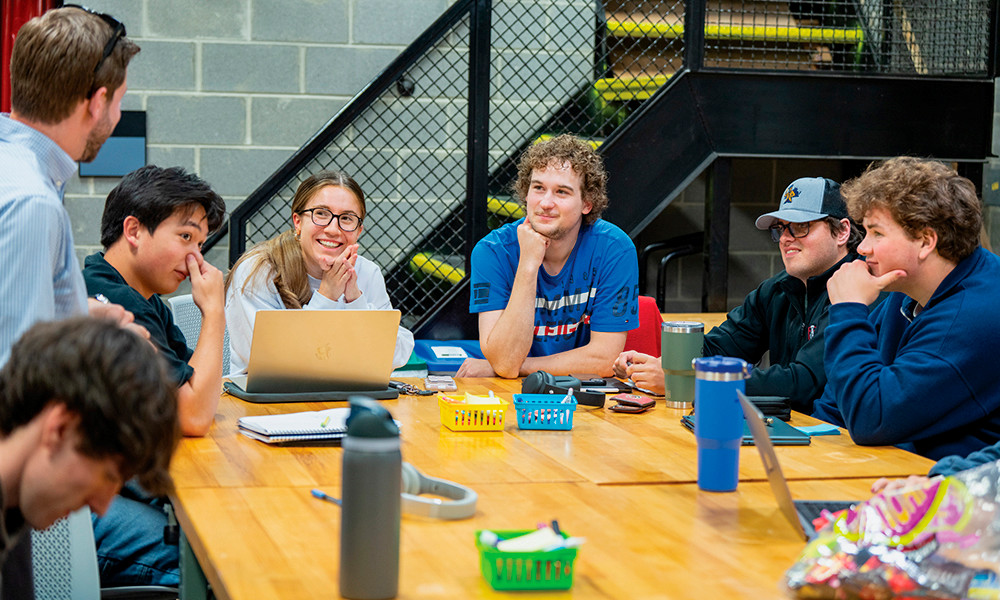
SUMMARY: Each semester JMU X-Labs offers a batch of classes that promote cross-disciplinary collaboration. In Fall 2025, four classes presented students with a unique learning experience, through topics of confronting organized retail crime, hacking well-being at JMU, teaming with AI to tackle grand challenges, and using 3D printing to tell the story of James Madison’s Montpelier.
More details about this article, and other exclusive content, is available in the Madison app. 
JMU’s X-Labs has made a name for itself as one of the university’s most active centers for interdisciplinary work, cultivating collaboration among students, faculty, and external partners alike as they tackle complex problems. For students, JMU X-Labs functions as both a classroom and a testing ground for projects that have real, tangible impact. Last fall, X-Labs offered four courses that started not with a predetermined project, but instead with a problem that Dukes were challenged to address with innovative solutions. This led to everything from new product concepts to social campaigns. Read more below about each class.
Reimagining Virginia’s Fight Against Organized Retail Crime
By Lillian Johns
The idea for the Fall 2025 JMU X-Labs class Reimagining Virginia’s Fight Against Organized Retail Crime (ORC) developed from a real-world problem that has challenged the Office of the Attorney General of Virginia in Richmond.
All X-Labs courses require a challenge statement that reflects a wicked problem that Dukes aim to tackle. For the Fight Against ORC, the statement read: “Students will develop solutions that help the Virginia Office of the Attorney General tackle organized retail crime across Virginia.”
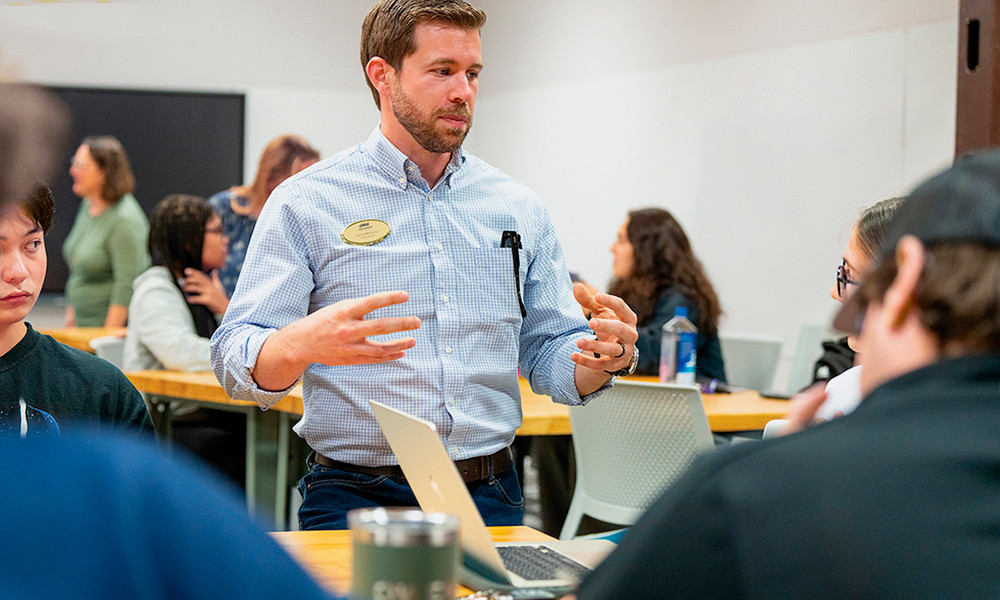
While X-Labs has a long history of helping students gain real-world experience by confronting big issues, this one was something new. As part of the interdisciplinary teaching team, Adrienne Hooker, an associate professor in the School of Media Arts and Design and assistant director of engaged learning for X-Labs, wanted the class to develop an understanding of organized retail crime.
“I will say, most in the class were like, ‘What? What is organized retail crime?,’” she recalled. “And I am not just saying students. I will admit, as a professor, I was like, ‘What are we talking about?’”
Retail crime goes beyond just shoplifting, she says. Gift-card fraud, for example, might involve a person stealing the card number and pin of a gift card, draining the money once a buyer has loaded money onto it.
According to the attorney general’s office, organized retail crime schemes are often tied to larger criminal networks or cartels, and linked to more serious issues, such as human trafficking.
Last year, after the Office of the Attorney General approached JMU with its idea to collaborate, the initiative found a home in the X-Labs program. Over the summer, the course took shape as the teaching team, along with Judi Lynch, director of outreach for organized retail crime in the Office of the Attorney General, identified the issues to work on with students. The class kicked off the Fall 2025 semester with a visit from fellow Duke and then-Virginia Attorney General Jason Miyares (’98) that set the stage for a learning opportunity that would take them beyond the classroom.
Students broke into teams and brainstormed solutions to the issue, planning at the end of the semester to present directly to the attorney general’s office. The process demanded intensive research and interviewing of stakeholders to better understand the problem from multiple perspectives.
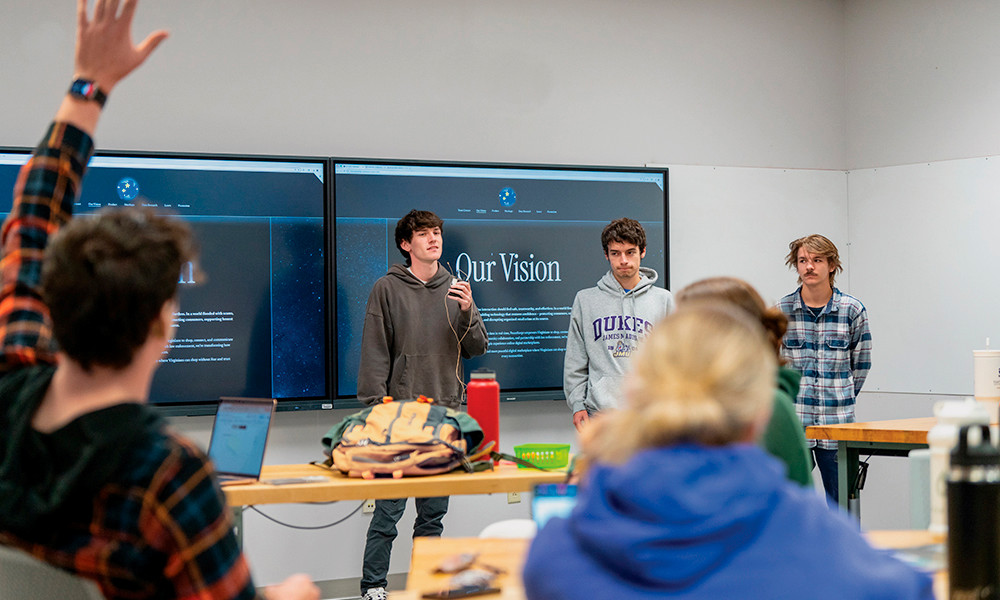
Nico Peeples, a senior studying Industrial Design, found that X-Labs courses fit well into the curriculum requirements of his major and that his educational background could bring a unique perspective to the course.
Peeples and his groupmates sought to prevent a certain aspect of organized retail crime. “My group focused on trying to prevent the activity of it all. We were trying to stop it from happening,” he shared. “The idea weaved its way into a browser extension we made that would plug into online shopping websites and flag suspiciously listed items.”
His team trained their software to compare a product found online with similar ones and display the real price, alerting the consumer if they were being scammed or perhaps contributing to resale crime. “In X-Labs classes, the solutions are either an innovation, or a product, or looking at systems and discovering where the gaps are,” Hooker said.
Three of the five teams focused on systems, while the other two devloped products.
Another group undertook the creation of a public safety announcement campaign to alert consumers about the prevalence of online retail crime on commonly used sites like Amazon and Facebook Marketplace, sharing that if a sale online seems too good to be true, it probably is. By showcasing the prevalence of online retail crime on sites where students regularly purchased items, the groups’ campaign brought the problem into the personal domain.
“The other three groups were dealing more with networks and communication of who’s doing what where,” Hooker explained. “Because with this issue, you have retailers, you have state patrol and law enforcement, you have lawyers, prosecutors. And so, there’s a lot of different people within this network figuring out who is reporting to whom, and when and how that is being done ... That was the major point that the students picked out of the system that needed to be better.”
All X-Labs courses are developed with two key factors in mind: interdisciplinary collaboration and experiential learning. These factors are reflected in the makeup of students’ majors and in the teaching team, which included Hooker in the College of Arts and Letters; Dr. John Robinson (’09), associate professor of intelligence analysis in the College of Integrated Science and Engineering; and Fadi Majdoub, lecturer of marketing and international business with the College of Business.
The design of an X-Labs course is unique in several aspects, including Dukes taking a more active role in their learning. For Peeples, the opportunity to participate in a team-based, student-led class was an exciting prospect, but he also noticed obstacles to learning when the class's motivation would wane, which would stall progress.
Additionally, the interdisciplinary aspect of the class facilitated teamwork across expertise, which students and professors found rewarding. “It was really nice to be surrounded by people with different skills,” Peeples said. “And when we were doing group projects, everyone’s backgrounds really did show, and we ended up making some cool stuff because everybody had a different talent.”
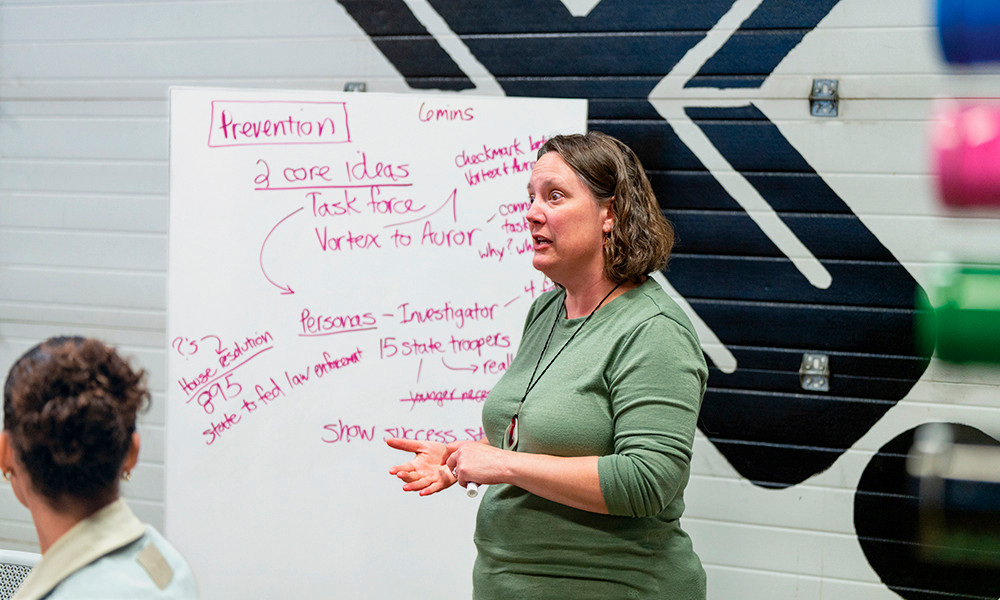
The ability of students to operate under that kind of learning model was Hooker’s goal for the course. “We all have different languages within our majors; we all have different understandings,” she said. “And so, to be able to work in a team, to come up with something to understand a problem and to come up with a solution is really hard, but I think, at least in my mind, the X-Labs classes are so good at bringing in different people and bringing them together to tackle an issue.”
Joshua Montanez (’11), director of the Valley Scholars program, recently began collaborating with X-Labs through its Faculty Associate Program. Angela Hayslett, lecturer of sports risk management with the Hart School also served as a faculty associate.
Montanez's role as a faculty associate was to facilitate the use of what the Stanford d.school (design school at Stanford University) calls Design Thinking Methodology.
Design Thinking Methodology sets out to challenge the notion that problem-solving is a strictly linear process. “If you think back to high school, middle school, we talked about the scientific method and those sorts of things,” Montanez said. “And even in the majority of courses, we have syllabi that have specific assignments throughout, and how well you do on those determines the outcomes.”
But there is another way. “The intent behind the design is to [offer] a human-centered approach to problem-solving,” he said. It’s an iterative process, one reliant on repeated cycles of trial-and-error without a determined starting point. The process is categorized into three primary groups: noticing, sense-making and experimenting.
“Noticing is focused a lot on observations, the human-centered piece,” he shared. “Building empathy is a critical component of this process.” This means understanding clients’ challenges and intentions.
“Sense-making is essentially what it sounds like,” Montanez said. “Making sense of the information you have and how to take this large amount of information — interviewing is a big part of this — and make it into a meaningful collection.”
The experiment piece manifests in what Montanez calls prototyping: “What is the bare-bones, prototype physical object that I can develop that helps people understand the concept I am working toward?
“At its most basic, it’s, ‘How do we infuse creativity into this process in a collaborative way?’ Because we know the research says if you work with different perspectives, and on a team you’re going to get a better result,” Montanez said. “The idea is never to say, ‘Let’s get this perfect thing,’ but, ‘How do we get this prototype or system that we can demonstrate to other people, and then go through this cyclical, iterative process?’”
Reflection played a large role in the course, with emphasis on the process and experience instead of the outcome. Students regularly interacted with the following questions:
-
“What did I notice about myself in that learning process?”
-
“How did I feel when encountering barriers?”
-
“What was my response? How do I feel while working with this group of people?”
“At about a third to halfway through [the semester], I could see students were frustrated,” Hooker shared. “Because we weren’t giving them answers … [Instead] we were trying to help them find resources and to facilitate how to tackle this … And I would say, the moment that the teams had those ‘aha!’ moments of ‘Oh, we see now, we’re seeing where things can be adjusted.’ … Those moments where they pushed past that frustration and dove in harder, those are the moments I always appreciate as a professor.”
In the context of this course, students were presented with a problem that was unfamiliar to many, but by using design thinking, they were able to approach the problem in a new way.
“There are a lot of unknowns and a lot of ambiguity,” Hooker said. “This isn’t a known thing. There isn’t a Step 1, 2, 3 … we don’t have that. We very much lean on ambiguity, because a lot of times, that is where innovation can come from. If everyone comes with an open mindset and questioning stance, that leads you to interesting solutions.”
The Virginia gubernatorial election in November brought a change in administration in 2026 and a pause in the implementation of proposed solutions to organized retail crime in the commonwealth. But Hooker and Lynch are optimistic for the partnership between X-Labs and the Office of the Attorney General going forward.
X-Labs course reimagines James Madison’s Montpelier
By Taylor Moore
A unique Fall 2025 X-Labs course centered on Montpelier brought students from various disciplines together to solve a problem through team collaboration.
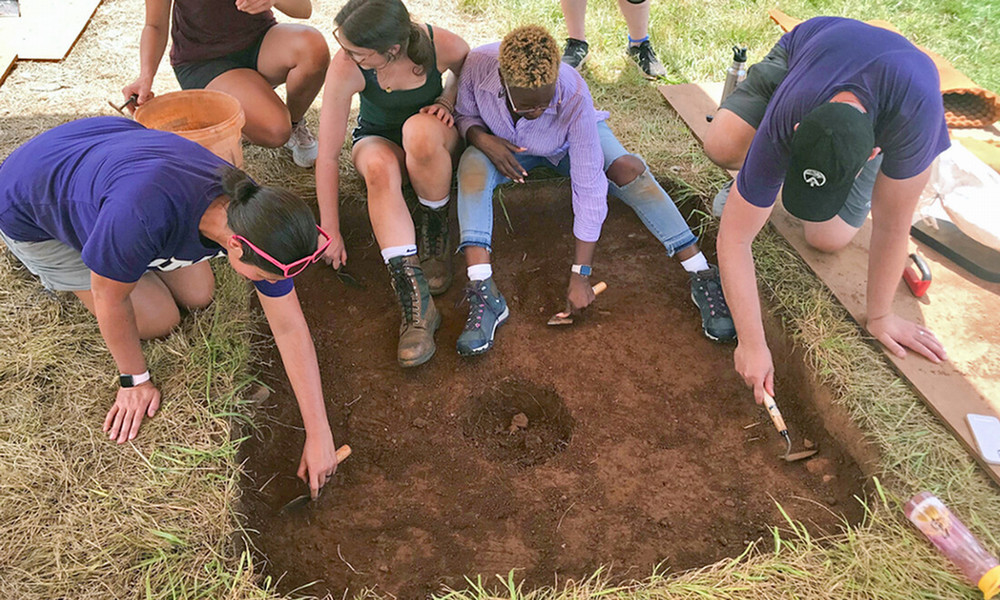
Dr. Aaron Bodle, professor of early, elementary and reading education, had been taking his students to James Madison’s 18th-century plantation in Orange County, Virginia, for years to learn about the property’s enslaved individuals and how their stories are told today.
In 2024, the Community Archaeology Lab at Montpelier (CALM) burned down, and a new facility was built across the road in the old Montpelier Supply Company Store on State Route 20. For the X-Labs course, students had to come up with suggestions for how Montpelier might encourage people to visit the lab despite it being farther from the main property.
Joining Bodle in teaching the class — How Does 3D Printing Help Us Tell the Story of Montpelier? — were Jamie Calcagno-Roach (’04, ’06M), director of educational technology services, and Dr. Carole Nash (’83), professor of geography and integrated science and technology. They modeled the class on another X-Labs course, 3D Printing Real-World Solutions.
“The hallmark of an X-Labs course is it’s cross-disciplinary taught, so we had an education background with Dr. Bodle, I brought the X-Labs expertise and Dr. Nash had the geography-archaeology expertise,” Calcagno-Roach said. This course also satisfied the Madison Foundations’ Critical Thinking requirement. One question students had to answer was “How are they going to continue this very important story if they are no longer in physical proximity to the mansion itself?”
After beginning the second week of the course and working with Matt Reeves, director of archaeology and landscape restoration at The Montpelier Foundation, the professors realized the trajectory of the course would change entirely. “In true X-Labs style, we were able to pivot and work with the students and help them get through that trajectory,” Calcagno-Roach said.
“In order to help our students understand folks who were experiencing the problem, they were put in front of community archaeologists and folks who actually did some of the work of uncovering the artifacts that were so important to the story,” Calcagno-Roach said. The professors trained students in how to conduct interviews, and they were given contacts from Montpelier staff members.
One team pitched an educational archaeology lab to expand CALM’s outreach. “Our final creation was a mobile version of the lab called CALM on Wheels. I really liked it, and if implemented, it would serve Montpelier well,” said RJ Gatling, a junior Architectural Design major.
“This course introduced me to the concept of public archaeology,” said Jean Wong, a junior Graphic Design major, “and I found it really powerful that CALM was taking a space that holds a lot of painful history and helping return it to the community. Montpelier and CALM are considered models of public archaeology at historical plantations, especially plantations of the Founding Fathers. CALM is helping challenge that status quo and the stories told surrounding the Founding Fathers, telling the story behind their households and who was doing the work.”
“One of the reasons this was so very important is that, as the archaeology lab is reopening in this new space, it wants to be a community center,” Nash said. “It doesn't just want to be a scientific laboratory. It wants to be a place where the members of the descendant community, the local community and kids, can come and learn about the connection between archaeology and these hidden histories that are never told.”
Confronting global challenges using artificial intelligence
By Lillian Johns
From urban-farming projects to heat sinks to textile waste, students enrolled in the Fall 2025 class AI for Global Impact: Tackling Grand Challenges With Generative AI prototyped solutions to some of the world’s most complex and urgent sustainability challenges.
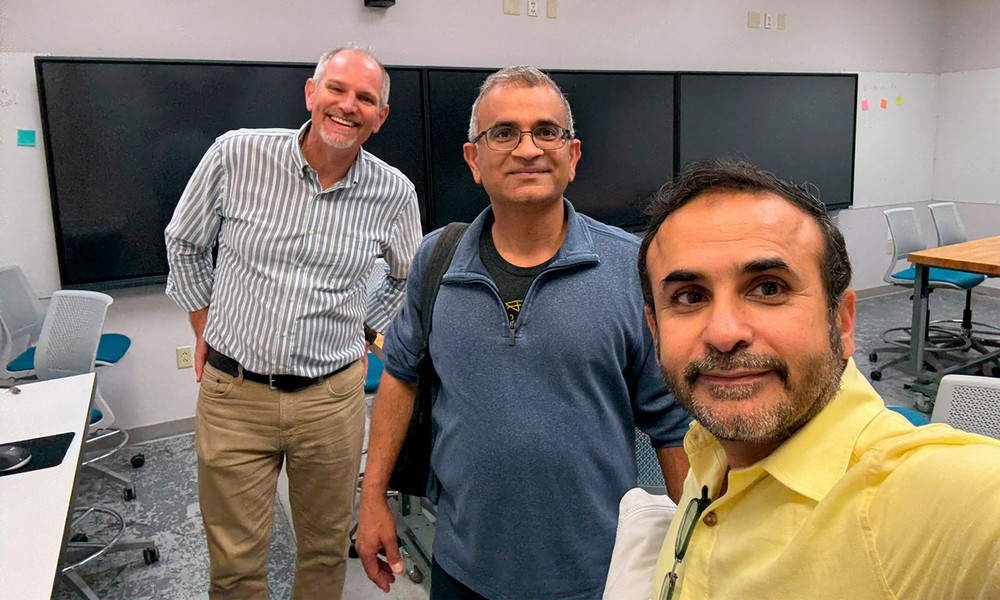
Two of the instructors, Dr. Raafat Zaini, assistant professor of integrated science and technology, and Dr. Venkat Kolluri, CEO of internet advertising company Cidewalk, have been friends for more than a decade and have stayed connected through bi-weekly meetings in which they discuss the intersection of industry and academia.
In the spring of 2025, one such discussion led to an intriguing idea. “We realized something important: While AI tools were rapidly advancing and transforming industry, many students — especially non-STEM students — were either ignoring these tools altogether or using them in very limited ways,” Kolluri said. “We recognized a growing AI gap — not just in access, but in meaning, understanding and application.”
This insight led to the development of an X-Labs course that would introduce students to the practical application of artificial intelligence tools and then push them to apply AI to real-world problems.
“We came up with the idea of having something to do with AI, not just at a productivity level, but to take [on] big challenges in the world and use it to collaborate with as a creative partner,” Zaini said. “And I thought, ‘Hey, JMU is very interested in sustainable development goals.’”
Rounding out the class’s teaching team was Dr. Christian Early, director of JMU’s Ethical Reasoning in Action program and professor of philosophy, who brought an expertise in the ethical implications of design thinking and product development.
“So often, what happens is that ethics becomes tacked on at the end,” Early said. “It’s sort of an afterthought. But what we were really working on in this class is incorporating ethics into the thinking for product development and design, so the ethics is less of a catastrophe-event response and more of a navigational guidance tool that you can use in directing your efforts.”
An important aspect of the course’s development was the implementation of the Defense Advanced Research Projects Agency framework, which offered students a template to tackle these large-scale problems. The framework uses the Heilmeier Catechism — named for George H. Heilmeier, former DARPA director — which presents the following questions:
-
“What are you trying to do? Articulate your objectives using absolutely no jargon.”
-
“How is it done today, and what are the limits of current practice?”
-
“What is new in your approach, and why do you think it will be successful?”
By leveraging these questions to help guide decision making, Early found it conducive to how human beings think. “They are helpful not only for product development and design, but also for DARPA to think about which programs to fund and which programs not to fund,” he said.
Many higher-education institutions are still grappling with how to benefit from AI in the classroom and the ethical implications of its usage. But courses like AI for Global Impact tackle that concern head-on.
“One of the most impactful aspects of the course was encouraging students to think of tools like ChatGPT not just as utilities, but as active research collaborators,” Kolluri said.
The course required a shift in mindset, with AI as a collaborator — a skill to learn, not just a shortcut, he said. “Students were guided to use AI for brainstorming, exploring alternative perspectives, refining ideas and iterating on proposals, rather than simply generating final answers.”

Sophomore Finance and Accounting double major Logan McIntire went into the course with some preexisting knowledge on how to harness AI tools, but he hoped for the chance to enhance those skills. That expectation was met during the first class, which included an assignment to use AI to develop a website to help students communicate with AI to produce a product.
“The skill that I developed the most was how to prompt an artificial intelligence system to get a more in-depth understanding of the topic I am researching,” McIntire shared.
He also noticed how challenging it was for him and his classmates to decide on a project focus and design. “Dr. Kolluri emphasized that we need to design our projects in a way that can impact ‘a billion people, not a million,’” McIntire said. “This paved the way for all groups to begin developing their projects on a macro scale.”
With those billion people in mind, McIntire chose to complete his final project individually. He took on the United Nations’ No. 2 sustainable development goal of eliminating global hunger. “The focus of my project was to establish vertical farms that combine natural light with transparent solar panels to grow fresh fruit and vegetables across the world,” he said. Inspiration came from a visit he took to a pineapple farm in Ponta Delgada, Portugal.
Vertical farming is a new and innovative solution to agriculture in the United States, where arable land is decreasing. McIntire, who comes from a family of cattle farmers, has experienced this deficiency firsthand. In this design, crops are stacked on top of each other instead of planted side by side, making it a particularly attractive innovation in urban settings. Vertical farms are typically housed inside a greenhouse-like environment, which allows for year-round food yield and less land and water waste.
“I thought that this vertical farm initiative could be something that can be a reality in the next decade, and, therefore, taking steps toward the establishment of this initiative would be a great experience for me,” McIntire said.
McIntire was proud of how he collaborated with AI tools to bring this project to life.
“I utilized AI to assist me with how my vertical farm concept could grow from an operation based in a large metropolitan area, to smaller communities,” he shared. “Figuring out potential global cities to start in, the costs of establishing a vertical farm, and potential questions a customer may have are examples of my collaboration with AI.”
Kolluri stressed that the goal of the course was to empower students to “think big — to see AI as a force multiplier that enables them to engage meaningfully with global challenges, regardless of their academic background.”
The title, Tackling Grand Challenges With Generative AI, highlights just that. “To me, it reflects a fundamental shift in what this generation of students is capable of achieving. With today’s AI tools, students can now engage with large-scale, complex problems that previous generations — including ours — could not realistically tackle at the same stage.”
Like all other X-labs courses, AI for Global Impact was comprised of students from different majors. “[T]his is one of the messages of this class,” Zaini said. “You don’t have to be a certain kind of person in order to make use of AI and be good at it.” He noted that X-Labs had “all the plumbing to make [the course] happen,” but it was the students who realized their vision for the course — a sentiment shared by Early.
“I think the big achievement was seeing how good JMU students are at collaborating and working together, and noticing how the values of the students were being expressed in the products that they were proposing,” Early said. “None of the schemes were get-rich-quick schemes. They were all thinking about how to make the world a better place … and that just felt really hopeful.”
Hacking well-being on the JMU campus
By Taylor Moore
A new X-Labs course during the Fall 2025 semester, Hacking Well-Being at JMU, challenged students to address health and wellness needs on campus.
The class grew out of discussions led by Dr. Kristina Blyer (’12M, ’16Ph.D.), associate vice president for health and well-being; Dr. Stephanie Baller, professor of health sciences; and Dr. Jonathan Stewart (’19Ph.D.), assistant vice president for finance, information technology and assessment.
“Improving well-being has been a specific focus on JMU’s campus for several years,” Baller said.
One of the first critical steps in this direction came in Fall 2022, when JMU joined the U.S. Health Promoting Campuses Network in response to the Okanagan Charter call to action. The charter examines health from all aspects, locally and globally. Blyer worked with other JMU leadership teams to develop new domains for health and well-being around campus.
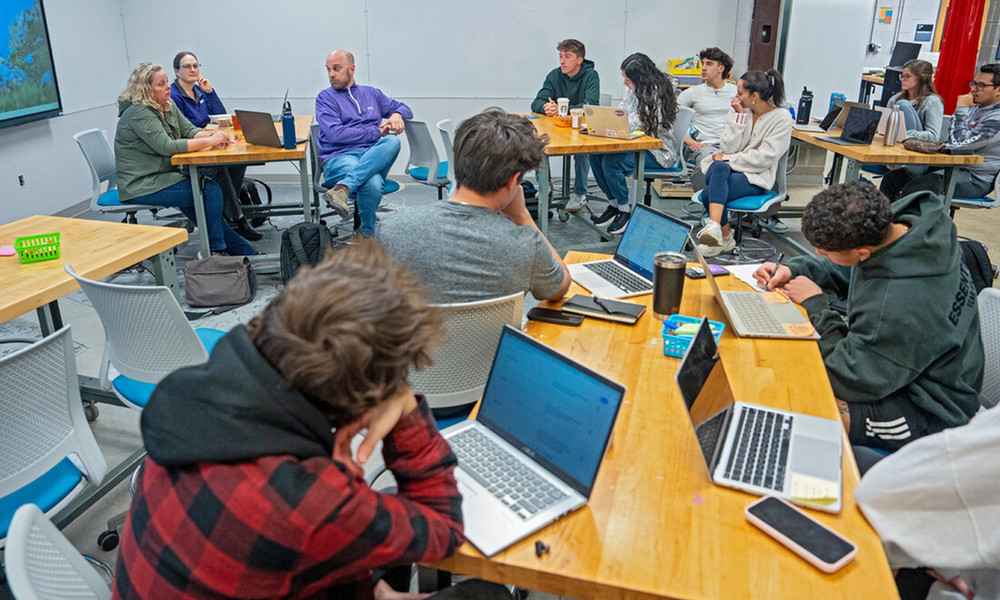
In preparation for the course, Blyer, Baller and Stewart devoted time to discussing how the class could merge evidence-based thinking with the design-thinking process. These talks resulted in the course using a combination of teachings from the College of Health and Behavioral Studies and the division of Student Affairs.
“As a Health Sciences major, I was drawn to learn about how students’ well-being plays a critical role in shaping JMU’s campus,” said sophomore Claire Machi. “I wanted to engage in a course that differed from a traditional learning environment and collaborate with diverse cohorts and departments at JMU.”

Machi and her colleagues came to realize that not every problem has a straightforward solution. “No one person will have lived the same experiences as another,” she said. “There is no single solution that will improve everyone’s well-being.”
The name Hacking Well-Being comes from the idea of “data-driven, incremental change for better well-being,” Baller explained. Courses like the ones X-Labs offers “highlight the opportunity for students to bring their disciplinary lens to the well-being challenges we face on campus.”
Senior Computer Science major Diego Navia knew the course would be challenging. “It was completely out of my area of study,” he said. But once he started, he felt more confident. “I found out that a lot of things that were integrated into the course were very familiar to me, and a lot of the things that I’ve learned throughout my computer science career could be applied into this kind of class.”
Baller found that gaps in well-being happen for different reasons. Sometimes it’s a “lack of awareness of existing resources or evolving changes that need to be grappled with to be meaningfully understood,” she said. As part of the course, student researchers were tasked with investigating gaps that they felt were most relevant to JMU’s campus.
“One wonderful thing about Health Sciences is that students in the major have a wide range of career goals,” Baller said. “So, to some extent, the students get to see how viewing health challenges from different career paths can yield differing perspectives.”
Machi initially thought the class would be centered on improving preexisting frameworks focused on well-being. Instead, she had to “reimagine the future of JMU regarding health and well-being.”
Students used a combination of feedback, experiences and research from their respective areas to develop solutions. One of their revelations was that JMU students — and college students in general — tend to lack engagement, attention and discipline when it comes to their well-being, and are afraid to step outside of their comfort zones.
At the end of the course, students gave a presentation that was shared with JMU’s Health and Well-Being leadership team.


