

JMU students take on organized retail crime in X-Labs course
JMU News


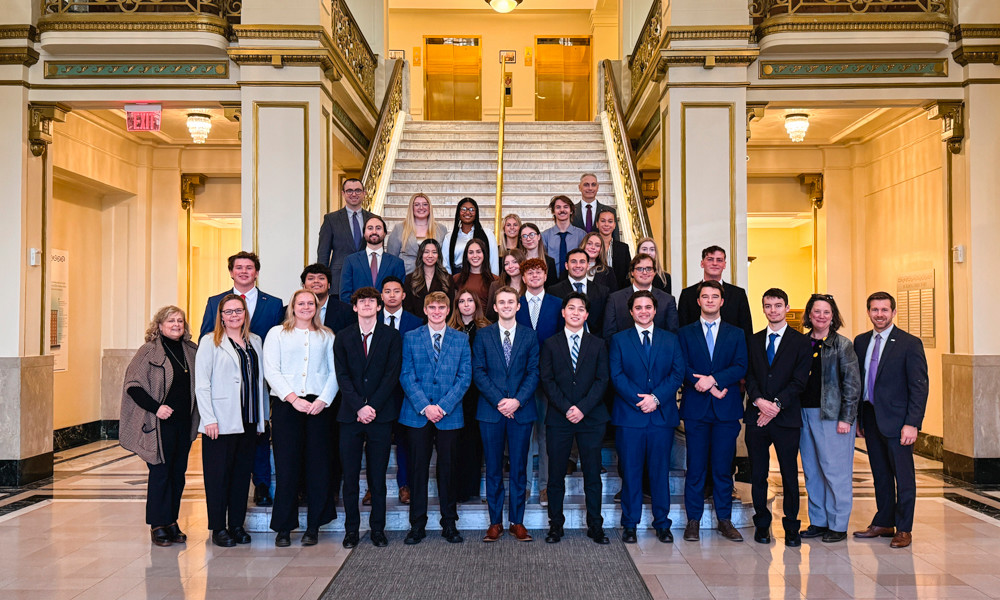
James Madison University students spent the fall semester tackling the growing problem of organized retail crime through an X-Labs course titled “Reimagining Virginia’s Fight Against Organized Retail Crime.”
The experiential learning course, which brought together students from 11 academic disciplines and faculty from the College of Integrated Science and Engineering, the College of Arts and Letters, the College of Business and the Division of Access and Enrollment, was developed in partnership with the Virginia Attorney General’s Office to determine how Virginia could better address the issue, said intelligence analysis professor John Robinson.
Organized retail crime is estimated to cause about $1.3 billion in merchandise losses annually, translating to more than $80 million in lost tax revenue for the commonwealth.
“Having an external stakeholder you’re working with can change the nature of an X-Labs course,” said Angela Hayslett, a lecturer at JMU's Hart School of Hospitality, Sport & Recreation Management. “The students had to keep in mind they were trying to provide solutions or ideas that would support that external stakeholder’s purpose or objective.”
Over the semester, four student teams researched the issue, interviewed experts, and built prototypes aimed at helping retailers and state officials curb coordinated theft. The approach mirrored real-world dynamics, participating faculty said, emphasizing the need to combine diverse expertise.
“In the real world, no single person or single discipline can solve a problem,” said Fadi Majdoub, a JMU marketing lecturer. “You need expertise from different disciplines to come together, brainstorm and create something that can truly address a complex, real-world issue,” Majdoub said.
Students said the interdisciplinary structure was one of the most valuable aspects of the course.
“They found it refreshing that they got to work with people outside their discipline,” Hayslett said. “Being challenged or having their minds opened by other disciplines really expanded their thinking and their understanding of interdisciplinary teams.”
The teams ultimately presented their findings to representatives from the Attorney General’s Office in Richmond. Faculty members said the students’ confidence and preparation stood out.
“Our guys were super relaxed,” said Majdoub. “They had visual elements and stories to tell that really helped sell their solutions. It wasn’t just, ‘Here’s the research, here’s the data.’ They had to craft stories and visual components that really helped convey their message.”
With a change in administration following the November election, the next steps remain uncertain. “There’s a pause because of the transition in the Attorney General’s Office,” said Adrienne Hooker, an associate professor of media arts and design. “There’s a possibility things can develop, but there are no definite plans until the transition occurs.”
Hayslett noted that the timetable for action is not going to be immediate, limiting students’ ability to see their work carried forward. Still, faculty remain optimistic that the groundwork laid this semester will influence what comes next.
“One of the interesting comments was about how the solutions the students presented were consistent with things they were already thinking about, so I think that JMU legacy will carry forward regardless,” said Hayslett.
Even with the future unresolved, faculty said the course showcased the power of the X-Labs model: interdisciplinary teamwork, real-world stakes and solutions shaped through experience rather than instruction. Students, they said, walked away better prepared for the collaborative problem-solving expected in their careers.


