


Curious About Quercus was an exhibit displayed in the Edith J. Carrier Arboretum January - February 2026. It was created by Kelli Hertzler, Education Coordinator, with assistance by Caitlynn McFee.
Oaks are a genus within the Beech family. Found worldwide, more than 95 species are recognized in North America and 28 in Virginia. Within the Arboretum, you can find twelve native species and one exotic, the Emperor Oak, all represented on this display by their leaves.
Oaks are old giants of our eastern hardwood forests with a long natural lifespan; white oaks live about 600 years. They are called a keystone species because of the innumerable relationships that exist between oaks and other organisms - like mammals, birds, insects, fungi, and other plants - binding their ecosystem together in a web of interdependence.
All oaks produce flowers that mature into acorns, although it may take decades before it is old enough to produce for the first time. The genus is divided into three groups. Identification cards here are marked with symbols identifying to which of the groups each tree belongs. (The third group, Golden Cup, is not found in this region and not represented here.)
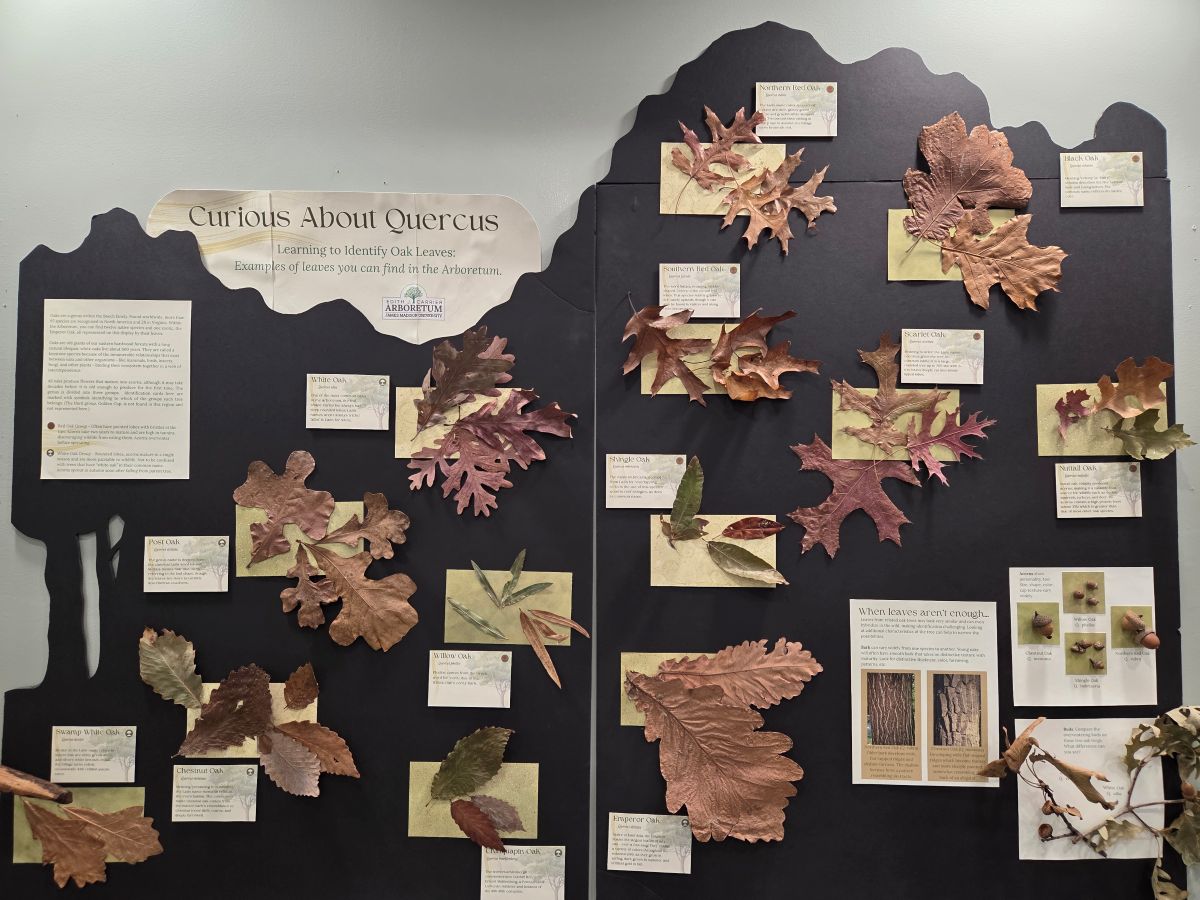
White Oak Group
- White, Quercus alba
- Swamp White, Q. bicolor
- Post, Q. stellata
- Chinquapin, Q. muhlenbergii
- Chestnut, Q. montana
- Willow, Q. phellos
- Emperor, Q. dentata **
Red Oak Group
- Shingle, Q. imbricaria
- Black, Q. velutina
- Southern Red, Q. falcata
- Northern Red, Q. rubra
- Scarlet, Q. coccinea
- Nutall, Q. nutallii
** native to East Asia
When leaves aren’t enough...
Leaves from related oak trees may look very similar and can even hybridize in the wild, making identification challenging. Looking at additional characteristics of the tree can help narrow the possibilities.
Bark can vary widely from one species to another. Young oaks will often have smooth bark that takes on distinctive texture with maturity. Look for thickness, color, furrowing, patterns, etc.
Acorns show personality, too. Size, shape, color, cap texture are all notable features. 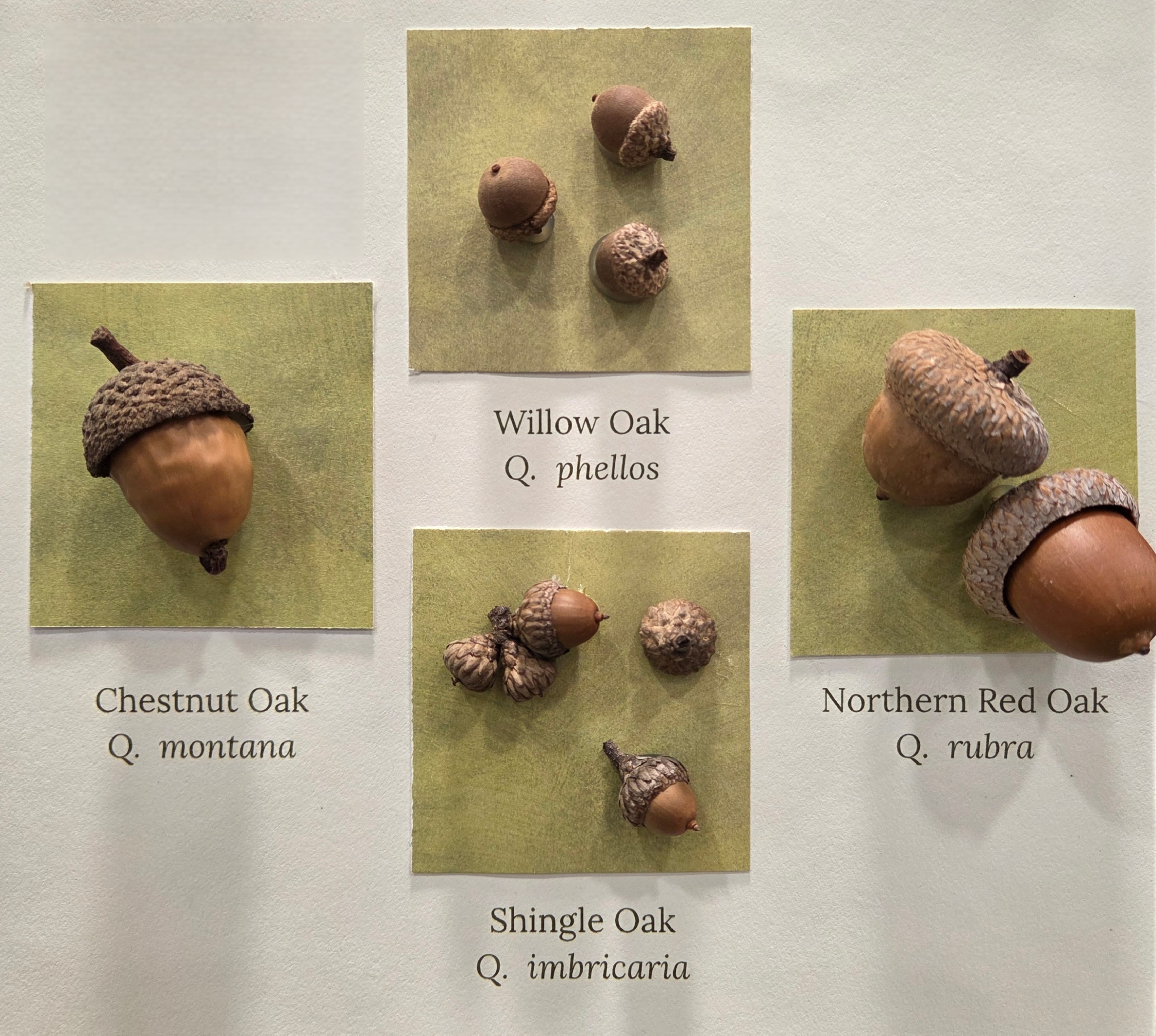
Buds. Compare the overwintering buds on these two oak twigs. What differences can you see?
See additional resources below for recommended tree identification guides.
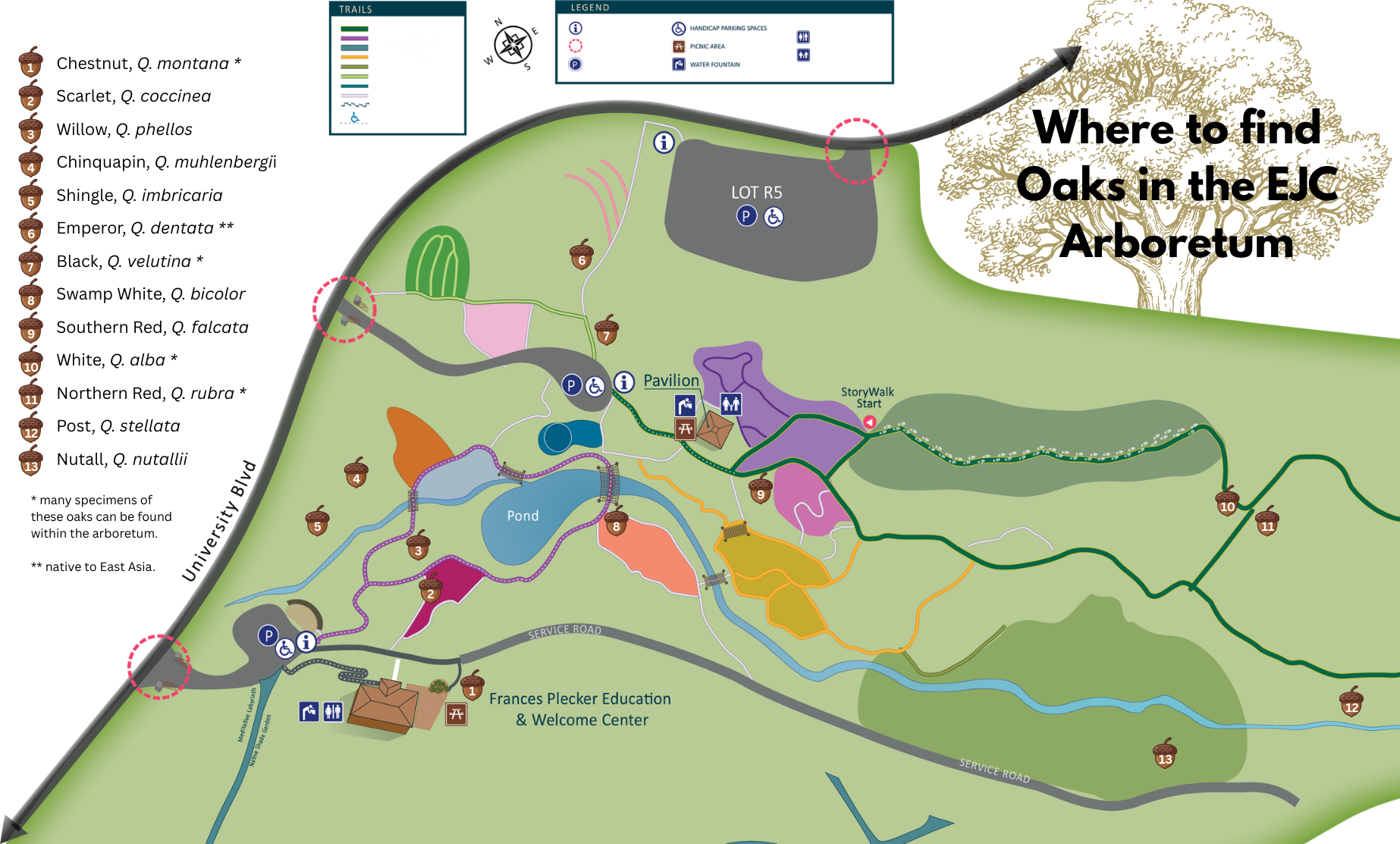
Download a PDF version of the Oaks in the EJC Arboretum map.
Online resources and recommended reading list to share via website and/or with display:
- Downloadable USDA Field guide to North American oaks
- Trees of James Madison University: A walking tour of the diverse trees on JMU's campus. Created with StoryMap and available online to use while you are walking
- Tree Campus Inventory Map powered by ersi ArcGIS mapping software
- iNaturalist for Edith J. Carrier Arboretum location
- Virginia Tech Drendrology Created for a VT class, contains Virginia-specific tree ID tools
- The Nature of Oaks book by Doug Tallamy
- The Nature of Oaks YouTube presentation by Doug Tallamy
Curious About Quercus exhibit
Grounds: Free to the public
Dawn to dusk | 365 days a year
Frances Plecker Education Center:
M-F | 8 AM - 4 PM

