


Background
Just like the Arboretum, this page is expanding. Check back soon for more updates!
In alignment with the Arboretum's Mission and Future Outlook, the expansion into East Campus natural areas and the University Boulevard reforestation allows for significant growth of the Arboretum's model of a living laboratory of forest, naturalized areas, and gardens.
Plans for the Arboretum expansion and reforestation area trace their inception to summer 2025, as campus staff thought about the final outcomes of the University Boulevard construction project. We thought "what if" we reforested this space and "what if" we incorporated this space into the Arboretum? We realized that expanding the Arboretum onto East Campus would be an exciting, well-timed opportunity coinciding with the visioning and new strategic planning process undertaken by President Schmidt. We wanted to encourage JMU to reimagine how a university landscape can support learning, wellness, sustainability, research, community engagement and stewardship across generations -- and these all converge within an expanded Arboretum.
With the help from our campus partners to work out the reforestation details, the Arboretum applied for the Storm Smart Chesapeake grant from the Chesapeake Bay Trust and the US EPA Region III to help fund the reforestation. We learned in early June 2026 that this application was successful; read more below.
During an inauguration event celebrating the reforestation project on April 10, 2026, President Schmidt announced that the University was also expanding the Arboretum footprint to include most of the East Campus natural areas and the area around the University Boulevard construction that isn't already designated for future building. That encouraged conflation of the two projects, since the reforestation area is now officially 'in' the Arboretum.
University Boulevard Reforestation:
At our earliest opportunity based on site conditions, (fall 2026 or spring 2027), we will plant 3 acres in the Forest Hills area on either side of the newly reconfigured University Boulevard and on 1.28 acres on the currently turfed slope of the road that runs past the Arboretum. Plans call for:
- 1,300+ native trees via contractor supported by the grant.
- Several hundred native shrubs via volunteers, spring 2027. (Who wants to help?)
- 180 native street trees via contractor along both sides of University Boulevard where practical based on site conditions between where the University's property starts by the Spark Motel all the way up to Carrier Drive.
- There's a multi-use path going in there as part of the construction project, and we have educational signage to develop for that as well.
- The post-construction soil stabilization is seeding a native meadow for pollinators and habitat that trees and shrubs will be planted into, so it will carry environmental benefits for years while we wait on the trees to grow.
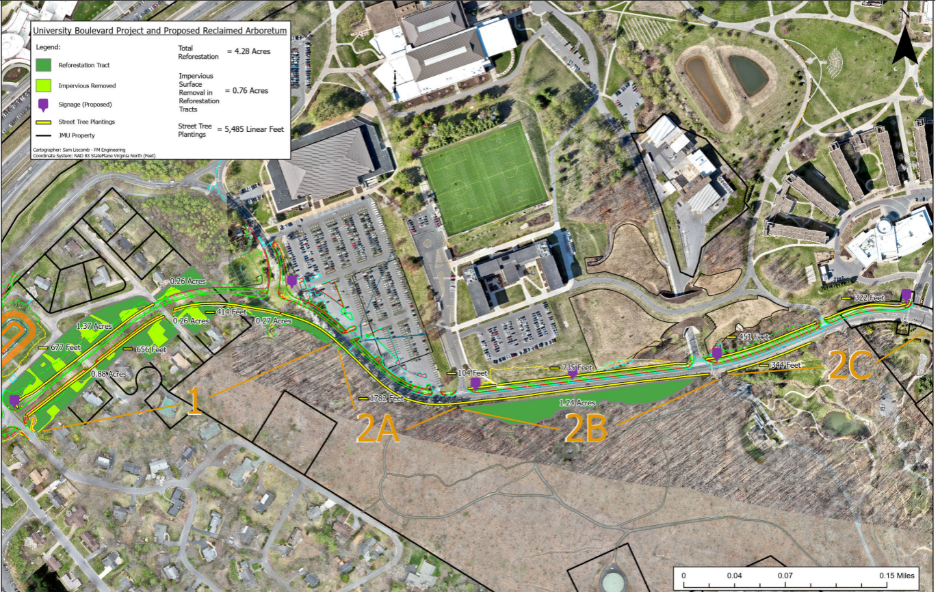
Above: Area 1 and 2B are getting the 'full' reforestation treatment, with native meadow as the soil stabilization, native trees planted into the meadow at least 300/acre, and shrubs to complement; along with street trees along both sides of the street where practical based on final utilities and site conditions. Area 2A is having some invasive Bradford pears removed and native street trees planted; and 2C will also have street trees planted. We have plans for six educational signs along the multi-use path.
Storm Smart Chesapeake Grant:
The Arboretum has received a $163,410 Storm Smart Chesapeake grant from the Chesapeake Bay Trust and the United States Environmental Protection Agency Region III to support the reforestation. The grant will fund the planting of the approximately 1,500 native trees and hundreds of native shrubs beginning in fall 2026, helping establish a restoration effort that improves water quality, enhances biodiversity, and expand hands-on learning opportunities for students. The reforestation project has environmental benefits including reduced nutrient runoff to the Chesapeake Bay watershed, improved stormwater management, and enhanced wildlife habitat. Over time nearly 1,500 new trees, when mature, will intercept more than 1.5 million gallons of rainfall annually.
This project has been funded wholly or in part by the United States Environmental Protection Agency Region III under assistance agreement 4I - 953A0190 - 0 and Chesapeake Bay Program Office under assistance agreement 4I - 95309901 – 2 to Chesapeake Bay Trust. The contents of this document do not necessarily reflect the views and policies of the Environmental Protection Agency, nor does the Environmental Protection Agency endorse trade names or recommend the use of commercial products mentioned in this document, as well as any images, video, text, or other content created by generative artificial intelligence tools, nor does any such content necessarily reflect the views and policies of the Environmental Protection Agency.
 Arboretum Expansion:
This expansion brings the acreage of the Arboretum from the original 63 acres to 110. (Reference: See the map below.) The purple highlight area on the map is the original arboretum footprint. The yellow highlight area is the expanded footprint. The black hashmarks are areas that have already been in permanent stormwater conservation (BMPs), and will remain so.
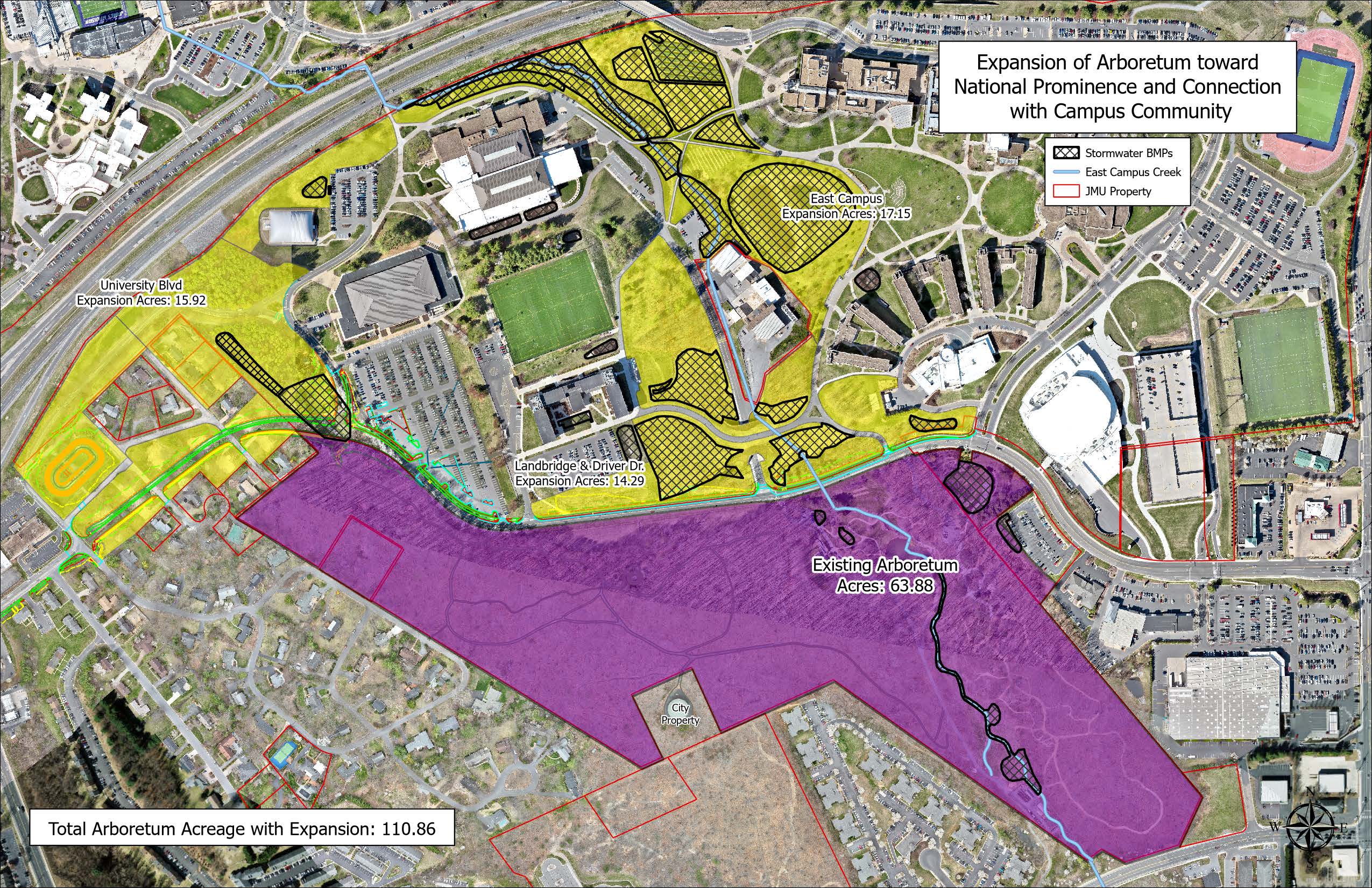
We're not changing the character of the East Campus natural spaces that are well set in their usage, such as the meadows, for instance. Some of the areas that right now are turf without a specific use might be a good place to plant some trees in the future; but there are many considerations to be figured out as we go forward.
Ultimately, the Arboretum will be responsible for the facility maintenance of that whole area — which means managing it with ecology and positive environmental impact as well as faculty and student research and educational needs in mind. We will be reworking our landscape staff structure over the coming months and years to incorporate that, and it will involve mentoring cohorts of students in a variety of natural resources/conservation work skills and helping them explore careers in the environmental sector.
There was already a lot of research and class lab use being done both in the original Arboretum and on East Campus, so we aim to keep strong two-way communications open with faculty and encourage even more use of the space. We're hoping to be able to develop ways to tell more stories about the interesting work that's happening here, and invite the community in to participate. We are re-tooling our website, for instance, to better hold those stories and the data collected in the Arboretum for people to learn from.
This expansion provides opportunities to expand educational programming for the community as well. With more than 20,000 community visitors, nearly 2,000 JMU students already utilizing the Arboretum for class each year, and public programs and K-12 education that serves over 3,000 children from 50 local schools each year, this expansion represents an investment in a resource that is already delivering meaningful value to the university and the broader community. We are particularly excited to expand our work supporting local pre-service and in-service teachers as they build their capacity and confidence in using the outdoors as a place to learn.
Both the reforestation and the expansion are exciting because of the potential it represents to enhance the student experience, expand educational opportunities, support environmental goals, strengthen community connections, and contribute to the conservation of an important place.
It's our hope that JMU students, and all other people too, will have these outdoor learning experiences, develop a strong connection to and understanding of the natural world through those experiences, and go out into the world to make a positive difference with that in mind, whatever their career paths or life stage. We hope that people come to love this place and use that love, and knowledge, to fuel positive contributions in their own spheres of influence, wherever that may take them.
In many ways the expanded Arboretum demonstrates that some of the most effective infrastructure on a university campus is not always made of concrete and steel. Sometimes it is made of forests, wetlands, streams, and the natural systems that quietly work every day to support both people and the environment.
Frequently Asked Questions:
(Check back for updates and submit any questions not addressed here to: ejcarboretum@jmu.edu)
I thought the Arboretum was 125 acres already. What happened?
Nothing but better measurement, as far as we can tell. A review of the Arboretum boundaries using modern technology determined that the footprint that has been the Arboretum for many years is actually 63 acres.
Was this land that was already used for a different purpose by the university and then just reassigned to the Arboretum? Or did the university buy new land, or did someone donate it?
All of the East Campus land was already owned by the University and is being reassigned to the Arboretum's care. The land in the Forest Hills area was acquired by JMU over the last few years ahead of the University Blvd. construction project. The post-construction remainder not already slated for specific projects is being assigned to the Arboretum and therefore represents an increase in campus space.
When does this start?
It starts now! It will take us some time to fully integrate Arboretum operations to cover the whole expansion area. The University Boulevard reforestation project is already underway, with some of the soil stabilization being accomplished through native meadow seeding this past spring; the invasive Bradford pears opposite the Convocation Center parking lot have just been removed, and we are waiting for construction conditions to allow further action! We hope to have the trees and shrubs planted before Fall 2027. It is a big lift and will depend on site conditions for the exact timing.
How can I help?
We welcome volunteer help for certain aspects of the reforestation planting, and for other on-going Arboretum maintenance including in the expansion areas. Learn more about volunteer opportunities and sign up here.
You can also make a big difference by contributing to the work of the Arboretum financially, by becoming a member or making a gift of any amount. Learn more here.
Grounds: Free to the public
Dawn to dusk | 365 days a year
Frances Plecker Education Center:
M-F | 8 AM - 4 PM

