High School Workshop
What can your blood reveal about your health—and how do scientists uncover those clues? In this hands-on workshop, students step into the role of medical investigators, exploring blood at the microscopic level to solve a disease case. By examining cells, testing blood types, and interpreting patterns, they discover how scientists use evidence to diagnose illness while connecting observation, analysis, and creativity.



Faculty Developers: Dr. Bisi Velayudhan and Jess Marquardt, Biology
What students do:
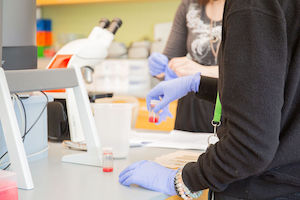
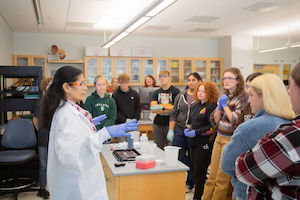
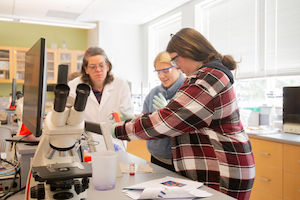
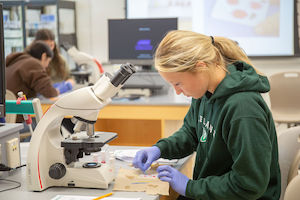
Students engage in a hands-on investigation of blood in the context of disease diagnosis. They prepare, stain, and examine blood smears from different species, analyze abnormalities, and determine blood types using a lab kit. Throughout the session, they ask questions, compare findings, and conclude by creating an artistic representation of their observations to deepen understanding and communicate results.
What students learn:
- The role of blood analysis in disease diagnosis
- How to prepare, stain, and examine blood smears
- Identification and comparison of different blood cell types across species
- Blood typing and its importance in transfusions
- Quantitative reasoning by counting and comparing cell types
- Systems thinking related to blood function and disease effects
- Scientific communication through discussion and visual representation
- Basic lab skills, including microscopy and pipetting
- The connection between science and art through data visualization and observation
Background Knowledge
- Basic understanding of blood (what it is, what is in it, it's function).
- Exposure to microscopes, helpful but not required.
Information for teachers:
- Blood Basics Introduction to blood
- Blood Smear Protocol Example protocol for blood smear staining
Connection to Research:
Professors Velayudhan and Marquardt are physiologists who research and teach about blood in health and disease. Both are deeply committed to STEM outreach and believe in fostering early curiosity in science. This workshop highlights their research and importance of understanding how physiology connects to everyday life and helps us appreciate the complexity of the human body.