

Attention Literacy effort challenges Dukes to think critically about technology use
Featured Stories


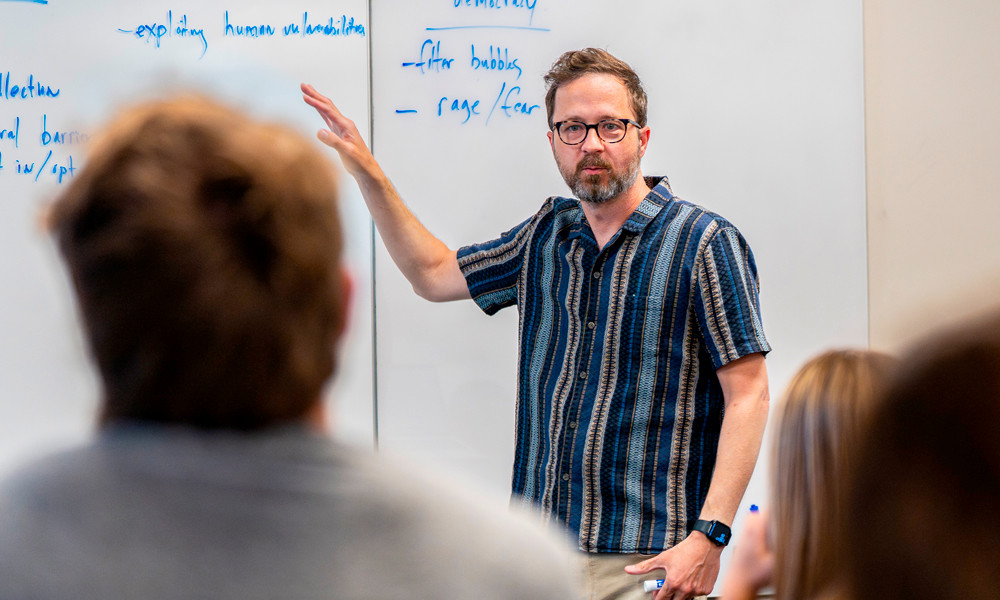
SUMMARY: JMU's Attention Literacy Initiative seeks to inform students and faculty about the dangers of social media, including the mental and physical consequences, and the ethical realities of contributing to the attention economy. Through the effort, several courses are helping students improve their focus on class assignments, while also addressing the time and attention they are investing in social media.
About halfway through the Fall 2025 semester, junior Geography major Austin Gilbert started to notice his phone apps were stealing his time.
In monitoring his screen usage for his Honors class, Navigating the Attention Economy, Gilbert realized he was spending about four hours a day scrolling one app, while another was subjecting him to comparison culture. “That was the beginning,” he said. “That really sort of opened my eyes to how much time I was missing out on.”
Since then, Gilbert, who is concentrating in Applied Geographic Information Science and Environmental Conservation, Sustainability, and Development, has removed most social media from his phone and now spends a lot of his downtime reading. “I just feel like I’ve got more time, whereas before I felt like I didn’t have enough time to do everything.”
Having had a similar experience, junior International Affairs major Natalie Fay has been touting the class to family and friends. “They’re probably sick of me talking about it, but I’m just like, ‘Everybody’s got to do this course,’” she said. “It’s just so good. It’s all I talk about.”
Though she hasn’t completely quit social media, she said she’s much more present since starting the class and learning how companies thrive on the time that people put into their social media apps.
“Our attention is like money, and our engagement is free labor for Big Tech,” Fay said. “We think we’re in control of our social media usage and tech usage, but it’s really integrated into every aspect of our lives. It’s frying people’s attention span and ability to critically think, and have our own awareness of what matters to us. ... You could be doing so much with your life, with the time that you’re spending on social media.”
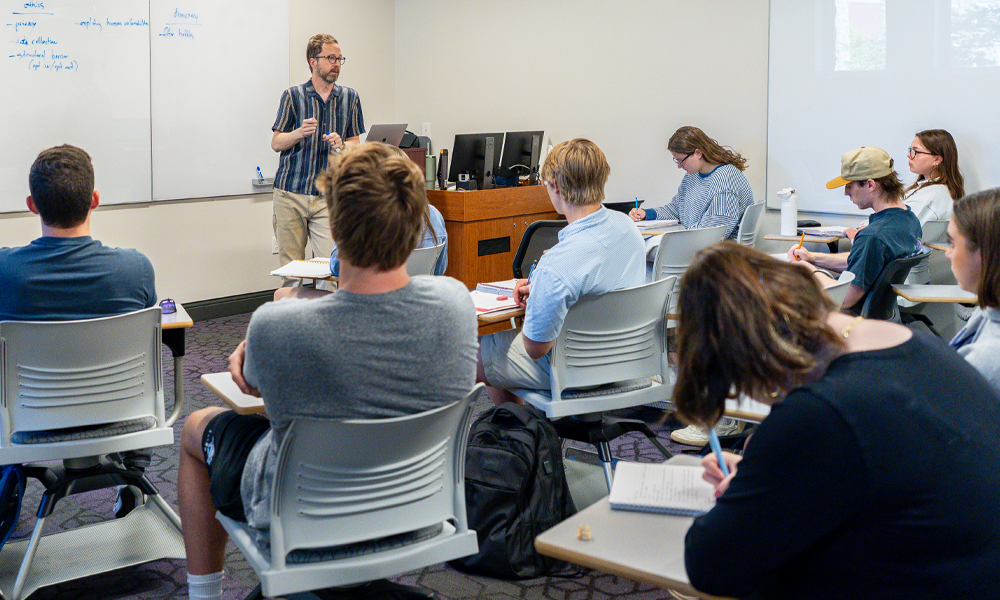
Led by professors of Interdisciplinary Liberal Studies Dr. Jared Featherstone and Dr. Phil Frana, Navigating the Attention Economy is one of several courses at JMU in recent years that address the topics of attention literacy and mindfulness, as well as the ethics of the attention economy. The courses started as a way to address faculty concerns about students struggling to focus on their class assignments, but have since grown to address the time and attention that students and faculty, alike, are investing in social media.
“The framework of attention economy is about human attention being monetized,” Featherstone said. “The designers are well aware of psychological vulnerabilities, cognitive vulnerabilities, and they’re exploiting them all the time to get us to stay on longer than we would have chosen, to get an emotional reaction to buy something.
“Our human attention being a monetizable commodity is threatening to our personal will,” he said. “We can’t create educated and enlightened citizens if they are perpetually distracted and misled by polarized or fake news in their feeds.”
Featherstone’s classes lean into the real-world changes that students might implement after realizing how they can better manage their attention. “Anecdotally, we had a lot of students announcing changes that they’ve made in their life ... and it’s worth saying that our final assignment asks them to do that,” he said. “We’ve called it an attention-optimization plan. They have to take everything we’ve talked about in the course — all the research, all of our discussions, and experiential work — and create a plan for themselves to regulate and optimize their attention in everyday life. It’s a personalized, research-backed plan. ... We’re seeing evidence of change, that it’s possible for them to take this newfound understanding and these ways of applying it and put it into practice.”
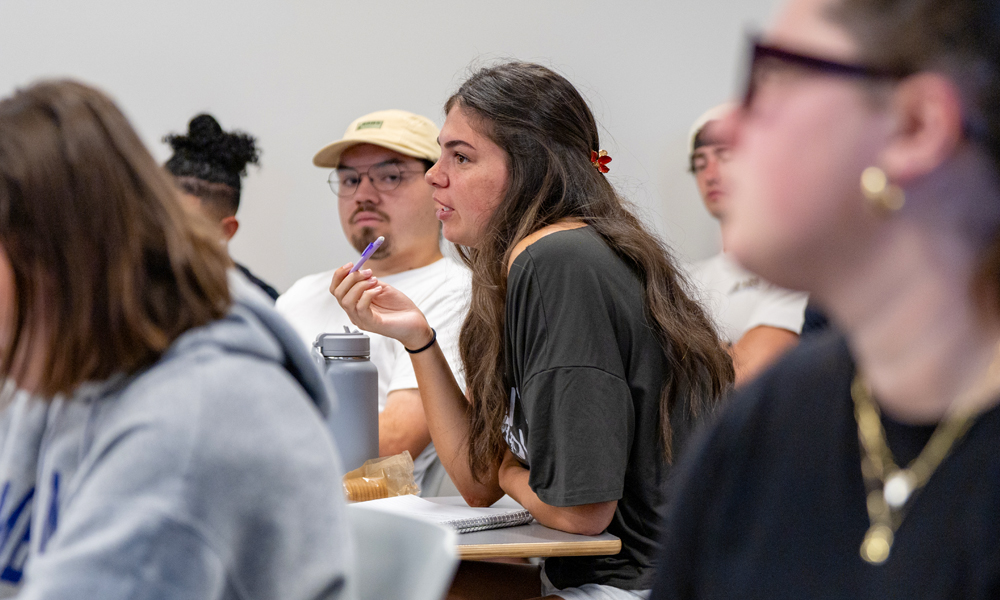
Featherstone was director of the University Writing Center in 2023, when he launched the initiative alongside Dr. Sri Siddhi Upadhyay, associate professor of psychology and member of the University Writing Center Advisory Board. They co-founded a campuswide initiative that used Upadhyay’s research in cognitive psychology and teaching, and Featherstone’s teaching of mindfulness, meditation and pedagogy.
“This is an area of interest to both of us,” Featherstone said, “and we soon determined that a lot of these issues that appeared as writing or reading issues were actually attention issues.”
Although faculty had approached them to address concerning patterns they had noticed in their classes, Upadhyay didn’t want to offer a simple Band-Aid solution. “We could probably do something that’s a little more structured,” she recalled thinking.
This was also during the thick of the COVID-19 pandemic, she said. “Everyone had made this rapid shift online with varying degrees of pedagogical understanding of how to do that effectively. The students were kind of maxed out, and so were the faculty.”
The plan was to offer a student resource hub, Featherstone said. “We needed to provide some means for them to develop those skills in the classroom.” After gathering materials, he and Upadhyay pivoted to providing courses so they could test ideas and gauge what worked. “Once we had a few of the courses,” he said, “we were ready with content for the website.”

The JMU Attention Literacy Initiative is an interdisciplinary collaboration of faculty, students and community members who aim to “restore the ability of individuals to accomplish goals and maintain intentions in the face of ever-increasing distractions and busyness.”
Lessons include ways that students can employ checkpoints for self-regulation and self-monitoring. They can ensure they understand assignments and adjust for errors in critical thinking and comprehension before turning in the finished product. Such exercises also address time-management misconceptions, such as multitasking, and promote better communication in the classroom.
“It turns out that it was actually hurting them a lot to be media multitasking while trying to do academic work,” Featherstone said. After he had students track their screen stats over a week compared with the time they had scheduled for other plans, they started to see the impact that digital distractions had on their goals. “I think that made it relatable for them to keep putting everything into conversation with what they’re experiencing now,” he said, “because they all show up to class and the phones are all out. I mean, the subject is right there in front of us.”
Since taking Upadhyay’s Attention and Mindfulness class, senior Psychology majors Jason Cheifetz, Guliana Claro and Ellen Gruber have become more aware of the time they spend on their phones.
Cheifetz, who has minors in Criminal Justice and Educational Media and is pursuing a career in sports psychology, found that social media didn’t follow through on its promises of entertainment. “If you’re scrolling, you don’t even remember the video you saw like three videos back,” he said. “You don’t get any enjoyment out of scrolling. It actually makes you feel worse, even though you want to keep scrolling more, because you think you’re going to get gratification, but you don’t. It’s a vicious cycle.”
Now, if he’s going to be on social media, he sets a timer to limit his use. “That’s already saved a lot of my time,” he said.
Claro, who is minoring in Criminal Justice and Family Studies and plans to pursue a master’s in social work, has been trying to be more present since noticing how scrolling affected her energy levels. “I learned that going on your phone is not giving your brain the mental rest it needs,” she said. “That’s just kind of preoccupying it and giving you small dopamine hits. I was like, ‘Why am I always so tired even if I’m taking the time to rest?’ But me resting was going on my phone and scrolling on social media, which wasn’t giving my brain the time.”
Gruber, who has a second major in Marketing, said Upadhyay’s class helped her decide on a career in school psychology. “I learned a lot about my own attention,” she said. “You have that instant gratification, and you almost have no room to be bored. If you just have your phone in your hand, you can do anything at your fingertips.”
Through the class, she analyzed her attention skills and made improvements through mindfulness. “That was the biggest takeaway,” Gruber said. “Your attention can be improved.”
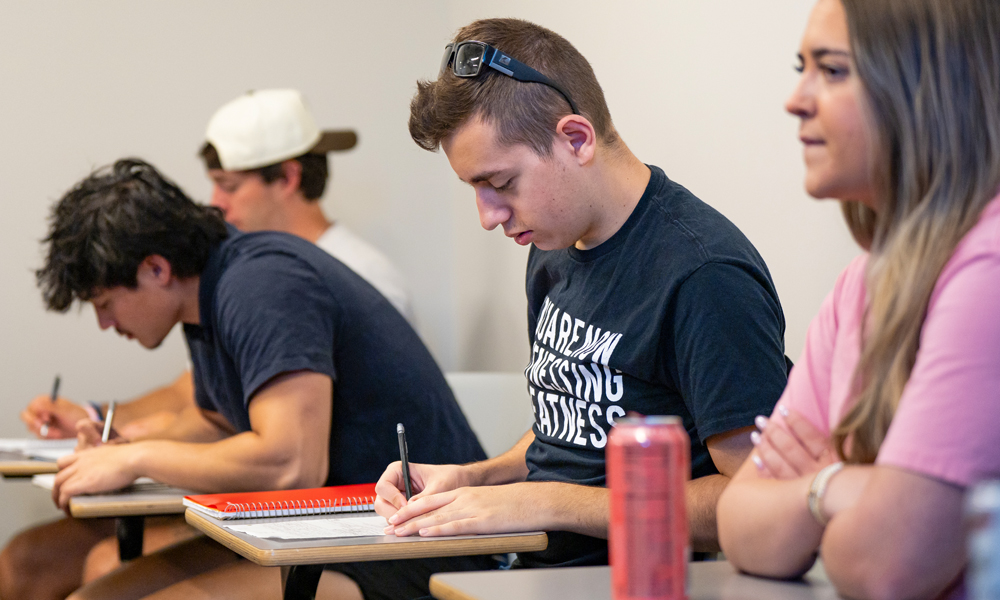
The classes give students the space to pause and think about the ways in which focusing on their attention literacy can highlight challenges in their lives. “At some degree, they’re aware of the problem already, right?” Upadhyay said. “They have frustrations with what they’re trying to do and what actually gets done. Here’s a way for them to maybe feel a little bit less of that helplessness.”
Beyond the immediate, personal costs of the attention economy are the big-picture costs that Featherstone says spark questions of ethics, and threaten personal freedom and democracy.
“The engagement metric means people are making money from how long you linger on an image or whether you click through on a link,” Featherstone said. JMU’s attention-literacy classes “get students to understand that they’re doing free labor for Instagram, for Meta, for TikTok,” he said. “Every time they post, every time they scroll, every time they click on something, they’re actually doing free work that someone else is profiting from.”
The metric has also been a factor in recent political cycles, Upadhyay says. Social media companies have been “running their own experiments on what they’re showing people in their news feeds and algorithms without consent from the people,” she said. “And that’s really dangerous, because what people are seeing often ends up being their only or primary news source. And they’re not really doing source checking; they’re kind of taking that information and subliminal messaging. Just seeing that information is going to change the way that you’re forming thoughts.
“So many people are relying on social media as being their first point for really learning about anything, but they’re not,” Upadhyay continued. “It’s this passive flow of information. There’s not even time to really think about, ‘Where is this coming from?’ or ‘Should I be trusting this?’ And then it’s already in your head.”


