


An exhibition of international pop culture objects related to the late French queen
Curated by Dr. Doe Polanz (WLC) and Adrienne Hooker (SMAD)
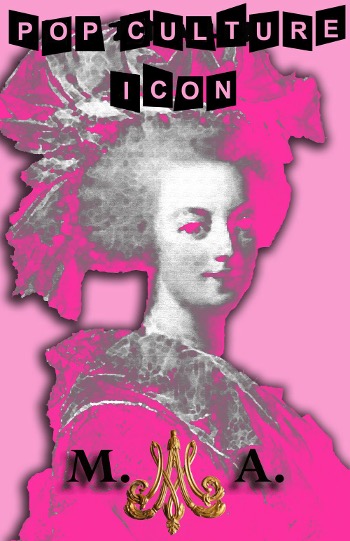 We know Marie Antoinette. There is no avoiding her. Not the actual woman (born 1755, died 1793), nor the historical character (Queen of France), but a third Marie Antoinette, a figure that we should just call "M. A." to avoid confusion. M. A. appears in advertising, in fashion, in movies and TV shows, in comics, in politics (people in power deemed to be irresponsible will inevitably end up being compared to her), and in fact just about anywhere. Marie Antoinette was born in Austria and lived in France for thirty years, but M. A. has now become a global icon, universally recognizable even by those who have little or no knowledge of eighteenth-century European history.
A first phase of this project took place from June 2013 to April 2014 at the National Museum of the French Revolution in Vizille, France, when a sampling of our collection was presented for the first time to the public in the context of a larger exhibit "Pop Culture and French Revolution in the 20th and 21st Century." In a scholarly conference held in conjunction with the exhibit, with my co-owner and colleague Guy Spielmann (Georgetown University), we put forth a series of arguments to explain the M. A. phenomenon, which reflects the need for immediately recognizable icons serving as cultural shorthand in our understanding of the human experience. We developed the theory that the M. A. persona (rather than the actual person or historical character) has been used as a vehicle on which to project our most contemporary struggles and fantasies. This led to a series of international lectures and publications, including the scholarly article “From Myth to Meme: Reinventing (yet again) Marie Antoinette in the Age of Streaming” (Symposium, 2024, pp. 283-299) that won the Harold Jones Award for Best Essay of 2024.
Our collection showcases a vast range of objects somehow based on a representation of Marie Antoinette, none of which have any historical value in the conventional sense: photographs, drawings, films and videos, dolls and figurines, advertisements (for underwear, beer and Coca Cola), cigar labels, books for adults and children, candy, teas, make-up palettes, candles and perfume, board and card games, video games, postcards (mostly from France, Japan and the USA), are among the almost innumerable products that relate, obviously or not, to Marie Antoinette. Although many of these are showpieces in and of themselves, and hardly require an explanation, our goal is not just to fascinate, provoke or amuse the viewer, but also to account for the ubiquity of the M.A. figure and make sense of it. Why have so many people in so many different contexts felt compelled to refer to Marie Antoinette rather than to other, much more historically prominent characters?
In this unique exhibition, we would like to demonstrate how this argument is embodied in the realm of pop culture by showcasing and analyzing selected artefacts from our own collection of Marie Antoinette pop objects. By displaying a sampler of limited-edition, out-of-production and exclusive items from France, Japan and the US, we would like to foster a conversation on the iconic aspect of "M. A.," a crystallized figure that often has very little to do with the historical character Marie Antoinette. In fact, this “entirely new Marie Antoinette” morphs and adapts to the time period and the country in which each object originates, revealing a society’s aspirations and mindset. In a world where consumerism and marketing rule, "M. A." (if not exactly the late French queen Marie Antoinette) has become the "Queen of merchandising."
Collection Concept: A Piece of Cake!
In the “Let them learn” central display, an image of a cake introduces the concept that organizes the different representations of Marie Antoinette that you’ll see throughout the exhibit. In the background, you see a cake with several layers. Each layer indicates a presentational mode:
1–Representation, 2–Signification, 3–Metonymy and 4–Derivation.
First Layer (Pink): Representation
- Straight Representations that replicate images of the queen produced in her lifetime—drawings (including caricatures), engravings, paintings, sculptures.
- Modified Representations that do not replicate images of the queen produced in her lifetime, although they may incorporate isolated elements from an 1a representations (such as a pose from a famous 1a image).
Second Layer (Green): Signification
- Literal Signification. Items through which M. A. is signified, by her actual name (“Marie Antoinette”), or a phrase like “the French queen”; this also includes any of the nicknames that were bestowed upon her in her lifetime: “L’Autrichienne,” “Madame Déficit,” or “The martyr queen.”
- Metaphorical Signification. Items through which M. A. is signified by a nickname or periphrase coined after she died: “The Teen Queen,” “The Rebel Queen,” “The Killer Queen,” “The Bad Queen.”
Third Layer (Blue): Metonymy
- Authentic Metonymy. Metonymy is a figure of speech that works by associating two elements that are commonly found together. When you hear “The White House just announced that…,” you understand that it is the President of the U.S. who made an announcement. Items through which M. A. is signified by metonymy use discrete elements that were actually associated with her in her lifetime, like a “pouf” wig, a French-style 18th-century court dress, her monogram, the infamous collier de la reine, a guillotine.
- Imaginary Metonymy. Items through which M. A. is signified by metonymy, but with elements that were not actually (or not necessarily) associated with her in her lifetime, like macarons, cupcakes, pastel colors (and arguably the tag phrase “Let them eat cake!”).
Derivation. Represented by cake crumbs on our visual, these are complex items that incorporate elements that may belong to different levels of representation and signification, along with elements drawn from sources completely unrelated to Marie-Antoinette and her times, but that somehow ended up associated with her (such as punk rock).
Each display case features 4 highlighted items: 2 visuals and 2 objects. Next to these are “explanation bubbles” containing a text that provides insight on the meaning of these pieces.
Let them Create: Harrisonburg students’ works
General Description
In this display case, you will find the selected art pieces (2D, 3D, digital, mixed media) that students of JMU and local high schools have submitted for an art competition called "Visions of M. A." This collaborative initiative includes the work of WLC (World Languages and Cultures) students as well as students from SMAD (School of Media Arts and Design) at James Madison University. Adrienne Hooker’s students used the exhibit as part of their assignment for their SMAD 332-0001 and 0002 (Visual Communication Design) class this spring. Their assignment was to develop an overall visual theme for the gallery exhibit. Once the final theme was chosen by the curators, the teams then developed quality visuals demonstrating diverse visions of Marie Antoinette. To organize the display cases, students of SMAD 332 brought forth the concept of “Let them—” which they explained as follows: the “let them” theory, trending on Instagram and Tiktok, is about letting the people around you act how they want to act, and if it is mean or harmful to you, then you walk away, rather than trying to control them. So, the concept for this exhibit is to portray the beginning of Marie's “iconic line” and let the viewers believe what they want about M. A. She is an icon who does not need to explain herself to others. However, in order to form an opinion, you first need to be informed, which the different cases will do. The phrase ‘Let them—’ will be in pink frosting, hinting at the surface level and deeper meaning of the phrase in this exhibit. Each display case depicts a different room/space that the actual Marie Antoinette inhabited during her lifestyle, and which matches the “Let them—” action verb associated with each.
The collaboration also extended to the community as we worked with Kara Durren and her students in History from Rocktown High in exploring the different representations of Marie Antoinette. A jury will evaluate each piece, and prizes will be attributed to both JMU and high school students who participated in this competition at the junction of art, communication, history and French. Winners will be announced at the opening reception on May 7th, 2026.
Let them Play
General Description
The royal blue background visual in this display case depicts the “Théâtre de la Reine” aka “Théâtre du Trianon,” a theater built for Queen Marie-Antoinette by the architect Richard Mique in 1778. This intimate venue (contrasting with the majestic “Grand Théâtre” at Versailles) near the Petit Trianon, a miniature pavilion in the vast Versailles estate, was a refuge for Marie Antoinette to escape the strict etiquette of the court, and indulge in her love of theater, having comedies being performed for an audience of familiars. The objects and visuals showcased here center on the theme of play, from gambling to board games, video games, paper and digital dress-up dolls.
Featured Items
- Item: “Marie Antoinette” digital game by Doll Divine and Chpi.
Representations of M. A. also thrive in the digital realm! Marie Antoinette is a dress-up game (the digital equivalent of the paper doll books that you will find in another display!). The game description reads as follows: “Dress up a beautiful Rococo era princess! Mix and match 1700s tops and gowns to craft a beautiful historical dress! Choose from lovely powdered wigs in many shades of cream, and get your makeup game just right with moles, blush and eyeshadow. There are hand-held items, necklaces, earrings, and many other adornments like cute hats and flower crowns. The perfect game to create your own, rococo princess profile picture or re-create your historical original character.”
-
Item: Necklace and earrings historical reproduction set by Avon.
The design of this Avon crystal necklace and earrings is based on jewelry once owned by Marie Antoinette, housed in the Smithsonian museum collection. She actually did wear these baubles, unlike the infamous diamond necklace traditionally associated with her through the 1784 scam, when an impostor used the Queen's name to steal a 650-diamond jewel that Cardinal Rohan intended to give Marie-Antoinette in order to regain her favour. Even though she was not directly involved, public opinion saw the luxurious trinket as a symbol of her dispendious lifestyle, causing further harm to her already damaged reputation. Identify the object in this display case where Marie Antoinette is represented as wearing the notorious, apocryphal “Collier de la Reine” (Queen’s necklace)!
-
Item: Marie Antoinette Barbie doll by Mattel
Released in 2003, this limited edition doll is one of the most sought-after Barbies. Sold originally at $300, it can fetch up to $3000 today. It was part of a “Women of Royalty” series that included Empress Josephine (wife of French Emperor Napoleon) and England’s Elisabeth I, all based on actual portraits. M. A. is represented here from the well-known Portrait with a rose—but wearing the infamous necklace that she never owned! The head sculpt is by noted designer Bob Mackie, who also created a spectacular “Madame du Barbie” doll, playfully named after Madame du Barry, the official mistress of King Louis XV. The favorite had a very complicated relationship with the Dauphine Marie Antoinette, who had her expelled from the Versailles court immediately after the king’s death.
-
Item: Assassin's Creed: Unity
Set during the French Revolution, and more specifically the so-called “Reign of Terror” (1793-1794), Assassin's Creed: Unity is an action videogame released by Ubisoft in 2014. It follows assassin Arno Victor Dorian, a French-Austrian noble (just like Marie Antoinette!) living in Paris and struggling with the Knights Templars during this time of chaos. The game was adapted as a live action movie in 2016, and its titular character made a cameo at the 2024 summer Olympics opening ceremony. This page from a book depicts Marie Antoinette at Versailles in one of her favorite activities: gambling. She was heavily criticized for her spending habits, earning the moniker “Madame Déficit.” Go to the LET THEM LEARN display to see a book with that unflattering title!
Let them Eat
General Description
The visual for this display case’s background features one of the finest creations of the renowned Manufacture de Jouy textile mill in the 18th century: the “Great Pineapple” fabric used for the walls of the dining room “À la Reine,” a section of Marie Antoinette’s private chambers that the Chateau of Versailles reconstituted and reopened in 2023. The objects showcased here thematically relate to food and drink, but also more generally to smell and taste: cookbooks fashion images (with the Moschino “cake” dresses, celebrities and drag queens), advertisements, perfume (with the “let them eat cake” scent), tea service and cake arranged for a “tea party fit for a doll” in a Marie Antoinette dress by American Doll.
Featured Items
- Item: Adriana the Bombshell as Marie Antoinette.
Though it is hard to determine exactly when drag queens in the United States started to regularly dress up as Marie Antoinette, we know that in seasons 3, 5 and 7 of RuPaul's Drag Race there was a special “Marie Antoinette at a ball” category. Different contestants portrayed their own, often quirky version of the late queen, sometimes snorting coke like Queen Jinkx Monsoon as “Detox Marie Antoinette.” From Halloween costumes (can you find the explanation bubble on one Halloween costume in this exhibit?) to makeup tutorials, Marie Antoinette has inspired all sorts of extravagant and spectacular fashion. Adriana The Bombshell, better known as Adriana, is the stage name of Daniel Albornoz, a Colombian-Canadian drag performer who competed on season 2 of Canada's Drag Race: here she showcases a necklace of cakes and macarons. Find out more on macarons in the same display case!
-
Item: Kylie Jenner as Marie Antoinette by the Morelli Brothers.
At 22, model Kylie Jenner posed as Marie Antoinette for the 2020 March issue of glam fashion magazine Harper’s Bazaar. At that same age, after 8 years of marriage with King Louis XIV, Marie Antoinette finally gave birth to her first child, a daughter, Marie Thérèse, nicknamed Madame Royale. At 17, having somehow survived the Revolution, Marie Thérèse was sent in exile to Austria, her mother’s birth country. In this image, surrounded by pink cakes and wearing a feather headband with a white towering wig, the American beauty mogul is posing with daughter Stormi, no doubt an homage to the ill-fated Maries. Another photo in this series mimics Marie Antoinette on the uber- famous Portrait à la rose. Go to the LET THEM LEARN display to see that official portrait!
-
Item: Marie Antoinette tea by Maison Ladurée.
Maison Ladurée is a French pastry chain established in 1862, which has been closely associated with Marie Antoinette since she was depicted eating macarons in the 2005 Sofia Coppola movie. Yet, these Parisian macaroons in pastel colors were certainly not available at the time of the French Revolution: original 18th century macarons come from the town of Nancy and were made by the Sisters of a religious order (Les dames du Saint-Sacrement), whereas the version familiar to us only dates back to the early 20th century. As Ladurée macarons were featured prominently in Coppola’s Marie Antoinette, the French company cleverly capitalized on this exposure to sell its confectioneries around the world. They expanded the line to beverages (to wash down the macaroons that MA never actually ate?) with a “Marie Antoinette” tea, a black tea blended with rose petals. The rose motif is a fairly legitimate association with the queen, since two of her official portraits show her holding that particular flower, including the famous Portrait à la rose by Elizabeth Vigée Lebrun, her favorite artist. Go to the LET THEM FANTASIZE display to learn in which Japanese fiction series Marie Antoinette was dubbed “The Rose of Versailles”!
-
Item: “Let them eat cake” wristlet bag by Betsey Johnson.
American designer Betsey Johnson created a collection of cupcake-like purses and wristlet bags including the displayed piece, which bears the phrase “Let them eat cake” at the bottom. These words are perhaps the element most frequently associated with Marie Antoinette. In French, the expression supposedly came as a response to the report that ordinary people were starving, having no bread to eat. Marie Antoinette snapped back “S’ils n’ont pas de pain, qu’ils mangent de la brioche!” (“If they don’t have bread, let them eat brioche!”). A buttery bread made with eggs, brioche was probably as luxurious as cake at that time. This uncouth retort, falsely attributed to Marie Antoinette (as it had been to other potentates), was used as propaganda to attack the monarchy by portraying the French queen as disconnected and out of touch with the plight of her people. Yet, it remains firmly associated with her… Go to the LET THEM JUDGE display to find more visuals with that infamous phrase!
Let them Learn
Although you can experience the exhibit in any order you want, we suggest that you start with the central display case (framed by curtains) and read about the “piece of cake” representation concept created by Dr. Polanz and Dr. Spielmann.
Featured Items
- Item: Political caricature of President Macron as Marie Antoinette by Daryl Cagle.
In 2018, Cagle, an American editorial cartoonist, created this visual of French President Emmanuel Macron struggling with the protest movement known as “les gilets jaunes” (the yellow vests). The unrest was triggered by increases in gasoline taxes implemented by the government to discourage people from driving, one of several measures taken against climate change. Mainly enrolling less affluent, often rural citizens, who need to drive to their workplace, the “gilets jaunes” “donned the yellow vests that they are required by law to keep in their cars for roadside emergencies, as a theme for their protests against Macron and the rich elite that they see as out of touch with their reality.” Cagle copied a design created by Marie Antoinette’s hairdresser Leonard for Macron’s hair tousled up in a huge pouf with a burning car on top of it. The queen had worn a Coiffure a la Belle-Poule (a nautical pouf that consisted of a model ship sailing on a sea of wavy hair) after the 1778 naval battle in which the frigate La Belle Poule was victorious against the British—one of the first examples of French involvement in the American War of Independence. This visual belongs to level 1.b from our “cake model”: modified representation. Use the QR code to read more on our collection’s concept!
-
Item: Marie Antoinette official monogram on a mug by Palace of Versailles
A monogram is a stylized version of a person’s name, typically reduced to its intertwined initials, that is affixed to various belongings, from a shirt to a building. Marie Antoinette’s “MA” monogram can be glimpsed on a variety of period objects held at Versailles, and the estate‘s merchandising division has used it on a vast number of knicknacks for sale at the chateau’s gift store. This object belongs to level 2.a from our “cake model”: literal signification. Use the QR code to read more on our collection’s concept!
-
Item: Marie Antoinette shoes with guillotine by Hot Chocolate Design.
Founded in 2004 by Carolina Aguerrevere and Pablo Martinez, the Mexico-based footwear company Hot Chocolate Design has released several Marie Antoinette shoes, asserting her status as a true global icon. This pink model came as flat, or with heels with a detachable lace-up overlay. The right shoe features a beheaded Marie Antoinette, with a picture of a guillotine on the heel. The buckle on the right shoe bears the name “Marie Antoinette” while the one on the left has her dates: “1755-1793”. The left shoe presents a picture of a two-tiered cake. The flat shoes come in a cardboard box designed to look like a chocolate milk carton and the high-heel shoes come in a layered birthday cake, with a hole to insert a candle on top! Go to the display LET THEM DIE to see another design of Hot Chocolate’s Marie Antoinette shoes! This object belongs to level 3.a from our “cake model”: authentic metonymy. Use the QR code to read more on our collection’s concept!
-
Item: “Anarchy in Versailles” poster
This Italian poster promoting the 2005 Sofia Coppola movie is a curious visual mash-up of an image of Kirsten Dunst as Marie Antoinette lifted from the film, and a lettering design borrowed from the iconic work of Jaimie Reid for the sleeve of the 1976 seminal punk rock album by the Sex Pistols, Never mind the bollocks. The tag line “Anarchy in Versailles” is a play on words, echoing one of the songs on that album, “Anarchy in the U.K.” This item is one of a series of posters that develop the counterintuitive association between Marie Antoinette and the punk movement, a link sketched out by Coppola in her portrayal of the “teen queen” (she was 14 when she married the future Louis XVI) as a rebellious misfit in the staid Versailles court, where a strict protocol was to be followed at all times. Such a vision of Marie Antoinette stands in stark contrast to the traditional image of an aristocratic woman living in outrageous privilege and indifferent to the predicament of the little people. This visual constitutes a derivation, according to our “cake model”. Use the QR code to read more on our collection’s concept!
Let them Fantasize
General Description
The visual for this display case is a golden rendition of the Queen’s bedchamber at Versailles, the room where Marie Antoinette spent most of her time. She would receive guests during and after her morning routine (toilette), an event strictly controlled by etiquette and only open to a few privileged attendants. This is also the room where the queen gave birth to her four children. In this display case, objects and visuals show us the more fantastical representations of the queen, ranging from Japanese manga to Halloween costumes, anthropomorphic figurines and famous pop culture characters or celebrities, make-up collections and movies— all “inspired by” Marie Antoinette with varying degrees of anachronism and creative licence.
Featured Items
-
Item: Brenda Starr as Marie Antoinette doll by Effanbee.
B.C. (“Before Coppola’s movie!”), the dominant colors of M. A. representations were not pastels or pink. As exemplified here, a profusion of gold and lame was used to convey a sense of regal luxury. Under the costume is reporter Brenda Starr, a famous comic strip character created in 1940 by female artist Dale Messick for the Chicago Tribune Syndicate. Brenda Starr—one of the first female action heroes in comics—poses in 2002 as one the most recognizable queens in history! You will find more gold in the Legs Avenue Halloween costume in this display case, although dresses in the 18th century would fully cover legs. Go to the LET THEM DIE display to see another M. A. Halloween costume!
-
Item: The Rose of Versailles (manga series) by Riyoko Ikeda.
In the Japanese shojo manga (comic book for young girls) Berusaiyu no Bara (The Rose of Versailles), General Jarjayes' wife dies while giving birth to a baby girl. Frustrated and refusing to believe his wife would die without giving him a male heir, the general names the girl Oscar François de Jarjayes and decides to raise her as a boy. Oscar ends up serving as commander of the Royal Guards, in charge of protecting the “Rose of Versailles,” Marie Antoinette. The series was a significant critical and commercial success, and by 2022 it had sold over 23 million copies worldwide. Author Riyoko Ikeda was inducted into the French Legion of Honour in 2009 for her work in promoting French history and culture in her comic books. An animated version (anime in Japanese) met with even greater success; in French, it was retitled Lady Oscar and broadcast on the popular television show for children, Club Dorothée, in the late 80s. This is how Dr. Polanz got inspired to learn more about the history of her own country—through Japanese lenses!
-
Item: DVD box of the movie Marie Antoinette directed by Sofia Coppola.
Sofia Coppola’s 2005 megaproduction had a tremendous impact on popular culture, as well as on the standing of Marie Antoinette as a cult figure. Although the screenplay was based on Antonia Fraser’s biography, Coppola put a very personal spin on the representation of the queen as a rebellious teenager, unlike earlier films that cast a mature woman in the part. The pastel color palette, the exuberant pastry displays and anachronical flashes (Ladurée macarons, Converse sneakers), as well as the post-punk soundtrack defined a new vision of Marie Antoinette eagerly embraced by fashion and advertising. Although the film was initially panned by French critics, it would ultimately be embraced by the public in France, and spurred a major exhibition of historical artifacts at the Grand Palais in Paris (2009). Go to the LET THEM LEARN display to see another visual with Kirsten Dunst as Marie Antoinette!
-
Item: Make-up collection by Too Faced.
In 2005, surfing on the popularity of Coppola's movie, Jerrod Blandino and Jeremy Johnson, founders of the cosmetics brand Too Faced, launched a Marie Antoinette inspired collection. The palette “Glamour Revolution” features models in pink poufs whereas “French and Fabulous” uses an actual portrait of the queen with her pouf colored in pink and posing in front of… the Eiffel Tower (which did not go up until 1889). The mini Let them have Too Faced “glamour to go” palette also features the Eiffel Tower with a silhouette of a lady wearing a pouf and carrying a piece of cake. Other brands jumped on the bandwagon, like Lime Crime (also in this display) with its “Palette d’Antoinette” featuring pastels eyeshadow evocative of the queen like “Royal Flush” and “Macarooned.” Go to the LET THEM DIE section to find another visual of M.A. associated with Paris in an outrageously anachronistic manner!
Let them Judge
General Description
The background pattern featured on the background for this display case comes from “The Gold Room,” one of Marie Antoinette’s private chambers at Versailles, here in the contrasting colors hot pink and black. The mirror in the center reflects our own image as we ponder on the queen’s fate. The display is organized in two separate areas where Marie Antoinette can either be judged as a greedy, out of touch royal, or as a carefree teenager, doting mother and martyr. Was Marie Antoinette guilty, and did she deserve to be executed? The question remains for you to answer.
Featured Items
-
Item: AI-generated cartoon of President Trump as Marie Antoinette, by Governor Gavin Newsom.
It would be difficult to name a major contemporary political figure who has not been lampooned under the guise of Marie Antoinette, whenever someone wants to point out the fact that they seem out of touch with the life of ordinary people. In fact, comparing a person to Marie Antoinette or associating them with the phrase “Let them eat cake”—or any variation thereof (more on that in our “Let them eat” display)—can effectively tarnish a person’s image and reputation. Yet we know for sure that she never said that! In 2025, California Democratic Governor Gavin Newsom used AI to post on his social media this image of President Trump as Marie Antoinette, as a way to criticize the construction of a 90.000 square foot ballroom at the White House during the Government shutdown. Identify French President Macron, President Obama and Prime Minister Justin Trudeau in this display case portrayed as greedy, vain, out of touch, modern-day avatars of Marie Antoinette!
-
Item: Show playbill for My name was Marie Antoinette by Robert Hossein.
In 1993, French director Robert Hossein recreated the final days of Marie Antoinette in an interactive stage production entitled Je m’appelais Marie Antoinette. During this reenactment of her trial, various historical characters (Mirabeau, King Louis XVI, Madame de Polignac, Count Fersen…) were called as witnesses. At the end of the show, 4000 spectators had 20 minutes to vote using a token with the fleur-de-lys on one side and the French flag on the other. The audience was directly involved in the resolution: acquittal, jail, exile or death. Two ends were performed: the one selected by the audience that night, and the historically accurate version: the execution with a guillotine on stage. On display you can see the playbill and the token: which way would you have voted?
-
Item: Marie Antoinette, illustration by Benjamin Lacombe.
In 2014, one of France’s most prominent and prolific illustrators, Benjamin Lacombe, published Marie Antoinette: carnets secrets d’une reine, a historical fiction for young readers mixing authentic and fictional letters and diary entries of Marie Antoinette. In our “Let them Judge” display, we bring attention to one aspect of the representation of the queen: a loving mother and a martyr. This illustration copies the family portrait by Elisabeth Vigée Lebrun in which Marie Antoinette was posing along three of the four children she bore (two boys and two girls). The empty cradle symbolizes the death of her youngest before the painting was completed. Commissioned shortly after the “necklace affair” (see “Let them Play” display) had tarnished the queen’s reputation, that painting was obviously meant to peddle a more sympathetic vision of the allegedly free-spending royal: wearing a simple dress and little jewelry, she is shown as a mother surrounded by her children. As the painting was completed in 1787, less than a year before the start of the Revolution, Benjamin Lacombe in his version foreshadowed the queen’s fate, her execution by the guillotine. Of her four children, only one reached adulthood: two died shortly before the Revolution and one in captivity. Marie Antoinette’s eldest daughter, Marie Thérèse (named after her own mother, the Austrian empress), was 15 when her parents were executed; she was spared, but jailed for two years and eventually deported, living in her mother’s native Austria until her death in 1851. Find the book with the official portrait “Marie Antoinette and her children” by Vigée-Lebrun in this display!
- Item: “I came to have a good time and I’m feeling so attacked right now” tee shirt by Look HUMAN.
This humoristic tee-shirt shows an aspect of Marie Antoinette that Sofia Coppola helped popularize: that of a teenager, a concept only invented by psychologists in the 1940s, as children were previously considered to have reached adulthood at the onset of puberty. Married at 14, Marie Antoinette struggled for years in her intimate relationship with husband Louis, the future king of France, and only conceived children between the age of 23 and 30, quite late for the time. However, according to semi-fictional representations, notably in film, fueled by intense gossip (but also attested by the intense and passionate letters exchanged for over 20 years), the queen had a lover: the dashing Swedish count Hans Axel von Fersen. They allegedly met at a ball, where a teen-age Marie Antoinette went in disguise, and danced all night. By choosing a portrait of Marie Antoinette at age 12 (therefore not yet a queen), and associating it with lingo that a millennial would use today, this tee-shirt reminds us of the youth and innocence of a girl thrusted into a tragic destiny, for the purpose of securing the political alliance between France and Austria. Go to the LET THEM FANTASIZE display to read more about Marie Antoinette being portrayed as a rebellious teenager!
Let them Die
General Description
The faded fleur-de-lis (a symbol of the French monarchy) is paired up with the shadow of a giant guillotine for this display case. This visual background comes from the Conciergerie prison in Paris, where the Royal family was held captive until their appearance before the Revolutionary Tribunal, a court that presided over the summary trials and executions during the so-called Terreur period (“Reign of Terror”). The cell at the Conciergerie recreates the space Marie Antoinette occupied for 10 weeks, before she was tried and publicly beheaded by guillotine on the same day at Place de la Concorde on October 16, 1793. This is where she wrote her last letter, forgiving “all [her] enemies the harm they have done [her]," concluding with her last pathetic words, stained with her tears: “Farewell, farewell!” Wide-spread fascination with the guillotine and the queen’s execution is expressed here through objects both gruesome and whimsical: a model guillotine, an action figure with ejectable head, a day-of-the-dead figurine, Japanese, French, Spanish and American comic books on the subject.
Featured Items
-
Item: Guillotine card game by Wizards of the Coast.
This is one of a considerable number of items linking Marie Antoinette and the guillotine, a contraption for efficiently executing criminals that became associated with the French Revolution, although it remained in use until the death penalty was eventually abolished in France in 1981. It was named after a physician (Joseph-Ignace Guillotin) who did not invent it, but promoted its use as more efficient, humane and egalitarian method of execution than what had been the norm under the monarchy: hanging for regular folks and beheading with an axe for nobles. Although Marie Antoinette was only one among thousands whose life was cut short (pun intended) by the guillotine after 1792, she has by far become its most famous victim, even overshadowing her royal husband. “Guillotine” is a card game where you win by “getting a head” (pun intended) ! As executioners pandering to the masses, the players are striving to behead the most popular nobles. Each day the nobles are lined up for execution and players take turns dispatching the ones at the front of the line until all the nobles are gone. Hours of fun! Of course, whoever sends Marie Antoinette to the gallows gets the largest amount of points. Count how many representations of the guillotine there are in this display case!
-
Item: Marie Antoinette Halloween costume by Ghost Stories.
Marie Antoinette happens to be a very popular theme for Halloween costumes, although she is not always specifically named, but rather hidden under fanciful titles such as “French court lady” or “zombie cake queen.” Look for another costume in another display case! Given her shocking, violent death, Marie Antoinette was bound to turn up as a ghost sooner or later. In August 1901, two British teachers, Eleanor Jourdain and Anne Moberly, while visiting Versailles, encountered various people wearing odd, antiquated clothes; near Trianon, they saw a strange woman whom they would later identify as Marie Antoinette. The incident was reported in a book, An Adventure (1911), which inspired a French TV mystery series episode, a British film and even an American opera by J. Corigliano and W. Hoffman, The Ghosts of Versailles. Identify the French graphic novel Marie-Antoinette, La Reine fantôme (“The Ghost Queen”), by Annie Goetzinger in this display!
-
Item: Marie Antoinette illustration by Shin-ichi Sakamoto.
Innocent and Innocent Rouge is a historical seinen manga (comics for young adult men) series by Shin-ichi Sakamoto that follows the Sanson family, executioners in 18th-century France. Les rêveurs du Louvre is a comic book anthology featuring eight Japanese and Taiwanese artists who created short stories inspired by the Louvre Museum for the “Louvre No. 9” exhibition, celebrating the 10th anniversary of that institution’s comics collection. Published in 2016, the book showcases unique perspectives on the museum through manga and manhua (Korean manga), with an exhibition that toured internationally. Unlike her predecessor Ikeda, Sakamoto has portrayed a very negative vision of Marie Antoinette as a selfish and greedy queen who eventually got what she deserved: here, the red blood on her throat foreshadows her gruesome fate. The iconic glass and metal pyramid of the Louvre designed by I.M Pei in 1998 crystallises the association of Marie Antoinette and Paris. Go to the display LET THEM FANTASIZE to find out which other modern Parisian building is also anachronistically linked to the queen!
-
Item: Antoinette Comic, variant cover by Sorah Suhng.
In 2018, Big Dog Ink owner Tom Hutchison launched a successful Kickstarter campaign to help produce the one shot comic he wrote: Antoinette (illustrations by Ryan Kincaid, colors by Whitney Cook), a fantasy where three girls bring back the queen from the dead: “225 years ago, Marie Antoinette was wrongly executed by guillotine. But what happened has never been revealed… till now!” goes the tag line. Over 350 people backed the campaign, which ended in 2020, receiving as rewards limited edition variant covers, ghost foil, metal pins… all playing with representations of the late queen. Several covers came as a set: with one regular illustration and a headless one. In the series showcased here, artist Sorah Suhng and colorist Sanju Nivangune depict the queen in contrasting visions: pink and black with the guillotine in the background. Look on the other side of this display to find a headless vision of M. A. from artist Shannon Maer, and an homage from the character in the comic “Shahrazad” (by Hutchinson and Castor, Krome and Ruffino): 1793—In Memory of Queen Marie Antoinette—“Let them eat cake. Go to the display LET THEM FANTASIZE to find out two more “Antoinette” variant covers by CB Zane and Mike Krome!

