

JMU Military Science program prepares future military leaders
News


SUMMARY: Consistently ranked among the nation’s top 5% of Army ROTC programs, JMU commissions about 33 officers annually and supports cadets with specialized training facilities, fitness resources and opportunities to lead on campus and in the community.
At James Madison University, preparing future military leaders goes far beyond the classroom. Through its Military Science program, the university equips cadets with the physical, mental and leadership skills needed to succeed in an increasingly competitive and performance-driven military.
JMU Army ROTC consistently ranks in the top 5% of programs nationwide. The program has won its regional Ranger Challenge competition 13 times and received the MacArthur Award four times. On average, JMU Army ROTC commissions about 33 officers each year, with cadets choosing between active duty, the Army Reserve and the Army National Guard.
What truly sets the program apart is the network of support behind it. Cadets benefit not only from rigorous training, but from a strong alumni base and institutional backing that extends across the university.
"Two elements make JMU ROTC unique among military science programs," said Lt. Col. Andrew Bryant, Military Science department head and professor. "The first is our alumni base. Our alumni have a long-standing track record of professional success in the Army as well as giving back to our program in the form of mentorship, resources and scholarships. Second is the unique support we receive from JMU leadership, especially President Schmidt, Provost Linder and Dean L'Esperance. We are extremely grateful to be valued members of the College of Education and the JMU community."
The leadership development experience of a JMU Army ROTC cadet is rigorous. Students participate in weekly leadership labs, scenario-based exercises, and land navigation training, where they learn to lead small groups through tactical situations using only a map and compass. Upperclassmen take on significant responsibility, planning training sessions, mentoring underclassmen, and helping run the organization, developing leadership skills well before they enter active duty.
Physical readiness is another key component of the program. The Cadet Physical Development Center, which officially opened in November 2025, provides a dedicated training space designed to help cadets prepare for the Army Fitness Test. The facility supports more than 160 Army ROTC cadets and 80 Air Force ROTC cadets. The center is supported by a full-time strength and conditioning coach, along with open gym access for independent workouts.
For 2nd Lt. Alex Sharff, who was commissioned in May 2026 and is currently serving as an active-duty Army nurse, the facility has become a valuable part of daily training.
"The cadet gym played a vital role in improving my performance on the Army Fitness Test," she said. "Equipment like sleds, medicine balls, and hex bars directly correlates to the events we're tested on, and I'm in the gym every day to keep improving."
Beyond physical training, the program supports cadets' overall well-being through access to athletic trainers and medical support at training events, ensuring cadets can recover effectively and maintain peak performance.
The Military Science program also prepares cadets for Advanced Camp, a required summer training program for rising seniors that develops leadership skills and evaluates their potential as future Army officers. JMU has further strengthened this preparation by investing in hands-on training resources, including training rifles that allow cadets to practice skills used during field exercises.
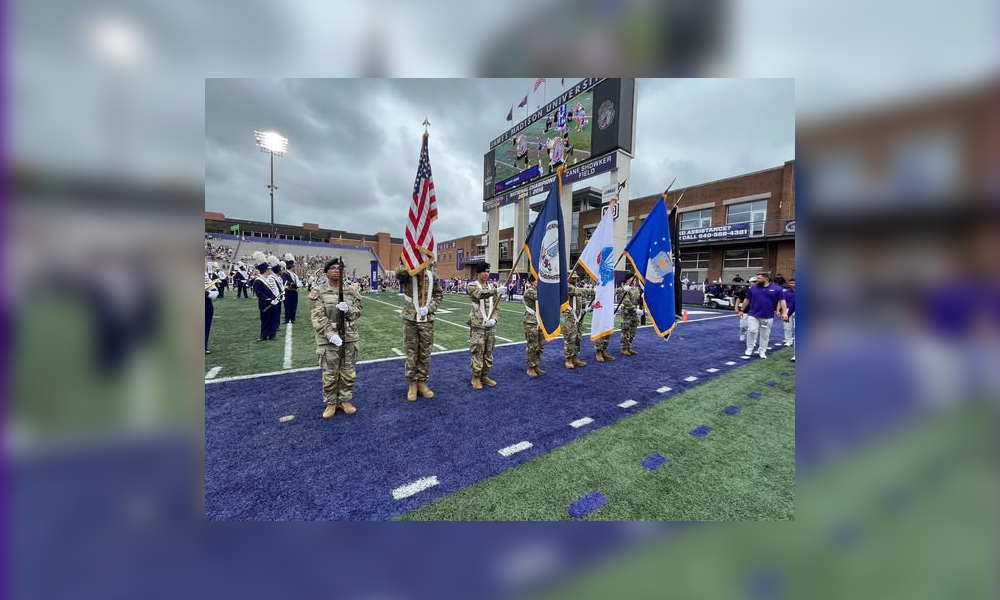
Outside of training, cadets remain actively engaged on campus and in the broader community. From leading ceremonial events and participating in game-day traditions to organizing service initiatives, they represent JMU while building the leadership presence expected of future military officers.


