

Inaugural summer Global Academy brings the world to JMU
Featured Stories


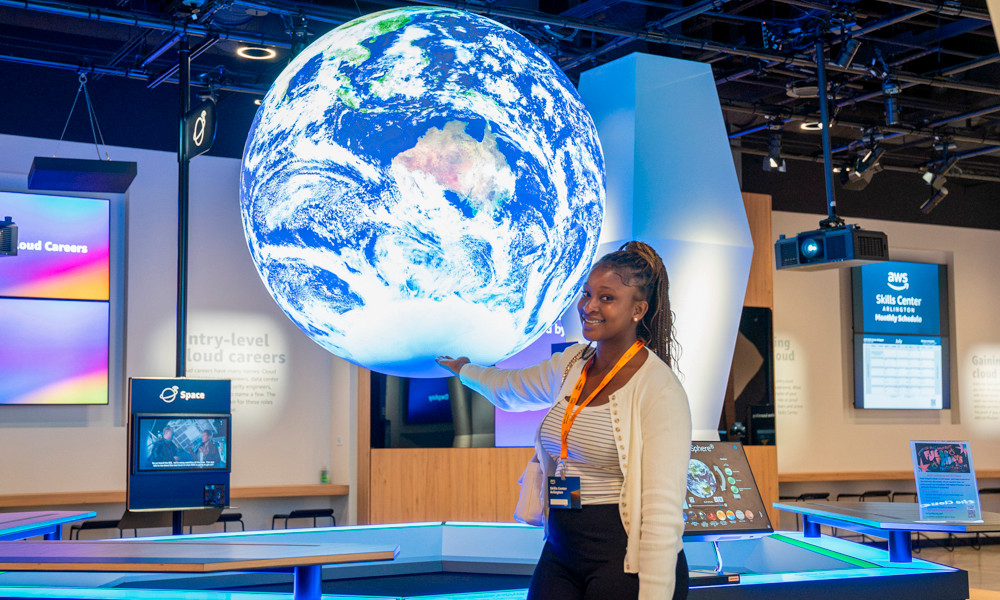
SUMMARY: JMU's Global Academy for Future Leaders program brought together visiting students this summer from partner universities in the U.K., China and South Korea to tour the region and work alongside JMU peer interns on innovative projects focused on using Artificial Intelligence to make lives easier.
DaYoon Lee, a 23-year-old Clinical Pathology major from Kyungdong University in South Korea, was excited to study in the U.S. for three weeks this summer as part of JMU’s first Global Academy for Future Leaders.
“It’s been a really good opportunity,” she said. “I’ve really enjoyed it. I’m thankful for JMU.” Lee, a senior who has also spent some time living in Toronto, Canada, was looking forward to working on her English skills and making new friends. “Even if we have really different backgrounds or culture and a different religion, we can communicate with one another.”
For Shuran “Susan” Ye, a 21-year-old Business English major from South-Central Minzu University in China, the three-week program flew by.
“What stood out to me most is the diversity because we work with different people from different countries and have different backgrounds, but we work together,” she said. “It’s very fascinating and excellent.”
As two of 22 students who participated in the program this summer, Lee and Ye joined students from around the world in learning from an immersive multicultural setting. The Global Academy served as an opportunity for students from China, South Korea and the United Kingdom to visit the U.S. during the summer holidays, while encouraging JMU students and summer interns to learn from the visiting students.
“Not everyone can study abroad,” said Dr. JY Zhou, associate provost for international initiatives and executive director of the Center for Global Engagement. “We bring the world to JMU.”
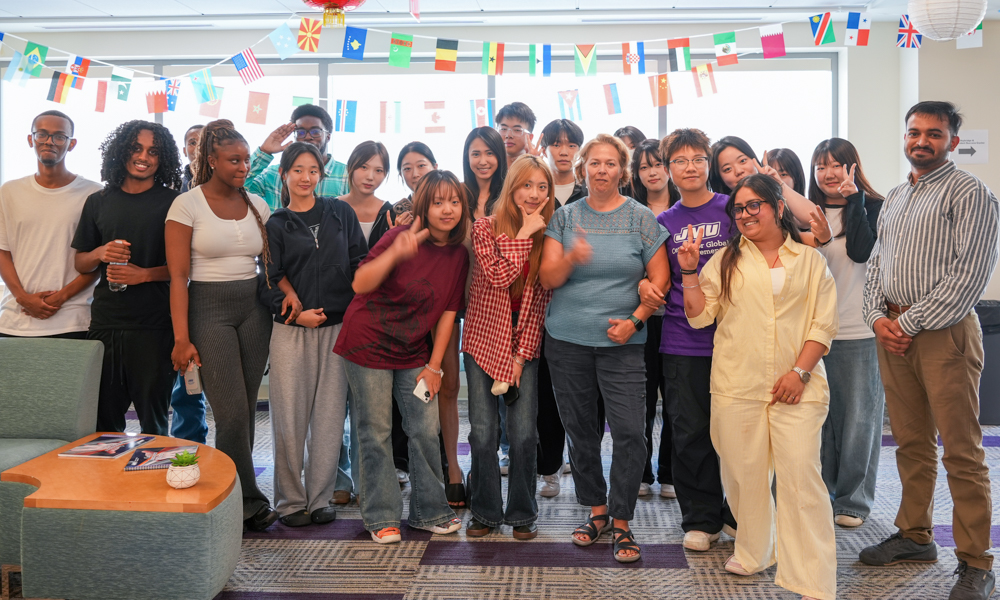
The inaugural three-week program, hosted by the CGE, welcomed global participants from Kyungdong in Korea, South-Central Minzu in China, and Kingston University in England for discussions on the topic of Artificial Intelligence and the Future of Learning.
Zhou, who led the formation of the Global Academy, says she was motivated by the idea of bringing more international students together with JMU students to work in collaborative settings. “I wanted to really create this shared learning space so we can talk about a topic that everyone is interested in,” she said. “We are creating a global community here.”
Throughout July, students toured the region, met with professionals who are using artificial intelligence in the workplace and collaborated on team projects to solve issues using AI.
Ye, who has traveled in Europe and visited Singapore, says she wanted to come to the U.S. specifically to learn more about advanced AI technology and how it differs from what she’s learned in China. “I came here not just about studying AI but also to create my own path for my majors with the help of AI, so I think it’s a very great opportunity to learn some differences,” she said. Though stressing that she and her fellow students aren’t experts at using AI, she says the summer academy allowed her to work in a simulated environment that made her feel like a professional.
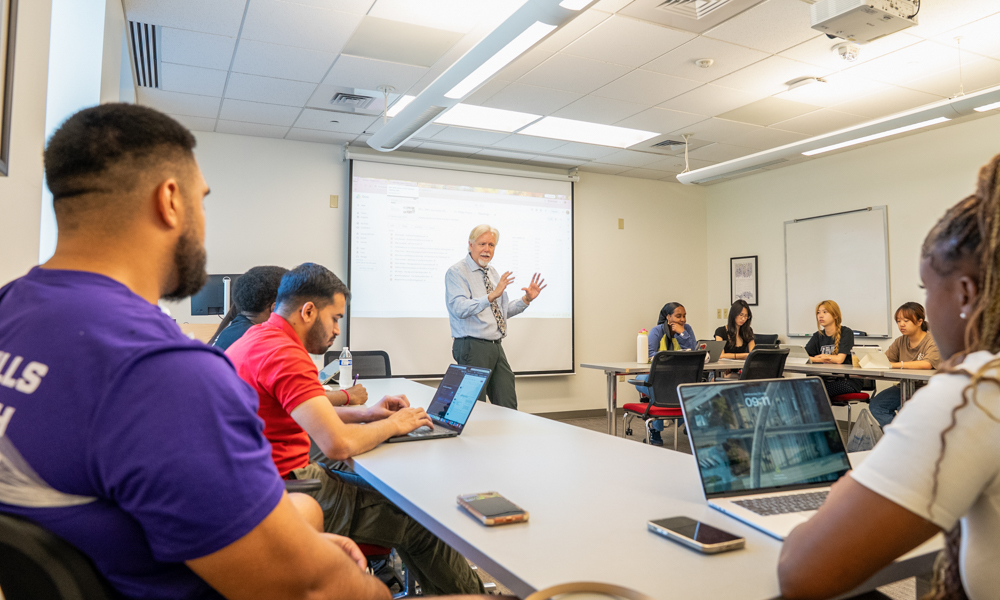
She also enjoyed hearing opposing ideas about AI from JMU professors Dr. Phil Frana, professor of interdisciplinary liberal studies in the Independent Scholars and General Studies programs, and Dr. Muhammad Ittefaq, an assistant professor in the School of Communication Studies.
While Frana took a more optimistic viewpoint of AI’s uses, Ye was grateful that Ittefaq, who lists one of his areas of expertise as “AI, conspiracy theories and trust,” offered a more critical viewpoint about AI.
“I think the classes, the teachers, they think in a really different way,” Ye said. “They have opposite attitudes, but they give you the different aspect toward AI. You can see it in a balanced way.”
Bryan Beugre, 23, a law student at Kingston University, worked on a group project that used AI to help address housing availability in the U.K. The goal, he says, was to shape a better Britain and provide a safer place to live using AI-generated designs and projections on the best places to build additional properties.
“What I took from the program has to be resilience and also just putting yourself out there,” Beugre said. “Before coming here, I was very nervous to speak in front of people. My culture might be different to other cultures I’m not used to seeing every day. And it was really a step out of my comfort zone, just seeing how easy it is to be around other people.
“When you live in one certain part of the world,” he said, “you don’t see other people, how they live, how they grow up, and it’s nice to just be in a place where we can celebrate each person.”
Andrea Nutter, assistant director of global learning and partnerships, says organizers are aiming for a larger group in future summer sessions. “This number is perfect for the inaugural group,” she said, but “I’d really like to see other partner universities join as well. We had a lot of interest from other partner universities that weren’t able to come this summer.”
JMU participates in numerous international-exchange programs, welcomes hundreds of international students each year, and regularly partners with various other universities. It’s also the only American university in the International Network of Universities, a global consortium founded in 1998, currently composed of 12 members. Other partner schools in the INU are based in Argentina, Germany, Indonesia, Japan, South Africa, Spain, Sweden and Ukraine, with two in Germany and two in the U.K.
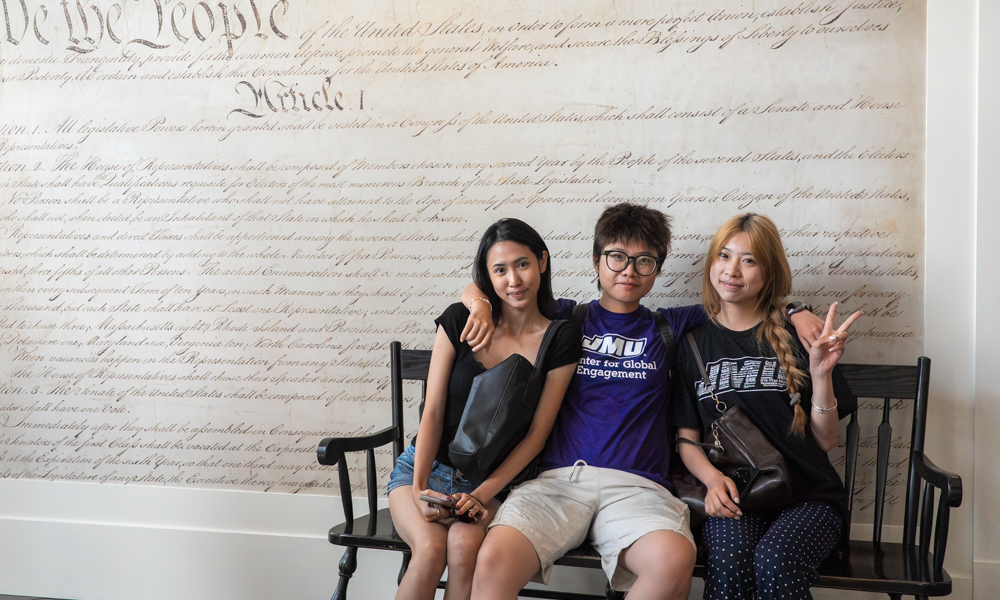
The Global Academy supports The Madison Promise through its focus on the study of AI and JMU’s efforts to enable every Duke to have a study-abroad opportunity, multicultural experience, or internship by the time they graduate. The academy also touches JMU’s goal of becoming “a preferred partner” in Virginia and beyond.
Dr. Corey Hickerson, director of global learning and curriculum internationalization and a professor of strategic communication and public relations, says the Global Academy stresses building a multicultural atmosphere while teaching students about leadership on a global platform. The academy asks participants, “What does it mean to be a leader in a world of AI?” he said. “I was hoping for them to learn about AI, about its potential and its problems, and then I wanted them to learn about the U.S. And I wanted them to learn about each other’s cultures.”
As a whole, they were successful in all those goals, Hickerson says. “They learned to live together in the Grace Street Apartments.”


