

Ghana delegation’s visit focuses on continued partnership
Featured Stories


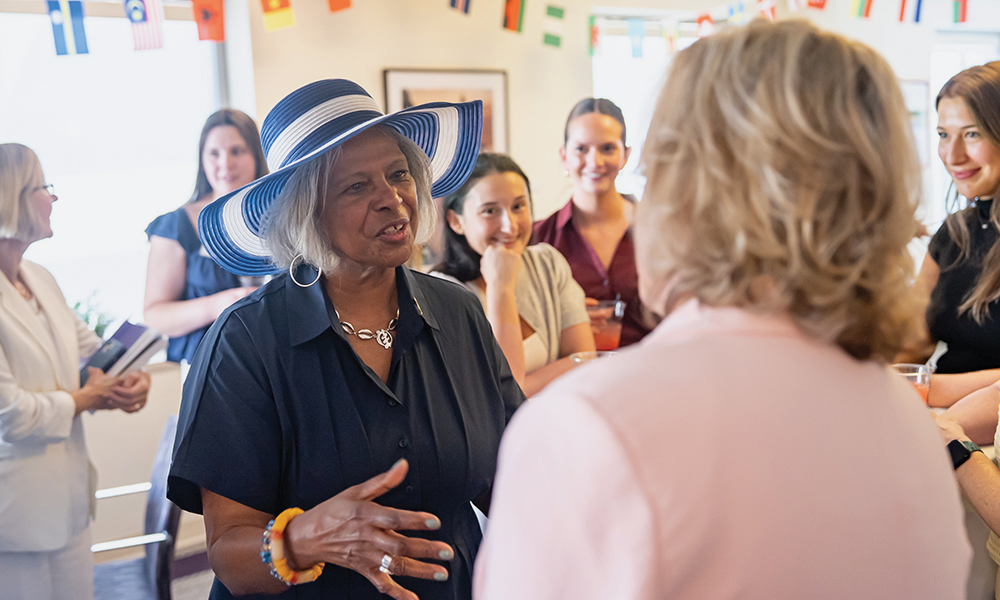
SUMMARY: Former U.S. Ambassador to Ghana Pamela Bridgewater and Her Excellency Deputy Ghanaian Ambassador to the United States Jane Aheto visited Harrisonburg in mid-April to discuss JMU's expansion of study-abroad programming in Ghana.
Hear more episodes and subscribe to the podcast at the Being the Change podcast page.
During a recent visit with two ambassadors, JMU leadership asked a question they hope will help grow Madison’s educational programs on the world stage: Why Ghana?
On April 15 and 16, former U.S. Ambassador to Ghana Pamela Bridgewater and Her Excellency Deputy Ghanaian Ambassador to the United States Jane Aheto met with students, alumni and faculty to discuss how JMU might further its relationship with Ghana through various study-abroad efforts and onsite plans in West Africa.
During their visit, Bridgewater and Aheto spoke with student leaders and international students from Ghana; heard a presentation from JMU’s Ghana Leadership Team; learned more about JMU’s overseas efforts; and attended a book signing of Bridgewater’s memoir, Bridging Troubled Waters.
The main topics of discussion were how to build on JMU’s existing efforts to strengthen partnerships with the Ghanaian and U.S. governments — and how to ensure these endeavors will be funded well into the future.
Aheto thanked the students for their feedback and their interest in visiting Ghana.
“[I] appreciate the fact that you were courageous enough to go to a new place ... and come back still happy about the place that you visited,” she said. “I know that a lot of people have all kinds of warped ideas about Africa. So, you could have decided to go to another place, but you went to Ghana. And I am happy to know that it was a good experience for you.”
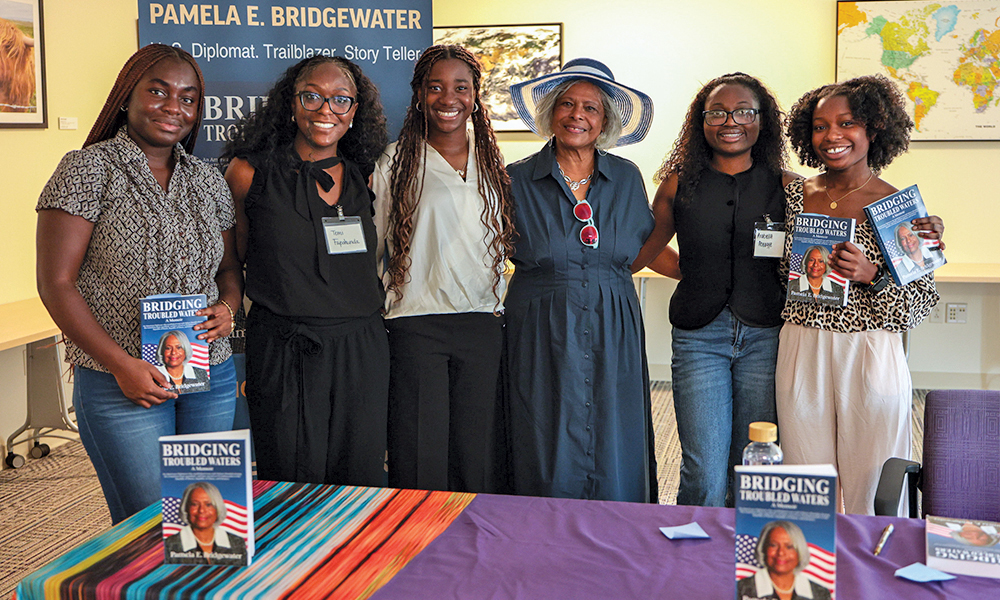
— Photograph by Xavier Chevrier (’25)
JMU’s study-abroad efforts in Ghana started in 1996 with Dr. David Awusu-Ansah, a history professor for nearly 40 years and director of the four-week study-abroad Ghana Summer Program and Internship.
Meanwhile, in 2003, Charles May Jr. (’83), Devena McLaurine (’86) and Derek Steele (’84) founded the Ole School Alumni Scholarship Group in hopes of better supporting first-generation students at JMU. In 2005, the engaged alumni group formally became a 501(c)(3) organization. The OSASG’s mission is “to serve as a continuing external force multiplier alumni group” that enhances and creates superior outcomes at JMU, the group’s website explains. OSASG offers student support under six pillars:
- Recruitment, with a $600,000-plus endowment
- Scholarship, with 47 scholarships offered in 2025
- Mentorship to 460 student contacts last year
- Internship, with more than 75 referrals with industry inside and outside of the Ole School network
- Job placements: They assisted and referred 25-plus employment opportunities for the JMU student cohort
- International and community engagement: In 2025, they provided financial assistance to five students participating in study-abroad programs, and OSASG provided over $100,000 in student support to JMU students.
About five years ago, the OSASG reached out to Awusu-Ansah to partner with the Ghana Program. Around the same time, JMU Provost Dr. Bob Kovoord contacted OSASG to begin plans for keeping the program going after Awusu-Ansah's retirement. The result of these conversations was the Ghana Experience, which provides various ways JMU can partner with the nation, including a three-year pilot program led by the OSASG and Owusu-Ansah.
Through the pilot program, the team offers three study-abroad trips to Ghana each year: a two-week winter nursing program; a four-week summer study-abroad program; and a three-week internship. As a continuing effort through Owusu-Ansah’s previous study-abroad program, the Ghana Experience is designed to answer the question “Why Ghana?” and demonstrate sustainment and recruitment of a university-sponsored Ghana effort, May explained.
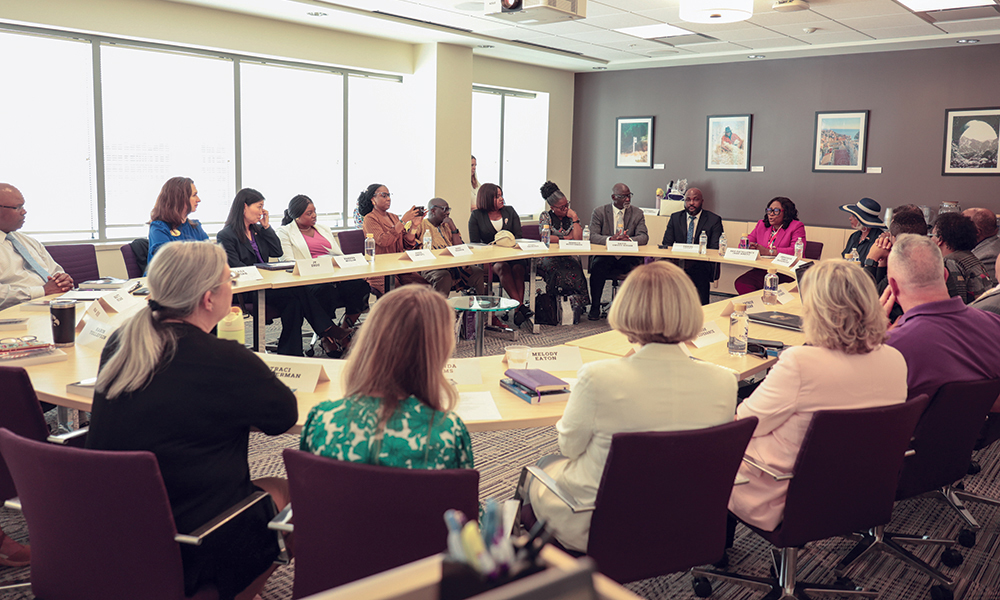
In addition to Steele, OSASG president; May, immediate former president; and Owusu-Ansah, the Ghana team includes Dr. Leonard Richards, assistant professor in the College of Education; Dr. Delores B. Phillips, English professor and director of the African, African American, and Diaspora Studies Center; and Art Dean, an associate vice president at JMU who has oversight over the Office of Equal Opportunity.
So far, the Ghana Experience has been a huge success, said May, operational co-leader of the Ghana Experience.
“If you’re talking about innovation, you’re talking about partnerships, you’re talking about any of those things, we feel like the effort that we’re making in Ghana demonstrates that in all areas,” May said. Asked about the student experience, he said, “I’ve not spoken to any student that has participated in the Ghana study-abroad program, that has not said, verbatim, ‘It changed my life.’”
That was the case for senior Nursing student Amanda Zanfardino, who attended the two-week study abroad trip in January. “I can absolutely say that it changed my life in every way possible,” she said.
“The people there made the entire trip,” said senior Nursing student Makenna Haag. “The relationships, like Amanda said, absolutely unreal.”
Along with their cohort, Zanfardino and Haag met a group of nursing students from Ghana and have kept in touch with them ever since.
“They wished us good luck on our exams, and we wished them good luck,” said senior Josephine Maschio. “Even though we’re so different, we were able to find our similarities and relate to each other, and we all just became such close friends. I would personally have any of them stay at my house, if they wanted to.”
Zanfardino agreed: “I wish they were here with us right now.”
The connection students forge through the Ghana Experience is exactly what organizers hope to encourage, Steele said. “On the United States side,” he said, “there are all kinds of different things that people say about Africa, whether they’re true or not true. But until you go, you don’t know.”
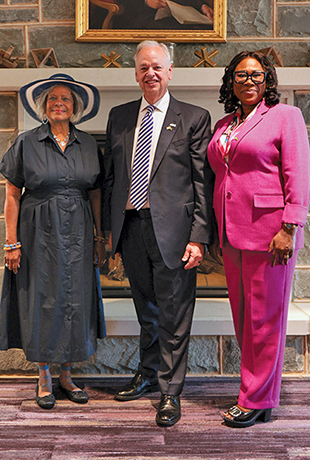
President James Schmidt meets with Bridgewater (left) and Deputy Ambassador Jane Aheto. — Photograph by Xavier Chevrier (’25)
Steele, who has visited Ghana as part of the leadership team, said the pilot program brought corporate partners to West Africa last summer and will bring President James C. Schmidt and other JMU leadership to Ghana this summer.
“We want to give them the feeling that we got,” Steele said. “We want them to understand how powerful this program is. We want them to understand and make the connection ... not just ‘Why Ghana?’ but ‘Why JMU with Ghana?’ And build those bridges.”
As part of its efforts in Ghana, the School of Nursing has Memorandums of Understanding with three universities: the Garden City University for nursing and midwifery in Kumasi, Ghana; University of Health and Allied Sciences in Ghana, in the city of Ho; and the Methodist University of Ghana.
Three years ago, JMU expanded its MOU to fully engage the University of Ghana’s School for the Performing Arts and the Institute of African Studies, founded in 1961 at the University of Ghana. Phillips said the partnership could allow for a cross-cultural student performance on the world stage. The team is also working on plans to open a Ghana Center Gateway to Academic Excellence in West Africa.
“This is our ultimate end goal,” Phillips said. “We want to create a center at the University of Ghana or aligned with the University of Ghana ... And that particular center will be the hand-in-hand partner with AAAD to provide services to students, to facilitate exchanges, and to make sure that all of our partnerships with the university in terms of the lectures that we bring remain robust and expand those partnerships across Ghana so that we can bring students a really, really rich experience and we can facilitate it smoothly and with a great facility.”
The Ghana Center, May said, “will be an enhancement of all the things that we’ve done in the previous 30 years under David Awusu-Ansah and provide more capability, not just for JMU, but for all academic institutions that are seeking partnerships, initiatives and activities in Ghana. We want to kind of be the introductory program that gets them all of the things that they need as they proceed throughout the continent.”
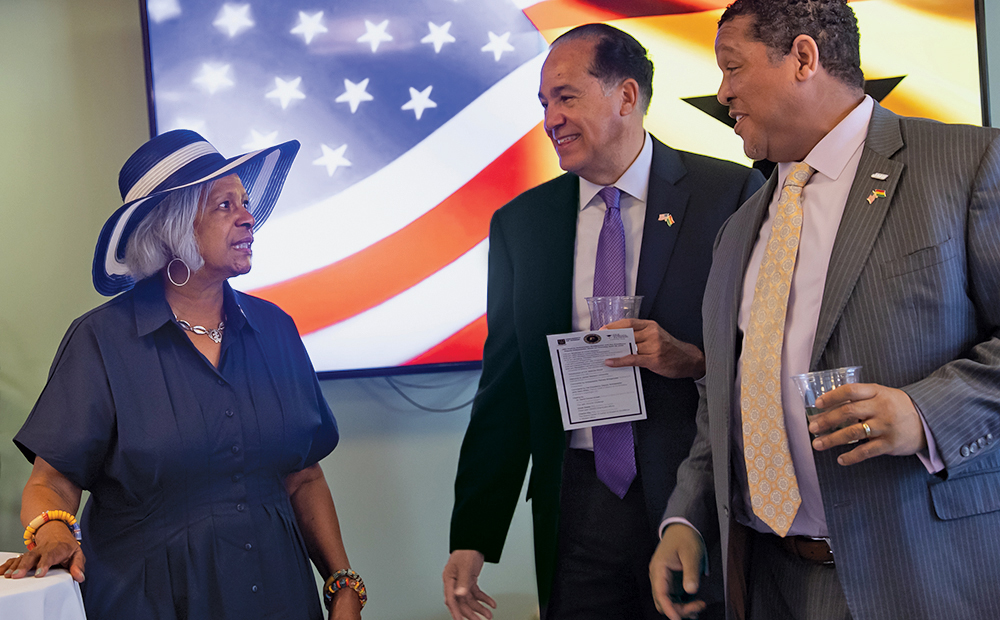
Adding her own twist on the question of “Why Ghana,” Bridgewater asked students, “Why should JMU, as a university, invest in study-abroad in Ghana? ... We know that the Ole Schoolers put money in it, individuals have put money in it. ... What would you say to the university as to why it should continue it? I understand they’re spending money to support study abroad in the U.K. and in Italy — Florence and London. Why should they spend money for you to study in Ghana?”
Senior Nursing student Ciara Gannon responded, saying that visiting Ghana gave her a new perspective, especially since she had also done a study abroad in London.
“I think I got a lot out of going to Ghana,” she said. “Such an amazing culture. I’ll never forget how nice everyone there was to us, and so welcoming. Sometimes you just see the world one way, and you need to actually have those experiences to get a different perspective. It’s one thing to hear about it; it’s another thing to actually experience it yourself. I think it’s important that more people go to these places and get that perspective.”
Aheto praised the study-abroad students for educating her on topics she can bring to the embassy. “You are in communities where we are not,” she said. “Your experiences will help bring together the global community and the discussions about Africa, about Ghana, and the places that you’ve been.”
Likewise, Steele told students, “Your voice matters to the university. It changes the university’s perspective on what you need.”
“When we first decided that we were going to invite the ambassador, this is what we envisioned,” May said. “That’s what my hope would be, is that people coming to Ghana and through Africa would say willingly, ‘Hey, I know what I know, but I’m coming here willingly to learn what I don’t,’” May said. “No matter how intelligent you are, you don’t know everything. And the best way to be educated is through exposure, willing exposure — partnerships, networks, all of those things that you can then do and become if you allow yourself to be.”


