

Beyond the rocket
Lessons that will shape engineering students long after NASA Student Launch.
News


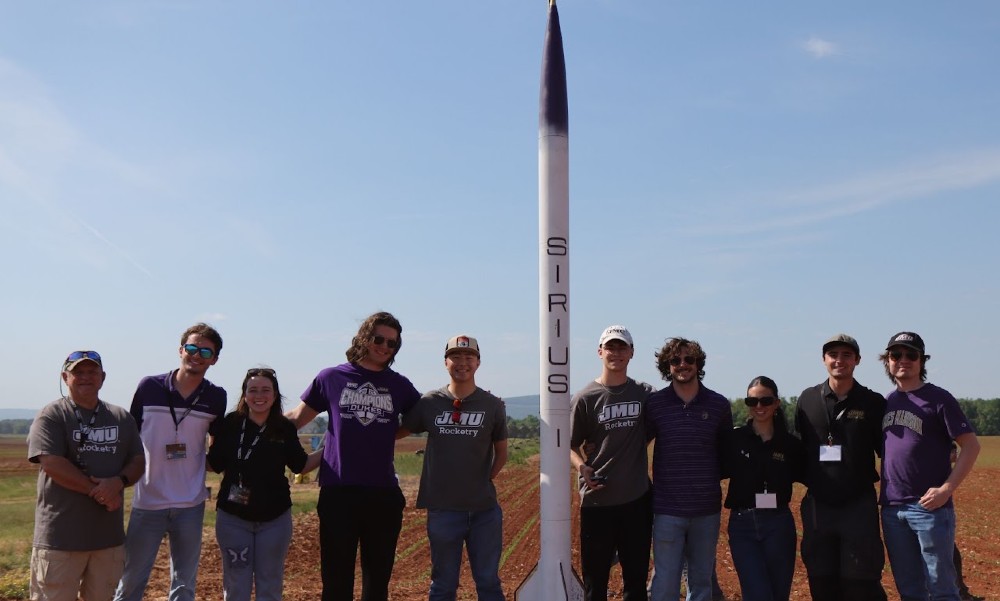
SUMMARY: A yearlong NASA Student Launch project taught 10 JMU engineering students lessons in teamwork, leadership and resilience.
Stories about JMU Engineering students often begin with what they build – a rocket, a medical device, a software application or a competition-winning design.
Those achievements matter. They represent months of design, testing and problem-solving. But the most important outcome of an engineering education isn't always the finished product. It's the ability to collaborate with people who think differently, navigate disagreement, adapt when plans fall apart, communicate ideas clearly, lead when needed and keep moving forward after failure.
For the 10 seniors on JMU's Sirius I team competing in the 2025–26 NASA Student Launch Initiative, those lessons became just as meaningful as the rocket they launched.
The team placed ninth overall and received the American Institute of Aeronautics and Astronautics (AIAA) Reusable Launch Vehicle Award, which recognizes creativity and innovation in designing a safe, efficient and reusable rocket.
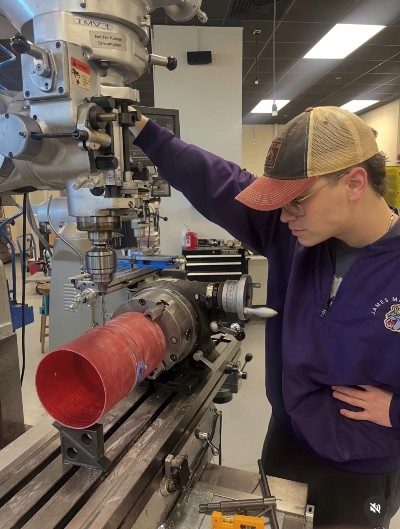
in JMU Engineering’s machine shop.
Jackson Lambert (’26), the team’s outreach lead, said the award reflected months of engineering decisions, testing and refinement.
To accommodate the rocket’s unusually heavy nose cone, the students developed a triple-deployment recovery system that included an additional small parachute to help stabilize the nose cone during descent. They also constructed the rocket almost entirely from fiberglass, carefully documented the materials, measurements and manufacturing methods used throughout the project.
The durability of the design became clear during a test flight when a parachute malfunction sent the rocket falling approximately 4,000 feet in what Lambert jokingly called an “unplanned drop test.” Despite the impact, he said, the vehicle suffered no structural failures.
NASA Student Launch is a nine-month challenge that requires students to design, build, test, and launch a high-powered rocket while completing detailed technical reports and formal design reviews. Long hours, demanding deadlines and constant problem-solving tested the students’ relationships as much as their engineering abilities.
"Small disagreements in design, workload input and inconsistent results would slow the team down," Lambert said. "As the competition went on, we learned so much about each other. We learned to overcome our differences and progress like a real team."
While the engineering accomplishments were significant, the students gained something even more valuable. "Our team consisted of 10 complete strangers to start and ended up like a big family,” Lambert said.
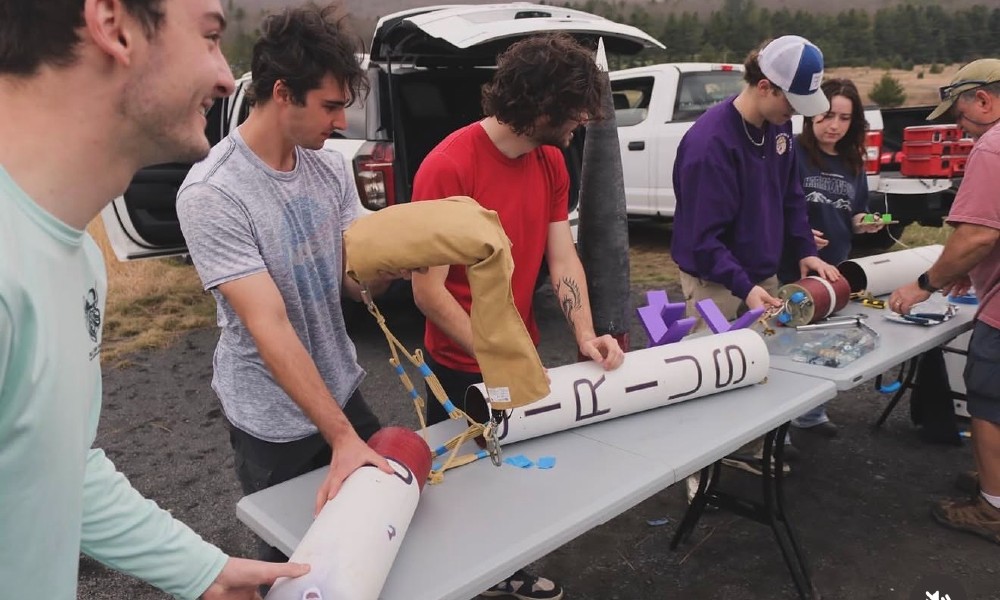
For Kimberly Carter (’26), the team avionics and recovery lead, those experiences reinforced the importance of communication. "The most important part about working in a team is open and honest conversations when things don't go right. This project put a significant amount of pressure on all of us, so it was only natural that disagreements and differences of opinion would occur."
"Being able to acknowledge when you make a mistake or be honest about your feelings makes the team significantly more cohesive," she added.
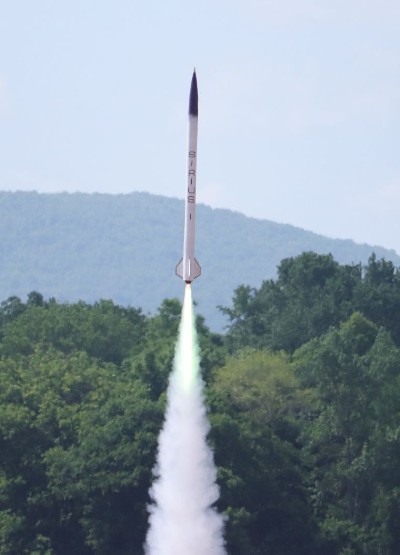
2025–26 Student Launch competition.
Carter regularly presented technical designs during NASA design reviews. Because the team's triple-deployment recovery system was unlike any previously used in the competition, she often found herself explaining complex concepts and answering detailed questions.“Being able to answer questions on the spot was nerve-racking, but it gave me a lot more confidence in my communication skills as an engineer."
Gabe Rohrbach (’26), the team structures lead, discovered that designing the rocket was only part of the challenge. Coordinating with the avionics and propulsion teams required just as much attention as designing the individual components. Every subsystem had to work together. “I learned that you need to trust your team,” he said.
The project also gave Rohrbach experience in computer-aided design, technical writing, manufacturing, project management and the engineering quality processes used throughout the aerospace industry. That experience ultimately helped him land a position as a quality engineer with Lockheed Martin Aeronautics. "The interviewers loved how I was able to describe my project management skills and communication methods," he said. "Those skills are difficult to teach."
“NASA Student Launch gives students an experience that is difficult to reproduce in a traditional classroom,” said Dr. Steven Woodruff, engineering professor and the team’s faculty advisor. “They must integrate multiple technical systems, defend their decisions in formal design reviews, meet demanding deadlines and respond when tests do not go as planned. The technical knowledge matters, but learning how to make sound decisions under pressure, communicate across disciplines and improve after failure is what prepares them for professional engineering.”
As the Sirius I team hands the project to the Empyrean I team, that lesson, along with many others, will carry forward. Engineering is about more than designing rockets. It's about learning to communicate, trusting your teammates, growing through challenges and discovering strengths you didn't know you had.


