Transforming community with virtual reality technology
Dr. Dennis Lo’s research examines our connection to place
Featured Stories


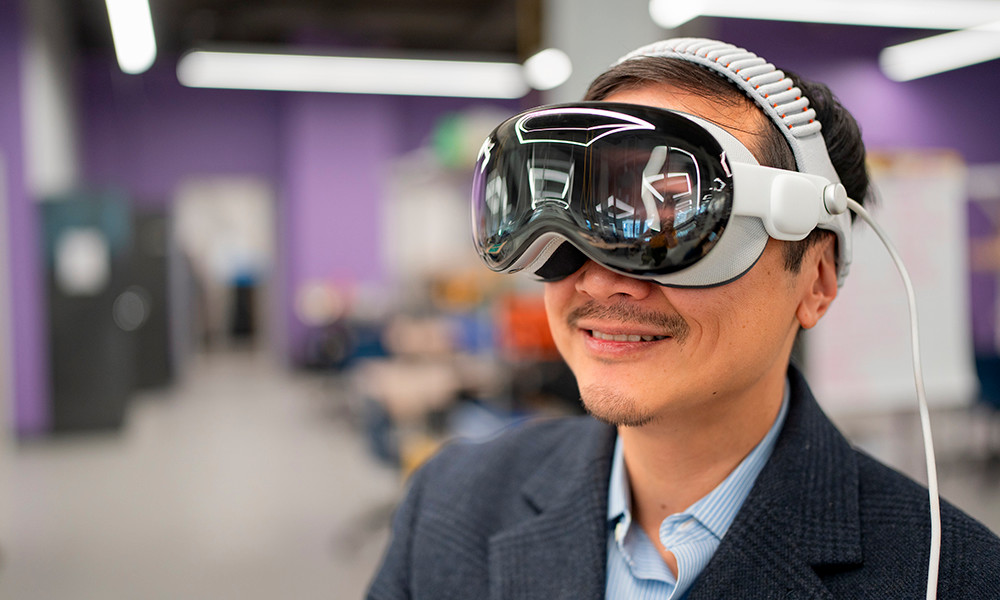
SUMMARY: Lo, who has created his own VR video-essay series, wants to use technology “to turn each space that we’re living in, that we’re working in, into a kind of everyday interactive museum.”
Dr. Dennis Lo developed a passion for cinema and film during his undergraduate years at Stanford University.
“I was fascinated with how using a camera could actually shape our perceptions about real locations in a very powerful manner,” said Lo, associate professor of global cinemas in the English department. His captivation drove him to create what he then coined a “locality film series,” now known as his Translocality Virtual Reality Series. The series consisted of short films that Lo shot in Taiwan, where he grew up. It’s also where the famous Taiwan science parks are located, replacing the familiar fields and traditional Chinese architecture.
“It was trying to capture, through the art of cinematography, the camera movements and all of that, what was going on with Taiwan’s really rapid modernization and development at that time,” Lo said. His locality film series was initially shot using traditional 2D cinema. After this experience, he considered applying camera technologies that could record in 360 degrees, capturing everything within the environment.
“Could that become an even more powerful way of understanding how the identity of a place changes over time?” Lo asked. “And that was the premise of this new series.”
Lo has created a VR and video-essay hybrid for his Translocality VR Series. VR helps the user immerse themselves in and interact with narratives, typically through a headset that provides “basically 360 degrees of fully digital content,” Lo said. He defines a VR video essay as “using the imagery and the footage captured from within a VR headset to make arguments about what is unique, special and different about this new, emerging medium.”
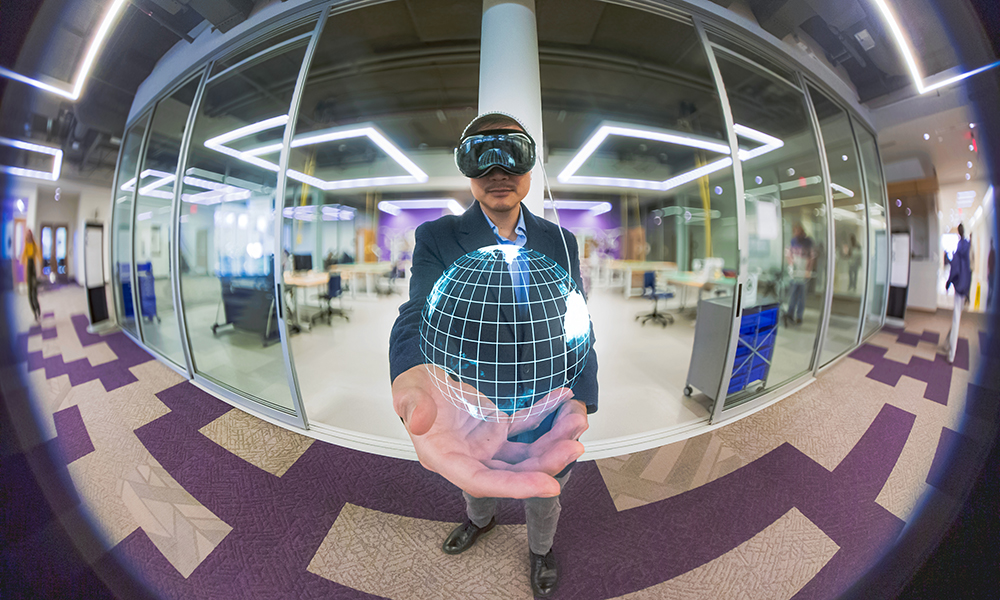
Since Lo’s central research is at the intersection of environment and media, he finds himself gravitating toward films shot in real places, “like outside the sound studio, in real communities and real settings.” Lo has even placed 360-degree cameras in his home in Charlottesville, Virginia, and other places that feel intimate to him, where he’s noticed notable changes over time. “I wanted to see and experiment with how using a 360-degree camera changed the way I felt toward those places, and hopefully through this set of experiments, I would be able to better understand how 360 VR cinematography could capture those kinds of changes,” he said.
Lo compares his research and experiments to participatory, immersive theater. “You’ve turned the environment into a place you could edit, that you could actually shape and control, and it gives you a sense of power in a way,” he said. “A film student is not just learning how to architect reality by telling stories, by designing sets, by using the camera. You truly are manipulating the world when you are seeing it through that lens, through the headset.”
Lo’s main objective is to use technology to amplify people’s connection to place — “to turn each space that we’re living in, that we’re working in, into a kind of everyday interactive museum.”
“What if our everyday life was also partly like that?” he asked. “That it had more context built into it, that it had more histories and other voices?”
Lo says these technologies can be used to create immersive learning experiences. Dukes could use mixed-reality glasses, for example, to reimagine buildings such as Carrier Library. Mixed-reality technology merges physical and digital environments, allowing them to coexist and interact in real time.
“Instead of just basically seeing updates of [Carrier] over time or little exhibits showing what was before, [or] what is it now, you walk around with these glasses, and as you turn your head around, you see portions of the old building,” Lo described. “As you get closer, a description appears or a video appears explaining to you the design process that tried to respect the past but also tries to move JMU into the future. Basically, it helps to create a much more mindful experience of our campus.”
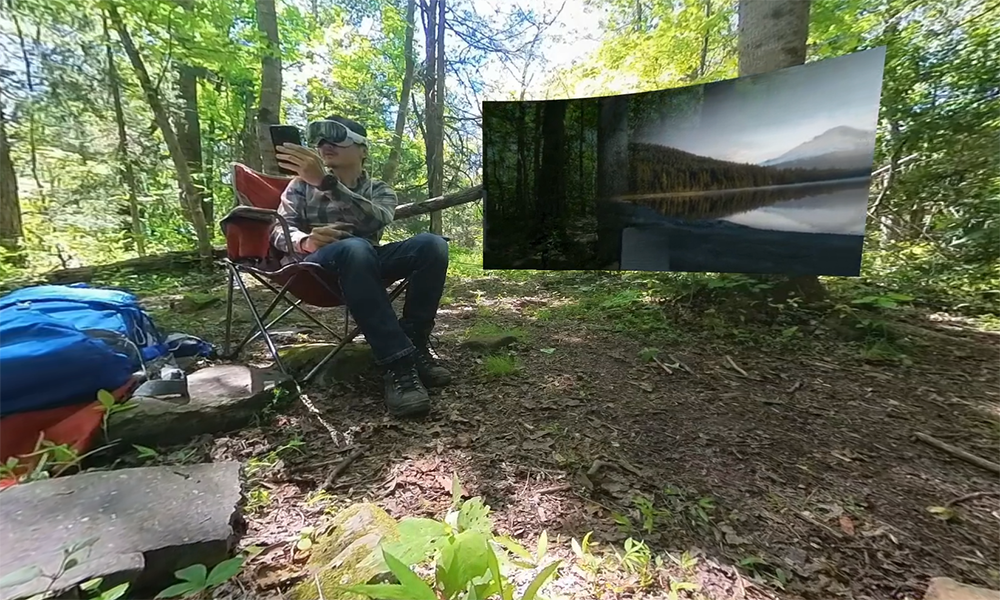
Lo mentions the possibility of the devices providing testimonials and recollections of the space from real students and alumni. “You go in realizing this is not just any library; this is Carrier Library that I’m truly in. It goes from being a space into becoming a place,” he said.
Lo further connects his research to JMU’s strategic plan, The Madison Promise, which includes the goal of creating an innovative campus community. “There’s going to be emphasis on really providing more housing, more on-campus experiences,” Lo said. “What makes a college experience, an on-campus experience, special is the human connections. It’s the relationships that you form, the interviews that we have in rooms such as this, and those things are irreplaceable. No matter how advanced your AI is,” Lo said.
He hopes that the introduction of mixed reality is a way for people to move what matters most from the background to the foreground. “Memories and stories, emotions and archives. Those are not things that could be curated by machines,” Lo said.
“They might help us to design some of the algorithms,” he said of AI. “But who gets to decide? What are the memories? What are the stories? What are the descriptions that go into these experiences? It’s the students; it’s the faculty.” He describes the act of co-creating something like this “a deeply human venture.”
Lo’s ultimate goal for mixed-reality technology is to help people stay present. “It also shows us that we have a role to play in shaping community in a way that AI could never replace,” Lo said. “We are developing emotional infrastructure.”