JMU chemist, students explore hidden world of cave microbes
At Grand Caverns, Dr. Lindsay Caesar is searching the darkness for clues that could lead to new medicines and environmental solutions
News


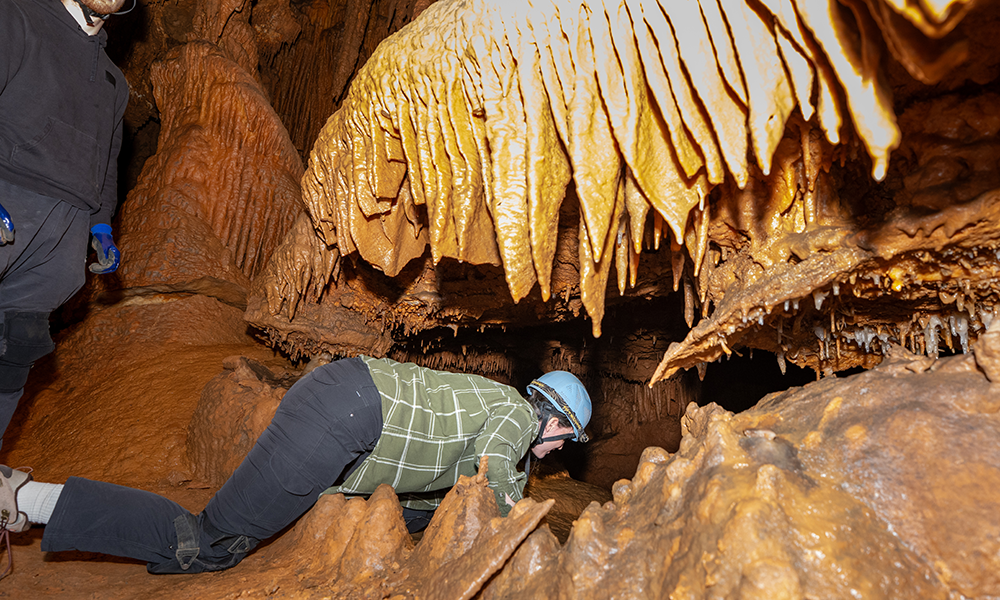
SUMMARY: Chemistry professor Dr. Lindsay Caesar connected with Grand Caverns shortly after arriving at JMU in 2022, hoping to provide her students with an opportunity to conduct research with the potential for broad impact.
For 200 years, Grand Caverns in Grottoes, Virginia, has hosted guests eager to see the wonders of an underground world filled with stalagmites, stalactites, and other rock and mineral formations not found above ground.
JMU chemistry professor Dr. Lindsay Caesar has spent the past four years taking her research students to Grand Caverns to look for something else, something most tourists never notice: microbes.
“Usually, people think of caves as being these lifeless places where nothing can survive, but there’s actually a lot of microbes that live everywhere in the caves,” Caesar said. “The microbes that are in the caves are really extreme. They can survive complete darkness, very low nutrients and a lot of the time the way they are able to survive in these extreme environments is through making really interesting, weird chemistry.”
While some of the microbes fluoresce under ultraviolet light, Caesar is more interested in what they might be capable of doing than how they appear. “We currently have over 100 strains of fungi or bacteria from the caves, and we’re testing them for things like anticancer activity, antimicrobial activity and an ability to potentially bioremediate heavy metals,” she said. “I’m looking for molecules from nature that can be useful for human medicine.”
The approach has a long history of success. Penicillin, perhaps the most famous example, originated from a naturally occurring fungus. Today, Caesar notes, roughly two-thirds of medicines are natural products or are derived from them.
What excites her most is how much remains undiscovered. “When I first came here, I said we needed to start our collection. We went outside to a tree right behind the chemistry building and gathered some soil, and one of the fungi in that soil seems to make 20 to 30 new peptide molecules that we think have potentially antimicrobial properties,” Caesar said. “I feel like there’s a ton to be discovered even in these common environments. When you get into an extreme environment, we’re really looking at something completely different that people aren’t looking for.”
Armed with ultraviolet flashlights, Caesar’s students scanned the cave walls for signs of microbial life and collected samples using a technique familiar to anyone who remembers the COVID-19 pandemic.
“It’s kind of like doing a COVID test,” Caesar said. Using sterile cotton swabs, students carefully collected samples and transferred them into vials before bringing them back to campus. Once in the lab, the samples were cultured in petri dishes, often revealing a surprising diversity of bacteria and fungi from a single collection site.
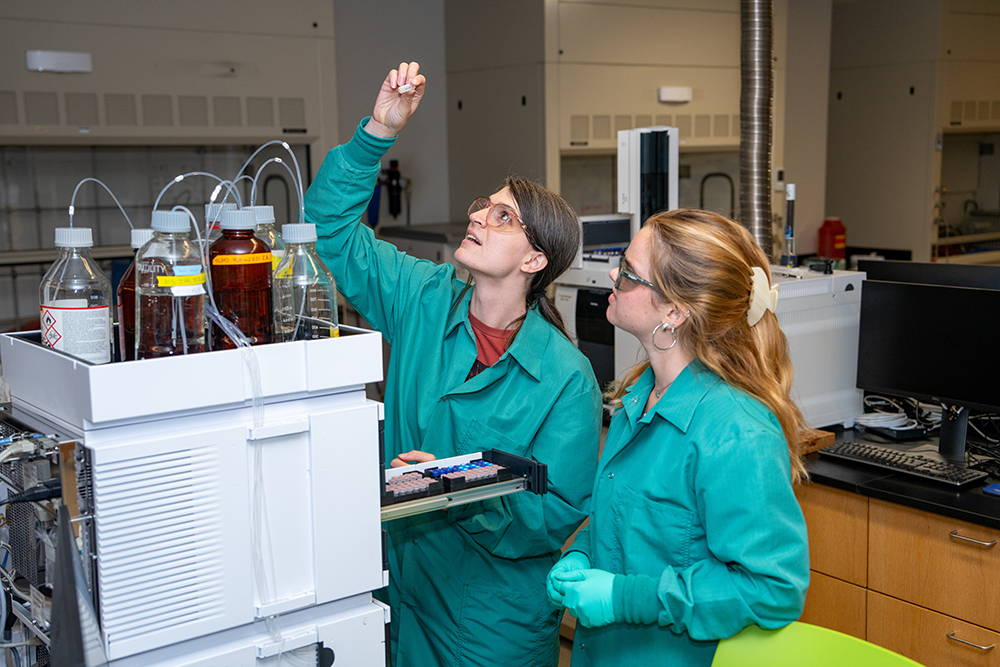
Caesar connected with Grand Caverns shortly after arriving at JMU in 2022, hoping to provide her students with an opportunity to conduct research with the potential for broad impact. One of her students spent this summer isolating DNA from microbes found in the cave to determine what they are and better understand their potential applications. Another worked to identify microbes that tolerate toxic heavy metals. “We’re hopeful they can remove cadmium from contaminated water and serve as bioremediators,” she said.
The possibility of discovery is exciting, Caesar says, but so is watching students experience it for themselves. “I love undergrads,” she said. “I love mentoring undergrads; I love the way that they think. They have sort of the beginner’s mind in a way that keeps them more open-minded.”
That enthusiasm extends beyond her research lab. Caesar is working to incorporate authentic research experiences into chemistry courses and recently submitted a grant proposal for a new general chemistry laboratory centered on Grand Caverns microbes.
Research may progress more slowly during the academic year, she says, but the discoveries will continue one step at a time.
Caesar also plans to expand her research into Fountain Cave, a neighboring cavern on the Grand Caverns property. While Fountain Cave is still accessible to the public via rugged adventure tours, it has avoided the heavy commercial development seen next door.
“Grand Caverns still has really interesting organisms, but it’s a show cave that people have been tromping around in for 200 years,” Caesar said. “It’s not as pristine as some of the others, so it will be a really interesting comparison.