

What’s next, America?
As the country marks 250 years of self-governance, JMU is asking the question the nation needs most
Being the Change


SUMMARY: The Madison Center for Civic Engagement’s Better Conversations Together program is turning the commemoration into a live act of democracy — one deliberation at a time.
By Dr. Kara Dillard, executive director of the James Madison Center for Civic Engagement, and Aidan Heitt (’24), director of the Better Conversations Together program
When delegates met in Philadelphia in the summer of 1787, they were not a harmonious group. They argued, threatened to walk out and held sharply incompatible visions of what the new nation should be. What James Madison helped forge from that conflict — through deliberation, compromise and the disciplined work of listening across difference — was a constitutional framework that has outlasted nearly every government on Earth.
As America prepares for its semiquincentennial, the James Madison Center for Civic Engagement is asking a question that gets to the heart of that legacy: What’s next, America?
We’re not asking rhetorically. JMU is engaging students in structured, facilitated, deliberative conversations about it — and we believe it may be one of the most fitting ways any university in the country is marking the anniversary.
A republic that forgot how to argue productively
America’s 250th is a natural moment to reflect on how far the country has come — and on what self-governance actually requires. Madison, Thomas Jefferson and George Washington understood that democracy demands people who can reason together, weigh hard trade-offs and engage honestly with views that challenge their own. Research suggests that today’s students are struggling to do exactly that.
The Knight Foundation has tracked college students’ attitudes toward free speech for nearly a decade, and the findings are sobering. While about 90% of students still say free speech is personally important to them, their confidence in the security of those rights has fallen 30 percentage points since 2016. Two-thirds of college students in the 2024 Knight-Ipsos survey reported self-censoring in class — holding back views on religion, race and politics — and two-thirds said that silence is actively diminishing the quality of their education. Students know they’re holding back, and they know it’s costing them.
The disengagement extends beyond the classroom. A 2023 survey by the Institute for Citizens and Scholars found that only 40% of Americans ages 18 to 24 could answer one of four basic civics questions correctly, and one in three had no intention of engaging civically in the coming year — not even by voting — despite 68% saying they believe their vote matters. Disillusionment and disengagement are rising together in the very generation that will carry the republic into its next 250 years.
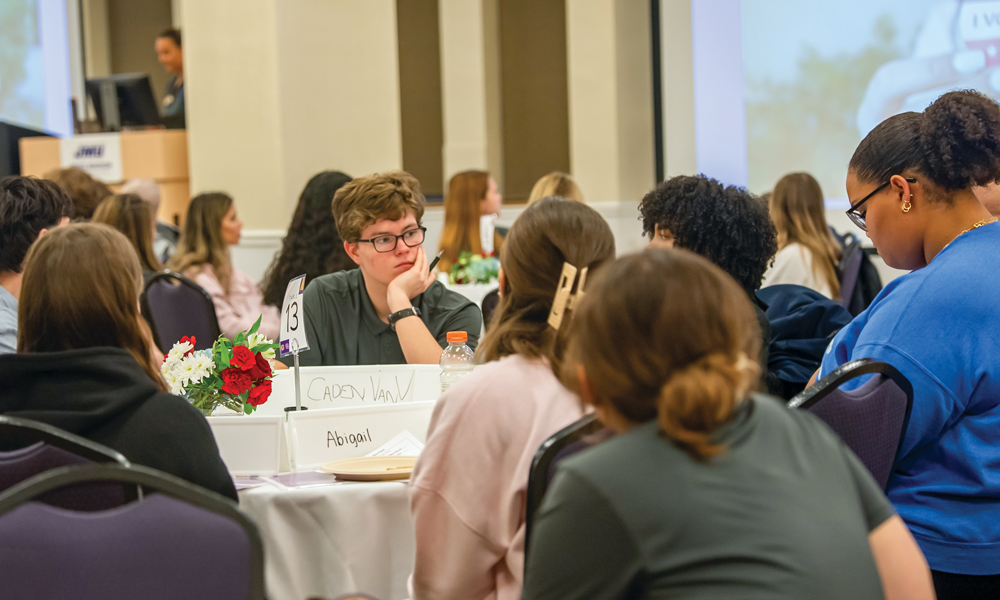
Deliberative practice can help. Engaging in structured dialogue gives students not only historical context, but the chance to build democratic habits: listening, compromise, conflict resolution and critical thinking. These habits cultivate what scholars call “civic efficacy” — the belief that one’s voice matters — which is essential for sustained democratic participation.
Asking the big questions, together
JMU’s response is Virginia 250: What’s Next America? — a deliberation-based initiative developed through the Madison Center’s Better Conversations Together program. It invites students and community members to do something deceptively difficult: sit together across their differences, and decide what kind of country they want to build next.
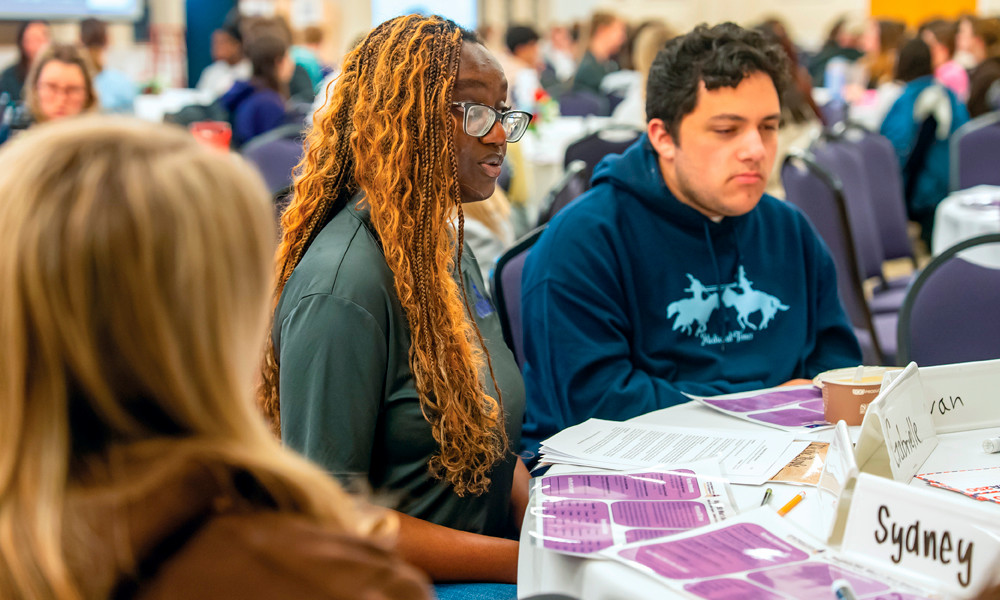
The deliberation is organized around four questions that move from reflection to action. Led by undergraduate Democracy Fellows trained in facilitating difficult conversations, participants engage in 90-minute, small-group deliberations intentionally composed to reflect a range of ideological perspectives.
The first question asks students to describe America as they see it today — not as they wish it were, but as it is — naming strengths and shortcomings, and building a shared vocabulary that surfaces the range of views in the room. The second asks which values and ideals from America’s past are worth carrying forward, while honestly naming the contradictions and costs those ideals have carried. The third turns toward the future, asking what new values the nation should adopt and what we would need to give up for them to take root. The fourth asks the hardest question of all: How do we realistically get there together?
That final question is where civic discourse most often breaks down, and where Better Conversations Together is most intentional. Students are asked not just to identify ideals, but to name trade-offs honestly: what a given value costs, who bears that cost and whether the group can commit to a shared action despite those tensions. The goal is to help students recognize that issues are rarely black or white, and that shared solutions require treating others’ perspectives as worthy of serious consideration. Participants leave not with vague goodwill, but with something concrete: one action they have agreed on and a collective vision for the next 250 years.
The skills behind the conversation
What’s Next America? is not a standalone event. It is an expression of a broader program that the Madison Center has been developing and rigorously evaluating. Better Conversations Together offers all incoming first-year students a required civic-discourse and deliberation experience, drawing on the Constructive Dialogue Institute’s research-based curriculum and a deliberation framework pioneered by the National Issues Forums Institute.
With assistance from the Center for Assessment and Research Studies, the Madison Center measures whether the program improves listening skills, intellectual humility and willingness to seek shared solutions — and whether it reduces affective polarization. The results indicate we’re moving the needle on all of these.
The country has taken notice. The Madison Center recently received nearly $5 million in federal grants — the largest competitively awarded in the university’s history — to expand Better Conversations Together to campuses in all 50 states and K-12 schools. Virginia’s former Secretary of Education, Aimee Guidera, called the work “both timely and essential, especially as we approach the 250th anniversary of our nation.”
The What’s Next America? discussion guide that participants work from opens with a simple reminder: “Every generation of Americans has had to decide what the nation should become, and that responsibility now belongs to us.”
At 250 years, the question is not only what we commemorate. It is the future we are willing to build together and whether we have the civic courage to have that conversation honestly. JMU and the Madison Center are showing the nation it’s possible.



