

JMU celebrates VA250 during Civic Education Week
Featured Stories


SUMMARY: James Madison University celebrated Virginia's contributions to the founding of America with a series of events in early March aimed at engaging and inspiring our community toward a more perfect union.
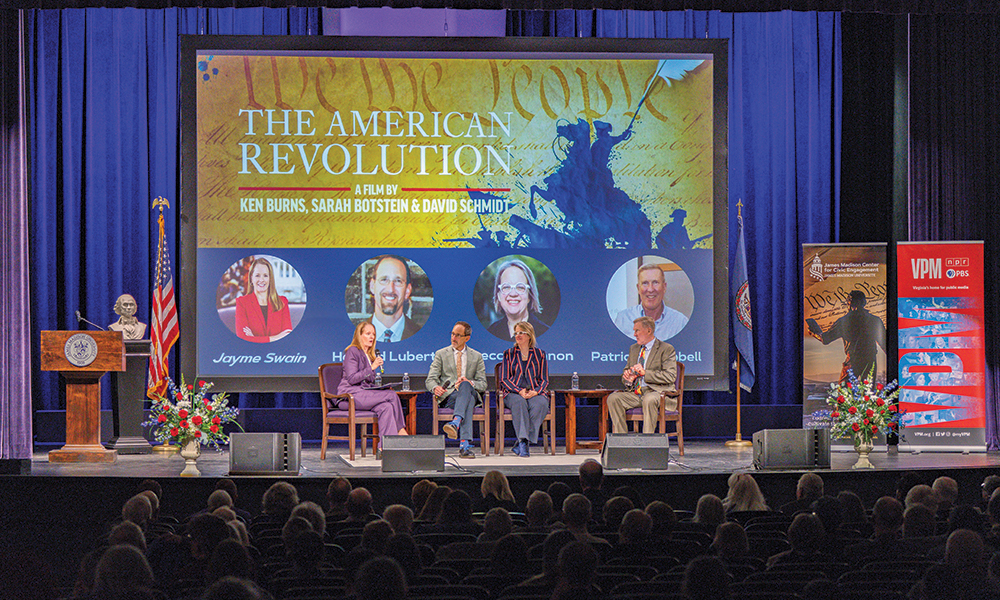
JMU kicked off a weeklong VA250 celebration on Monday, March 2, with a screening of Ken Burns’ film The American Revolution, followed by a panel discussion, in the Wilson Hall auditorium.
The event, hosted by the James Madison Center for Civic Engagement, drew students, faculty, staff and community members for an evening of deliberation and reflection ahead of the 250th anniversary of the nation’s founding.
Dr. Kara Dillard, the center’s executive director, set the stage by bridging America’s past and present. “It’s easy to assume that we live in uniquely divided times,” she said, “but the truth is that division and even violence has been part of America’s story since its beginning.”
The road to independence was undertaken by people who deeply disliked and distrusted each other, Dillard said. “And yet, despite their disagreement, Americans 250 years ago found a small spark that led to a common cause.”
And while the patriots were busy fanning the flames of revolution, it was a young James Madison who was leading the intellectual charge of freedom to its fullest, Dillard said. “Madison was asking probably the most important question: What would freedom look like and actually mean in practice for a diverse and pluralistic society?”
After viewing excerpts from Burns’ film, Jayme Swain, CEO of Virginia Public Media, moderated a panel discussion featuring JMU political science professor Dr. Howard Lubert, JMU history professor Dr. Rebecca Brannon and Patrick Campbell, director of the Robert H. Smith Center for the Constitution at James Madison’s Montpelier. The topics ranged from the colonists’ disparate views of war with Britain to the creation of a national identity to the founding fathers’ moral convictions.
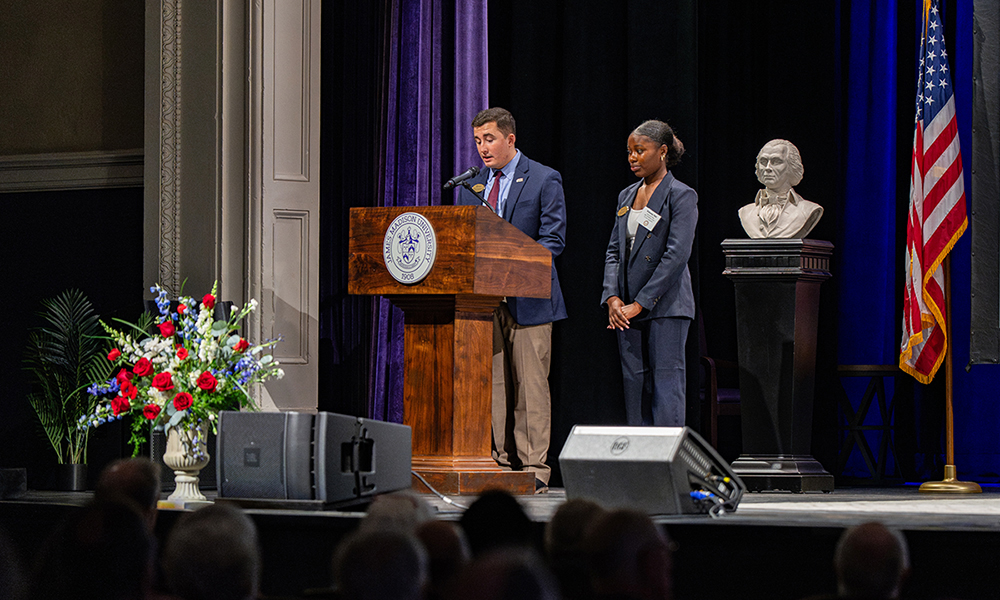
Kieran Fensterwald, a Madison Center Democracy Fellow and senior Political Science major, called on his fellow students in the audience to be civically engaged. “We are the ones who will take up the mantle of our democracy, and it is our duty to remain steadfast in our education and to make sure that we are enlightened and engaged citizens,” he said. “We ask that you think not only about what civic engagement means to you, but how you can best practice it in your daily lives.”
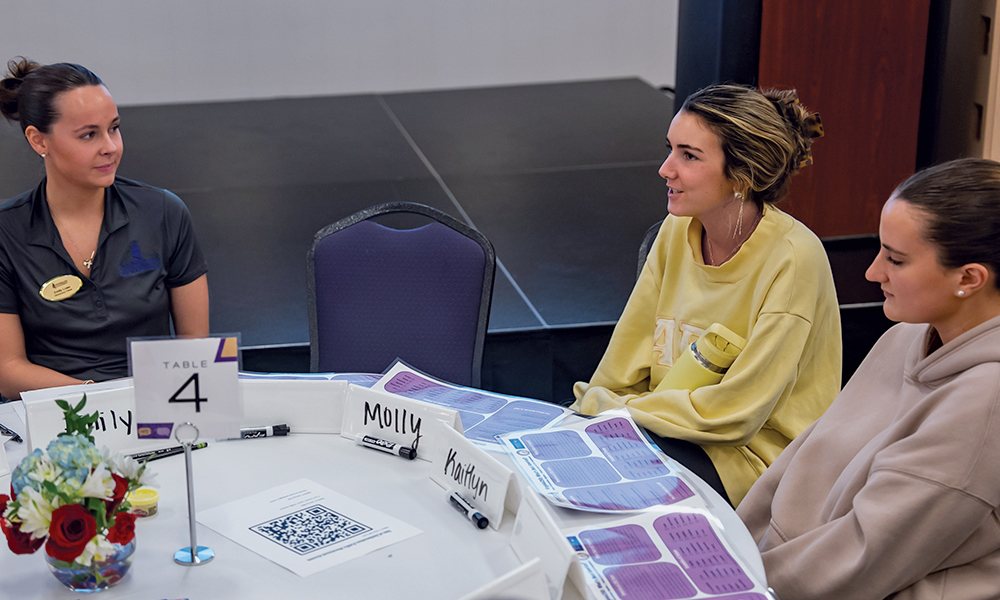
On Wednesday, March 4, in the Union Ballroom, more than 100 students, faculty and staff members took part in the Madison Center’s Better Conversations Together program “Deliberating the 250th: What’s Next America?”
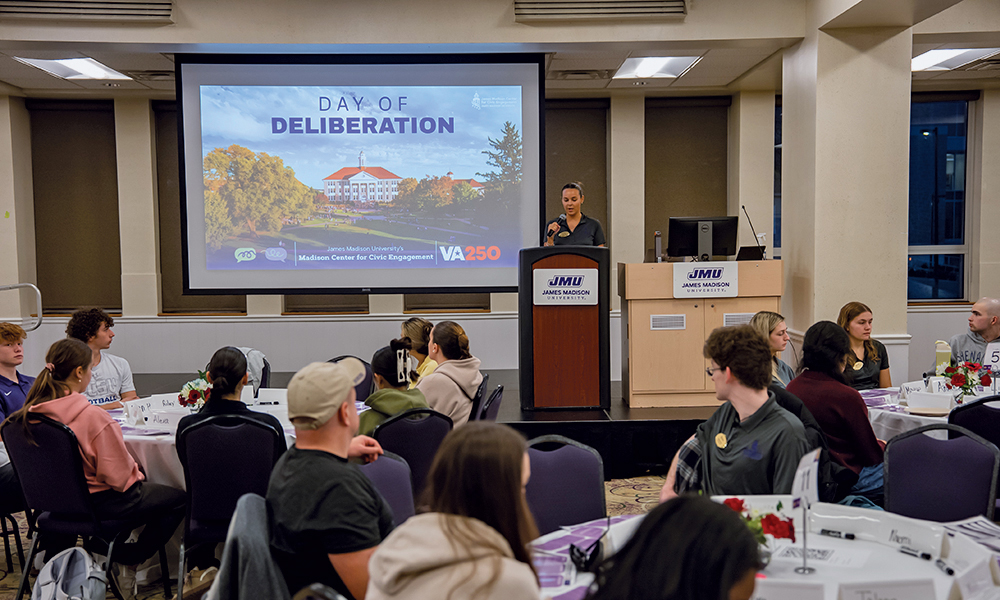
Attendees were asked to reflect on the founding ideals of American democracy, consider how these ideals have evolved over time and think critically about how they should guide America moving forward.
Participants sat at tables intentionally designed to include a range of ideological perspectives. At each table, a Democracy Fellow led the conversation, asking questions and allowing every attendee the chance to voice their opinion.
“At a time when polarization can make meaningful dialogue feel difficult or even uncomfortable, it can be challenging to know how to engage across differences,” said senior International Affairs major and Democracy Fellow Emily Lowe. “Tonight is an opportunity to lean into that challenge together and practice doing exactly that — listening and understanding each other. Our goal tonight is to connect with one another through conversation about the values that matter most to us.”
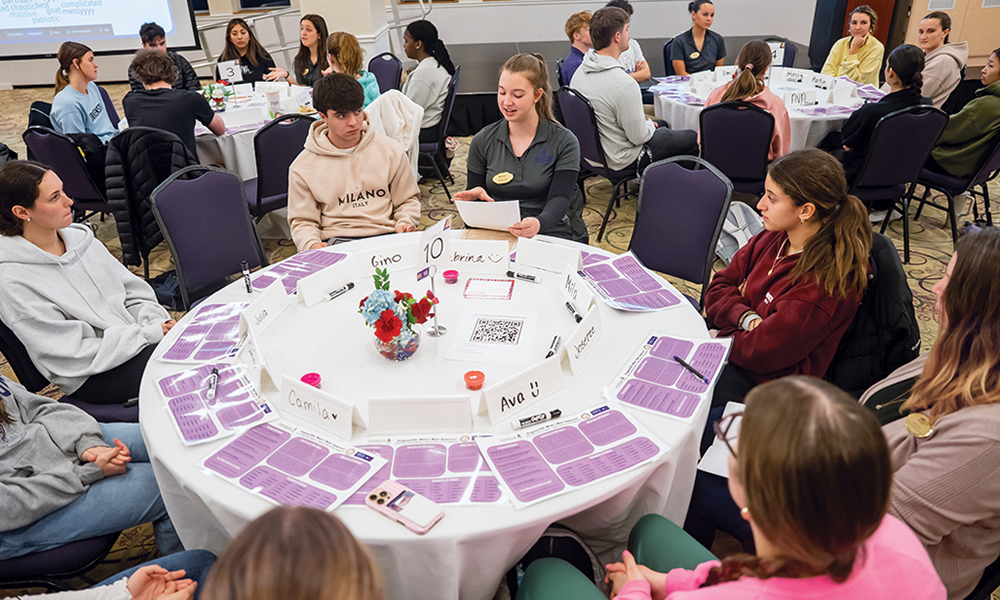
Senior Public Administration major Sabrina Burns spent weeks brainstorming with other Democracy Fellows on questions specific to the semiquincentennial. As an impartial facilitator, she asked members of her group to introduce themselves, then offered an icebreaker question before leading more difficult conversations like “What are some of the biggest challenges America may face in the future?”
Dillard was especially impressed to see young adults reflect on the potential of opposing ideas. “It requires a different level of thinking,” she said. “They have to step outside of their own views and values to say, ‘OK, now I need to think about how somebody who would oppose that would think,’ and to see, ‘Is there value in what they have?’ We call that a marker of intellectual humility, which is something we really try to teach as a part of this program. Can you take your own value, and can you say somebody else has a different value? ... To have a bunch of 18-, 19-, 20-year-olds thinking that way and talking about it, that’s amazing.”
On Thursday, March 5, the conversation turned to “Revolution and Religion in the Valley: A Community Conversation on the Mennonite and Brethren Experience in the Shenandoah Valley During the Revolutionary War.”
The people of British America tended to view their lives through the lens of religion, said panelist Dr. Robert Brown, professor of religion at JMU. Thus, it should come as no surprise, he said, that they saw the Revolutionary War as a quasi-religious affair.
“The natural human instinct when confronted with the prospect of war is to seek to avoid it. … Its suffering, its violence, its death, destruction of property, disintegration of social institutions, is appalling, no more so than when it is a civil war — which the [American] Revolution was. We can understand, then, why so many — some 30 to 35% of all Americans — chose to oppose the war.”
The war was especially appalling to the pacifistic Mennonite and Brethren communities who settled in the Shenandoah Valley in the 18th century.
“Brethren had been motivated to come to America only 50 years before the war by assurances that they would be able to practice their faith freely in the new world,” said Carl Bowman, a Church of the Brethren historian. “What they experienced upon arrival met their expectations — so much so that virtually all Brethren immigrated from Europe within about a 10-year period.”
In the America of the early to mid-1700s, he said, they found economic conditions and religious liberties far superior to their experiences in Europe. “No longer were they breaking the law by baptizing adults, and no longer were they required to embrace the faith of a particular ruler or prince. They could live peacefully as nonresistant people.”
Nevertheless, their primary feeling toward the king prior to the American Revolution was gratitude, Bowman said. “So, rather than responding enthusiastically to the prospect of independence from England, the prospect of independence made them nervous. Would they have the same religious freedom under the new American government … with the disorder and chaos of a war thrusting them into a conflict in which they had no direct interest?”
Mennonite migration into Virginia began in the 1730s with a steady stream of families moving into the Shenandoah Valley, said Elwood Yoder, interim executive director at the Brethren and Mennonite Heritage Center and a leading expert on Mennonite history.
When the British and the patriot militia exchanged the first shots of the war in Massachusetts, Yoder said, Quakers in Pennsylvania and Mennonites in Virginia were exempted from military service. But pressure from their neighbors who didn’t approve of their skirting of the draft was mounting. If they chose not to enroll in the militia, they would be subject to fines and additional taxes.
In 1780, the Virginia General Assembly voted to repeal the Mennonite exemption. According to Yoder, 71 Mennonite men in the area signed a petition in opposition to the measure, arguing “their forefathers came from a far country to America to seek this liberty.”
Five years later, in 1785, the Mennonites requested an end to penalties for not bearing arms during the war. James Madison was serving in the statehouse in Richmond, Virginia, at the time of the petition and was acutely aware of the persecution they were facing because of their religion.
Madison, who would go on frame the U.S. Constitution, would make religious freedom a centerpiece of the First Amendment: “Congress shall make no law respecting an establishment of religion or prohibiting the free exercise thereof.”
“And so, because of Madison’s work,” Yoder said, “men here in the valley can choose to drive 19th-century horse-and-buggies if they so choose, sing freely of their faith from a 19th-century sacred songbook, and not pay taxes to establish the church. Those words [come from] an actual moment in history when dissenters and other minorities achieved a degree of freedom of religion.”
Civic Education Week at JMU also included the VA250 Mobile Museum exhibit, an art showcase and a celebration of James Madison's birthday.


