


Wednesday, October 21, 2026
7:30pm
Forbes Concert Hall
Please silence all electronic devices.
Unauthorized videotaping or any other recording of this production is strictly prohibited in adherence with Federal copyright laws.
Program
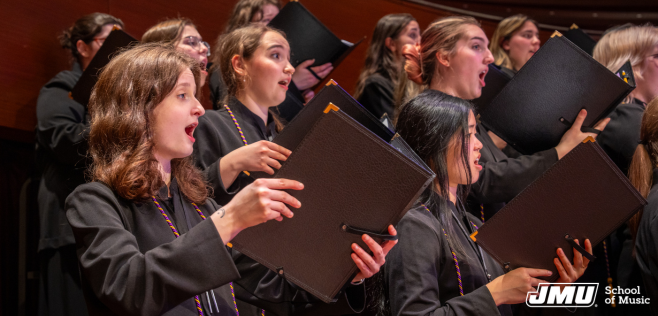
The Treble Chamber Choir
Dr. W. Bryce Hayes, director
Elizabeth Williams, collaborative pianist
Sing Creation's Music On - Stephen Paulus (1949-2014)/text: John Clare (1793-1864)
Light Like Letters - Dale Trumbore (b. 1987)/text: Erica Reid
I. Star Field
II. Tritina for Patience
III. Part of Me Hurtling Toward
Where the Light Begins - Susan LaBarr (b. 1981)/text: Jan Richardson
Allie Ranton, undergraduate conducting intern
I Am Only One - Adolphus Hailstork (b. 1941)/text: Edward Everett Hale (1822-1909)
Abbey Spencer, undergraduate conducting intern
Bring Me Little Water, Silvy - Huddie W. Ledbetter (Lead Belly) (1888-1949)
The Madison Singers
Dr. Jo-Anne van der Vat-Chromy, director
Adam Shenk, collaborative pianist
Colin Cossi, graduate conductor
Vidi Aquam (I Saw Water) - Michael McCarthy (b. 1966)
A Golden Day - Patrick Vu (b. 1998)
Hela Rotan (Pulling the Vine) - Ken Steven (b. 1993)
We Sing On - Paul John Rudoi (b. 1985)
Colin Cossi, graduate conductor
Alleluia* - Randall Thompson (1899-1994)
Phos Hilaron (Gracious Light)* - Texu Kim (b. 1980)
Alex Dickerson & Yasmine Akoum, handbells
Love Will Find a Way - Rosephanye Powell (b. 1962)
Vocal soloists: Joseph Brown, Sarah Damon, Miles Morley-Massado, Madeleine Parr, Sophia Scharlau, Brian Garmendia
*dedicated to JMU professor and former Director of Choral Activities, Professor David Watkins (1940-2026)
Sing Creations Music On - Stephen Paulus/text: John Clare
Sing Creations Music On is a favorite in the choral repertoire, celebrated for its driving energy and soaring lines. The text is drawn from the poetry of 19th century English Romantic poet John Clare (1793-1864), whose writing frequently explored themes of ecological beauty and spiritual wonder. In this particular setting, Clare speaks of nature as a vast, universal tongue, declaring that "songs like the grass are evergreen." Music, in this vision, is not merely a human invention, but an inherent condition of creation itself—ordered by "the Giver" to sing forever in a state of unbridled glee. Stephen Paulus (1949-2014) bring's Clare's text to life through fluid rhythms, sudden dynamic swells, and an expansive piano accompaniment that mirrors the endless vitality of the natural world. From its opening acclamations to its ringing, triumphant arrival on the concept of eternity, the work serves as a dazzling vocal showcase and a joyful meditation on the power of song.
Sing creations music on!
Nature's glee is in every mood and tone
Eternity.
Nature's universal tongue Singeth here
Songs I've heard and felt and seen
Everywhere. Everywhere. Everywhere.
Songs like the grass are evergreen
Everywhere. Everywhere. Everywhere.
The giver said live and be, and they have been forever,
Songs I've heard and felt everywhere.
Sing creations music on!
Nature's glee is in every mood and tone
Songs I've heard everywhere, songs I've heard everywhere
Song's I've heard and felt and seen
Everywhere. Everywhere. Everywhere.
Sing creations music on!
Light Like Letters - Dale Trumbore/text: Erica Reid
Program notes by Dale Trumbore
Composer Dale Trumbore writes, "The three movements of Light Like Letters explore how we move through three challenging aspects of mental health—loneliness, social anxiety, and depression—with grace and lightness. In "Part of Me Hurtling Toward," a restless piano accompaniment reflects a mind trapped in questions. In "Star Field," we see ourselves—even our social anxiety and desire for connection—reflected in the stars. The upper register of the piano accompaniment reflects the "anxious" activity of the stars, and as the poem describes people instead of the skies, the accompaniment moves into a more grounded, lower register. And in "Tritina for Patience," we explore "gloom" with a lightness unexpected in poems about sadness or depression—but here, it is this very lightness that allows us to accept the complexity of our minds and move through the gloom.
"Erica Reid's poem, "Part of Me Hurtling Toward" uses a poetic form invented by Kat Lehmann. In Lehmann's "sudo-ku" form, a 5x5 grid creates haiku both horizontallly and vertically. Setting these poems to music presents a challenge: How should a composer represent the 10 possible ways to read such a poem, as well as their fractured nature? As a starting point, I created a musical grid setting each cell to music as a way to generate fractured and complete melodies. In the poem, I see a mind trapped in questioning, which is reflected here in a restless piano accompaniment. Ultimately, this piece is about recognizing and naming all parts of yourself—the anxious and painful questions, yes, but also the quiet, intuitive voice that answers ("oh, I see her!").
I. Star Field
There is an uneasy peace between the stars.
Distance is never neutral—it is charged
with a social anxiety. For want of touch
stars question their place, forget after months
& decades & blips & eons whether
they are loved. They try to scootch together
& leave tracks across the starfield, rough
scratches in the void that will not buff
out. Stars send light like letters across the expanse
& as they stretch, the universe expands.
Our telescopes are weak, plus we can't hear
the sighs at night. Stars look so close from here.
II. Tritina for Patience
Once, I thought I'd leave this world too soon.
I'd not yet learned to put reins on my gloom
& let it canter through impeccable gardens.
A mind should be a forest, not a garden.
I once thought I would leave this world too soon
but now I braid the blue mane of my gloom
into diamonds of gloom, fishtails of gloom,
& clutch them as I trample through the gardens
that never suited me. I'm patient. Soon
impatiens will spring from my garden, bright as gloom. Oh, soon.
III. Part of Me Hurtling Toward

Where the Light Begins - Susan LaBarr/text: Jan Richardson
Where the Light Begins by American composer Susan LaBarr, sets an evocative text by poet and United Methodist minister Jan Richardson. While Richardson's original text was written as an Advent blessing for her book Circle of Grace, LaBarr collaborated with the poet to adapt the lyrics into a more universal message. Rather than focusing on a seasonal or external source of hope, the piece shifts its lens inward. It explore the idea that peace, kindness, and illumination do not descend upon us from afar, but instead begin directly within our own hearts and daily actions. LaBarr mirrors this text with flowing vocal lines that leaves a lasting impression of quiet hope.
I Am Only One - Adolphus Hailstork/text: Edward Everett Hale
I Am Only One is a powerful work by acclaimed American composer Adolphus Hailstork that captures the tension between individual limitation and collective impact. Hailstork sets a timeless text adapted from the famous words of American author, poet, and social reformer Edward Everett Hale: "I am only one, but I am one. I cannot do everything, but I can do something. And I will not let what I cannot do interfere with what I can do." Hailstork's setting ultimately serves as an inspiring reminder that every individual contribution—no matter how small—is a vital seed planted toward a greater, united good.
Bring Me Little Water, Silvy - Huddie W. Ledbetter (Lead Belly)/arr. Moira Smiley
Bring Me Little Water, Silvy is TCC's fall tradition piece—sung in the Forbes Center Concert Hall for the past sixteen years! This delightful arrangement utilizes body percussion to accompany this beloved American song.
Vidi Aquam (I Saw Water) - Michael McCarthy
The Vidi Aquam text has been used during Paschaltide since the 12th century. The Ezekiel 47 text is used to accompany the ceremonial sprinkling of holy water and is a version of the prophet's vision of water flowing from the temple. Michael McCarthy's setting features a new English version of the text by Susan Cherwien, which can be used in conjunction with Baptism.
Vidi Aquam/I Saw Water
Vidi aquam egredientem de templo/I saw water coming forth from the temple
a latere dextro, alleluia./on the right side, alleluia.
et omnes, ad quos per venit aqua ista,/And all those to whom this water came,
salvi facti sunt./are made whole.
Confitemini Domino quoniam bonus/Give praise to the Lord, our God
Quoniam bonus, Alleluia./Who is gracious, Alleluia.
Vidi aquam egredientem de templo/I saw water coming forth from the temple
Vidi aquam, vidi aquam, vidi aquam./I saw water, I saw water, I saw water.
A Golden Day - Patrick Vu (b. 1998)
Based on the poem by Paul Laurence Dunbar, composer Patrick Vu's poignant A Golden Day, is a passionate and stirring choral composition. Fashioned in a modern a cappella style with moving, close harmonies, the bittersweet lyrics recount a love found and lost on "a golden day."
I found you, and I lost you, all on a gleaming day.
The day was filled with sunshine, and the land was full of May.
A golden bird was singing, its melody divine,
I found you, and I loved you, and all the world was mine.
I found you, and I lost you, all on a golden day,
But when I dream of you, (my) dear, it is always brimming May.
Hela Rotan (Pulling the Vine) - Ken Steven
Composer Ken Steven writes, "Hela Rotan (Pulling the Vine) is a popular Indonesian folk-song from the island of Maluku (Moluccas). It tells about the traditional game of tug of war of the people of Maluku using rattan (Hela Rotan - pulling the rattan or vine). In this game, even though we compete, the party who wins or loses will get a prize, namely: 'togetherness.' Hela Rotan is a call to live in togetherness, even though there are differences that attract each other."
Full choral divisi, and ostinato-based close harmonies create an exciting drive for this Indonesian folk song setting.
We Sing On - Paul John Rudoi
From Paul John Rudoi, the creator of We Sing On: "Cantus has visited JMU several times while on tour, and given our Minnesota connection, I have also known DMA student Colin Cossi for many years, respecting and admiring his passion and expertise in so many areas. Given all this, I was honored and excited to be invited by JMU to compose a work based on inspiration from the data set from Colin's thess. A specific story emerged from these responses wherein some students' families are not supportive or understanding of their choice to study music. Two in particular stood out, one to Question 1:
...always asking 'How much money can you get out of that career?' 'Are you sure this is what you want to do with your life? Pick something functional and worth seeking a degree for.' 'Music is a hobby, not a career.'
"And the other, in response to Question 4:
abandonment, on my own, my choice, I cannot do something for the rest of my life that I do not love, money means nothing when happiness means everything.
"These two responses led me down a path of nostalgia from a time when I asked myself these questions, unsure of whether it was worth it. Ultimately, it was worth it for me just as it is for many others. It is only after considering why we musicians do what we do, no matter the cost, do we realize that we have the freedom to find ourselves in the music we create, share, and are."
We Sing On
You say this road would never lead to rest,
that songs grow thin when life comes due each month.
You ask us why we choose the harder way and speak of talent better kept aside.
You've cried and warned and quietly withdrawn.
But music came before we learned to doubt, a sound we carried long before the choice,
a drive that drove despite the rising cost.
We sing on. We sing on. With what we have, we sing on.
Through the noise, through the dark, with what we have, we sing on.
"What we have" is more than what it seems.
No praise, no proof, no answers neatly formed.
It is the breath we lend to someone else, the room made safe by listening and time.
It is the work that asks us to remain when silence would be simpler to accept. We learn at last what
carried us this far—not stubborness, but love that would not leave.
We sing on. We sing on. With what we have, we sing on.
Through the noise, through the dark, with what we have, we sing on.
Alleluia - Randall Thompson
With a doctorate from the Eastman School of Music and professional teaching ties to the Curtis Institute, the University of Virginia, and Harvard University, renowned American composer Randall Thompson was particularly heralded for his choral compositions. Counted as his most famous choral motet, Alleluia was commissioned by Serge Koussevitzky to open the Berkshire Music Center (now the Tanglewood Music Center). Although director Koussevitzky wanted a "fanfare" for voices, due to the war in Europe, Thompson felt that a jubilant Alleluia would be inappropriate and composed a quiet, introspective piece, in mostly soft dynamics with only a single fortissimo outburst near the end. The harmonies are simple throughout, although some subtle chromatic inflections give the work a special flavor. In Thompson's own words, "It is a slow, sad piece, and...comparable to the Book of Job, where it is written, 'The Lord gave, and the Lord has taken away. Blessed be the name of the Lord.'" To this day, Thompson's Alleluia is performed every summer at the opening of the Tanglewood Music Festival.
Phos Hilaron (Gracious Light) - Texu Kim
Texu Kim's choral composition Phos Hilaron is a 4-minute setting for SATB choir and bells that reimagines the ancient 3rd-century Christian lamp-lighting evening hymn. St. Francis in the Fields Episcopal Church commissioned it, and the Evensong Choir premiered it in 2020. The Phos Hilaron (Greek for "Gladsome Light" or "Joyous Light") hymn is traditionally sung at sunset during evening prayer or vespers across Christian traditions. The text offers praise to the Holy Trinity—Father, Son, and Holy Spirit—as day fades and evening lights are kindled, addressing Jesus Christ as the "giver of life" and pure brightness of the immortal Father. In Kim's contemporary choral arrangement, the treatment of this 3rd-century evening hymn uses contemporary harmonic palettes to aurally depict the transition from daylight to twilight, incorporating handbells/bells to evoke the shimmering, tranquil shift into evening. A beautiful sympathetic resonance occurs as the choir "blends into" the ring of the bells, augmenting the natural acoustics and upper partials generated by the bell strikes. This natural "halo effect" embodies the concept of Phos Hilaron—the Gladsome, Gracious Light.
Phos Hilaron (Gracious Light)
O gracious Light, pure brightness of the ever-living Father in heaven,
O Jesus Christ, holy and blessed!
Now as we come to the setting of the sun, and our eyes behold the vesper light,
we sing your praises, O God: Father, Son, and Holy Spirit.
You are worthy at all times to be praised by happy voices,
O Son of God, O Giver of life, and to be glorified through all the worlds.
Alleluia and Phos Hilaron (Gracious Light) are dedicated tonight to the memory of Professor David Watkins, long-time professor of voice, conducting, and Director of Choral Activities here at JMU.
Love Will Find a Way - Rosephayne Powell
Composer Rosephayne Powell is favorite here at JMU! Her new gospel work, Love Will Find a Way, points us all in the right direction! Energetic, dynamic, with multiple opportunities for solos and improvisation, this work is a beautiful addition to the contemporary choral canon. We know you will enjoy our wonderful TMS soloists!
Treble Chamber Choir
W. Bryce Hayes, artistic director
Elizabeth Williams, collaborative pianist
Allie Ranton, undergraduate manager
Abbey Spencer, undergraduate manager
Soprano One
Gloria Cox, Maya Habtamu, Elizabeth Kugel, Lula McCain, Abbey Spencer, Megan Wong
Soprano Two
Sofia Aikens, Trista Coltellino, Danis Jones, Caroline Legere, Kira Miller, Allie Ranton
Alto One
Mallory Billet, Kylie Charters, Emma Kamara, Katie McGee, Lauren Motter, Mia Polley
Alto Two
Joseph Brown, Brigid Downs, Julia Egnot, Kaytria Powers, Leila Slye, Jaya Whaley
The Madison Singers
Jo-Anne van der Vat-Chromy, artistic director
Adam Shenk, collaborative pianist
Joseph Brown, graduate conductor
Colin Cossi, graduate conductor
Soprano
Abbey Spencer, Allie Ranton, Annea Phillips, Aven Buchanan, Emalee Stepp, Emma Jones, Kendra Liverman, Kimberly Aikens, Marin March, Sarah Damon, Sydney Ashworth
Alto
Abby Sparks, Abby Smith, Emma Leudedorff, Hailey Donithan, Madeleine Parr, Savannah Whitley, Sheridan Anthony, Sophia Scharlau, Yasmine Akoum
Tenor
Brian Garmendia, Jacob Wunderler/Walton, Jeffrey Ruiz, Jonas Kerlin, Joseph Brown, Michael Discenza, Miles Morley-Massado
Bass
Colin Cossi, Alex Dickerson, Colin Riley, Ika Amos, Habib Jaafar, Isaac Markow, Kevin Landry, Riley Rothwell, Will Sanfilippo
JMU Choral Area:
Dr. Jo-Anne van der Vat-Chromy: Director of Choral Activities, Co-Coordinator of the Ensemble Area, Professor of Choirs, Conducting, and Choral Music Education.
Dr. W. Bryce Hayes: Associate Director of Choral Activities, Professor of Choirs and Choral Music Education.
Colin Cossi: DMA Choral Conducting Graduate Student
Joseph Brown: DMA Choral Conducting Graduate Student
Sarah Damon: Choral Librarian
Emma Leudesdorff: Poster & t-shirt design
JMU Choral Collaborative Pianists:
Adam Shenk: The Madison Singers
Elizabeth Williams: Treble Chamber Choir, UCSA
Dr. Linlin Uta: UCTB
JMU Voice Area
Dr. Sonya Baker, soprano/Voice area Coordinator
Dr. Kirsten Blair, soprano
Dr. Bridgid Eversole, soprano
Professor Pascale Spinney, soprano
Professor Brenda Witmer, soprano
Professor Michael Hadary, baritone
Professor David Newman, baritone
Dr. Jo-Anne van der Vat-Chromy, Director of Choral Activities
Dr. W. Bryce Hayes, Associate Director of Choral Activities
Professor Joshua Borths, Director of Opera Theatre
The Treble Chamber Choir (TCC), under the direction of Dr. Bryce Hayes, is the select auditioned soprano and alto ensemble. Consisting predominantly freshman and sophomore vocal music majors, this ensemble is designed to provide a platform for the discovery and presentation of often untapped advanced treble repertoire.
The Madison Singers, under the direction of Dr. Jo-Anne van der Vat-Chromy, is the premier advanced auditioned choral chamber ensemble at James Madison University. The Madison Singers perform a wide variety of musical genres from the Renaissance to the present, and maintains an active and demanding concert schedule, both on and off campus. This ensemble focuses extensively on advanced techniques of singing, as well as choral and harmonic skills. The ensemble has performed many esteemed concerts, most recently at Carnegie Hall in NYC in March 2025, in concert with the Estonian Philharmonic Chamber Choir in the spring of 2026, and in combined forces with the JMU Choral Area for the Inauguration Ceremony of President James Schmidt.
Thanks for our generous Friends of the Arts & Design scholarship donors whose support allows our students to continue to create, perform, and inspire.
Arts & Design Hero ($5,000+)
- Patricia Gould & Hasan Karsiloglu
- Ann & Mark Siciliano
- Richard & Sue Orem
- Joshua & Trish Weinstein
Arts & Design Champion ($1,500-$4,999)
- Beth Chandler Cahill & Jim Cahill
- Jonathan Fox
- Rubén Graciani & Matt Pardo
- Marilou Johnson
- Matthew & Sarah Von Schuch
Arts & Design Advocate ($500-$1,499)
- John & Susan Allemeier
- Jerry Benson & Martha Ross
- Nancy Davis
- Patrick & Stephanie Driscoll
- Holly Haney & Bob Kolvoord
- Quillon Hall & Karin Tollefson-Hall
- Gina & Tom Holden
- Thomas McKenzie
Arts & Design Ally ($250-$499)
- Sue Agranoff
- Ellen & George Aschenbrenner
- Charles Boepple
- Reginald Bryson & Souha Khawam
- Eric & Jess Guinivan
- MiKyoung Lee
- Amy & Sean Myers-Payne
- James & Virginia Newman
- Rebekah Noonan
- Cyndia & Dexter Taylor
- Heather & Theodore Tseng
- Bethany & Scott Vriesman
- Connie & Hugh Westfall
- Cecelia Wolf
- Diane & Leonard Young
Dear Patron,
Thank you for attending this School of Music performance; we appreciate your support! The JMU School of Music educates the most talented students from around the world to shape the fabric of society. We are ecstatic to showcase the talent and hard work of our students and faculty.
Scholarship contributions help young musicians blossom into mature artists. With your support, we will be able to offer our talented students more financial help in pursuing their goals. If you are interested in supporting our students' passion and dedication, please consider contributing to the Music Scholarship Fund at James Madison University by clicking the button below.