


About CFI's May Symposium
The JMU Center for Faculty Innovation offers May Symposium annually to support the ongoing development of faculty as teachers, scholars, and leaders. May Symposium compiles a variety of roundtables, speakers, and workshops on various topics such as course design, teaching approaches, scholarship networks, faculty peer mentoring, faculty and student well-being and belonging, and more.
This exciting collaborative effort provides full-time faculty, part-time faculty, academic unit leaders, and CFI partners of all sorts with opportunities to focus on teaching, scholarship, career planning, service, and leadership.
Registration Information
Programs within the CFI are designed to support the development of instructional faculty and AP faculty with instructional responsibilities. We also welcome staff to many of our programs. If you are interested in attending one of our programs but do not identify with the above classifications, please email cfi@jmu.edu.
For more information on registering for our programs, please visit the CFI Programs & Events web page, which includes details on registering for programs and an instructional video on how to use the registration portal.
If this is your first time visiting the CFI Program registration page this semester, be sure to clear your browser cache/cookies and update your profile information (including updating your college/division and department) during the registration process. You will be asked to sign in to the secure site using your JMU eID and password (through Okta).
If you stay for breakfast or lunch, we request that you register by May 12 so that we order the right number of meals.
The table below is best viewed at horizontal orientation on your device.
| Time | Location | |
|---|---|---|
| 01 - Breakfast | 8:15 - 8:50 a.m. | Union - Warren Ballroom |
| 02 - Interactive Sessions 1 | 9:00 - 10:15 a.m. | Union - Taylor |
| 03 - Interactive Sessions 2 | 10:30 - 11:45 a.m. | Union - Taylor |
| 04 - Lunch and Keynote | 12:00 - 1:30 p.m. | Union - Warren Ballroom |
| 05 - Poster presentations and coffee | 1:30 - 2:15 p.m. | Union - Warren Ballroom |
| 06 - Interactive Sessions 3 | 2:30 - 3:45 p.m. | Union |
Breakfast: 8:15 - 8:50 a.m. (Union - Warren Ballroom)
Participants must first check in at Warren Ballroom, located on the 5th floor.
- 8:10 a.m. - Doors open (Union - Warren Ballroom)
- 8:15 - 11 a.m. - Check-in (Union - Warren Ballroom)
- Pre-registration is recommended by Monday, May 1, at 12:00 p.m. Walk-ins are welcome.
- 8:15 - 8:50 a.m. - Breakfast
Interactive Sessions
The following is a selection of sessions offered during May Symposium 2026. Check back for updates about more sessions!
Interactive Sessions 1: 9:00 - 10:15 a.m. (Union - Taylor)
Beyond Policing AI: Developing Practical Wisdom for Human-AI Collaboration
This workshop shifts the focus from abstract debates about what AI is to the situated, practical judgments people make when working with it. Drawing on Aristotle's concept of practical wisdom and pragmatist philosophy of technology, Dr. Hayward Marcum presents a three-part framework built around situated judgment, aims and goods, and reflective mediation. Participants will examine sample case studies and contribute examples from their own disciplines, exploring how practical wisdom can guide thoughtful, context-sensitive AI use.
Facilitated by Joni Hayward Marcum (Learning Centers and CAL)
Building a Network of Support: A Faculty Guide to Madison Cares
Faculty at JMU care deeply for the well-being of their students and want them to be successful, but what do you do when they are experiencing a family emergency, or have missed numerous classes, or they share mental health concerns with you? Join us for this workshop to practice how to respond to students when they share their struggles with you, to learn how to connect students to the appropriate resources and get a behind the scenes look at the university care referral program, Madison Cares.
Facilitated by Dominique Rodriguez and Fiona Summers (Dean of Students Office)
Evaluating Your Teaching and Your Students' Learning
It's annual reporting season! Considering the amply documented limitations of Student Evaluation of Teaching (SET), faculty wonder how they can still report excellent (and satisfactory) teaching and learning. This workshop takes participants through a series of questions and activities to document their successes (and — see this year's keynote — failures), based on the resource guide developed by JMU's Provost's Committee on Evaluations of Teaching.
Facilitated by Andreas Broscheid (CFI and CAL)
From Numbers to Narratives: A Data Party on Student Belonging
In this collaborative data party, participants will dig into the institution's student belonging survey results, both the numbers and the stories behind them. Building on how student belonging is defined and measured, and what the data can and cannot tell us, we'll explore quantitative belonging data alongside qualitative student responses, uncovering patterns and themes that lead to practical strategies for fostering student connection and inclusion. No statistics background is required.
Facilitated by Paul Mabrey (Student Academic Success, CAL), Sara Finney (CARS, CHBS), Sarah Blackstone (PAIR), Megan Good (CARS, CHBS), and Chris Orem (PAIR)
Interteaching: An Alternative Method for Increasing Student Performance and Engagement
Interteaching is an alternative teaching method that has its roots in the psychology of learning. A growing body of research has shown that interteaching can improve student learning and engagement in classroom settings. Moreover, recent research has shown that interteaching is also effective in online formats. In this session, the process of interteaching will be discussed along with empirical evidence showing its efficacy.
Facilitated by Bryan Saville (CHBS)
Reimagining your Course with Work-Based & Community-Engaged Learning
Faculty increasingly seek ways to provide students with real-world learning experiences that connect coursework to professional and community contexts while enhancing student outcomes and preparing them for impactful careers. This session will explore strategies for re-imagining courses to incorporate Work-Based Learning Experiences (WBLE) and Community-Engaged Learning (CEL). Faculty will gain insight into how WBLE and CEL align, how they differ, and how they can complement each other.
Facilitated by Anna Maria Johnson (University Career Center) and Jenna Piersol (Community Engagement & Volunteer Center)
Shaping Tomorrow's Curriculum: JMU's General Education Program
This interactive session brings together faculty from across campus, both new to Gen Ed and veterans of the current program, to connect and learn about the new Gen Ed curriculum and its faculty-led governance structure. Participants will explore how the new learning-outcome based program works and how they can contribute to the learning outcome design for each of the 14 program requirements.
Facilitated by Dennis Beck (CVPA), Sarah Brooks (CVPA), Elizabeth Brown (CSM), and Kethera Moore (CHBS)
Interactive Sessions 2: 10:30 - 11:45 a.m. (Union - Taylor)
Cases of Evidence-based Design for Project-based Learning
This roundtable session will explore how project-based learning (PBL) can be designed to support authentic, process-oriented learning and assessment. Drawing on current teaching scholarship across different disciplines, the facilitators will highlight evidence-based design to approach PBL with key components, including alignment with learning objectives, structure, and length of PBL, individual and group activities, and process-oriented assessment. Participants will engage in examples and guided activities to translate their ideas into learning designs.
Facilitated by Abiodun Stephen Ijeluola, Zhenhuan Henry Yang, Juhong Christie Liu (JMU Libraries)
The Cost of Silence: Leadership and Workplace Bullying
This interactive workshop examines how leadership shapes the experience and meaning of workplace bullying through behaviors that function as organizational signals, either reinforcing or disrupting harmful dynamics. Participants will engage in guided reflection and small-group discussion to explore how silence, response, and accountability show up in their own contexts. The workshop invites attendees to consider practical ways to foster cultures where concerns are addressed and psychological safety is strengthened.
Facilitated by Wendy Kinyeki (Counseling Center)
Democracy, Discourse, and the Classroom: Course Development in the College of Arts and Letters
In this roundtable, faculty from History (Jones), Communication Studies (Busmek), and Political Science (Goldberg) discuss innovative approaches to teaching civic life and democratic participation. Panelists will share how new courses—on the Vietnam War, communication and civic engagement, and free speech in higher education—equip students with both historical knowledge and practical democratic skills. A recurring theme is the challenge of making civic questions feel urgent and personally relevant to students.
Facilitated by Becky Childs, Pete Bsumek, Abe Goldberg, and Jonathan Jones (CAL)
Designing with Care: Course Design Principles from Trauma Informed and Feminist Pedagogies
Students in higher education are navigating mental health and financial hardships, lack of social connectedness, and uncertainty about the future. Changing demands and finite resources make teaching and learning a challenge for both these students and their instructors. This workshop introduces and explores key tenets of trauma-informed and feminist pedagogy, ending with proactive course design principles rooted in flexibility and care. Support and care are not simply a response to an individual's need, but a prerequisite to our collective success.
Facilitated by Katherine (Katie) Walters (COE)
New(ish) at JMU: What Was Your Experience as a New Faculty Member?
Join this roundtable conversation for JMU faculty at the end of their first through third years to debrief what your experience was like and to think about what is next.
Facilitated by Gilpatrick Hornsby (Faculty Success)
Scholarly Questions Prompted by AI
Artificial intelligence was imagined and created by thinkers across a variety of disciplines. With its novelty and the pervasiveness of its impact, AI poses new research questions across the humanities, social sciences, and STEM. This roundtable session connects faculty with research or scholarly interests relating to AI with colleagues from across campus. It is intended as a complement to CFI's other programming about AI's seismic impact on every aspect of how and what we teach.
Facilitated by Holly Yanacek (CAL), Kenny Pearce (CAL), and Elizabeth Brown (CMS)
Teamwork That Works: Diagnosing and Maintaining Healthy Group Dynamics
This interactive workshop helps attendees diagnose and address the group dynamics that shape collaboration in student teams, research groups, committees, and workplace settings. Participants will explore how boundaries, task processes, interpersonal relationships, and self-oriented behaviors influence group effectiveness. The session introduces practical team maintenance strategies that can help normalize difficult conversations, prevent deterioration, and support healthier collaboration over time.
Facilitated by Raafat Zaini and Shannon Conley (CISE)

Keynote Speaker: Jessamyn Neuhaus
Jessamyn Neuhaus, Ph.D., is the Director of the Center for Teaching and Learning Excellence (CTLE) and Professor in the School of Education at Syracuse University. A scholar of teaching and learning, Jessamyn is the author of Geeky Pedagogy: A Guide for Intellectuals, Introverts, and Nerds Who Want to be Effective Teachers and editor of Picture a Professor: Interrupting Biases about Faculty and Increasing Student Learning, both published in the West Virginia University Press series, Teaching and Learning in Higher Education. A recipient of the SUNY Chancellor’s Award for Excellence in Teaching, Jessamyn has over twenty years of classroom experience, teaching courses on U.S. history, gender studies, and popular culture and is also the editor of Teaching History: A Journal of Methods.
Jessamyn's most recent book, Snafu Edu: Teaching and Learning When Things Go Wrong in the College Classroom, was published in the Oklahoma University Press series, Teaching, Engaging, and Thriving in Higher Education. Snafu Edu boldly foregrounds a reality often downplayed in college teaching advice: no matter how skilled, caring, and well-prepared instructors are, or how motivated and engaged learners are, sometimes things go wrong. The word "snafu" is a noun, a verb, and an acronym, and Neuhaus argues that in all senses it accurately describes the ways teaching and learning predictably and persistently get fouled up in higher ed. In this book, she offers evidence-based insights into why snafus happen, and practical, actionable strategies for recognizing, responding to, repairing, and reducing them.
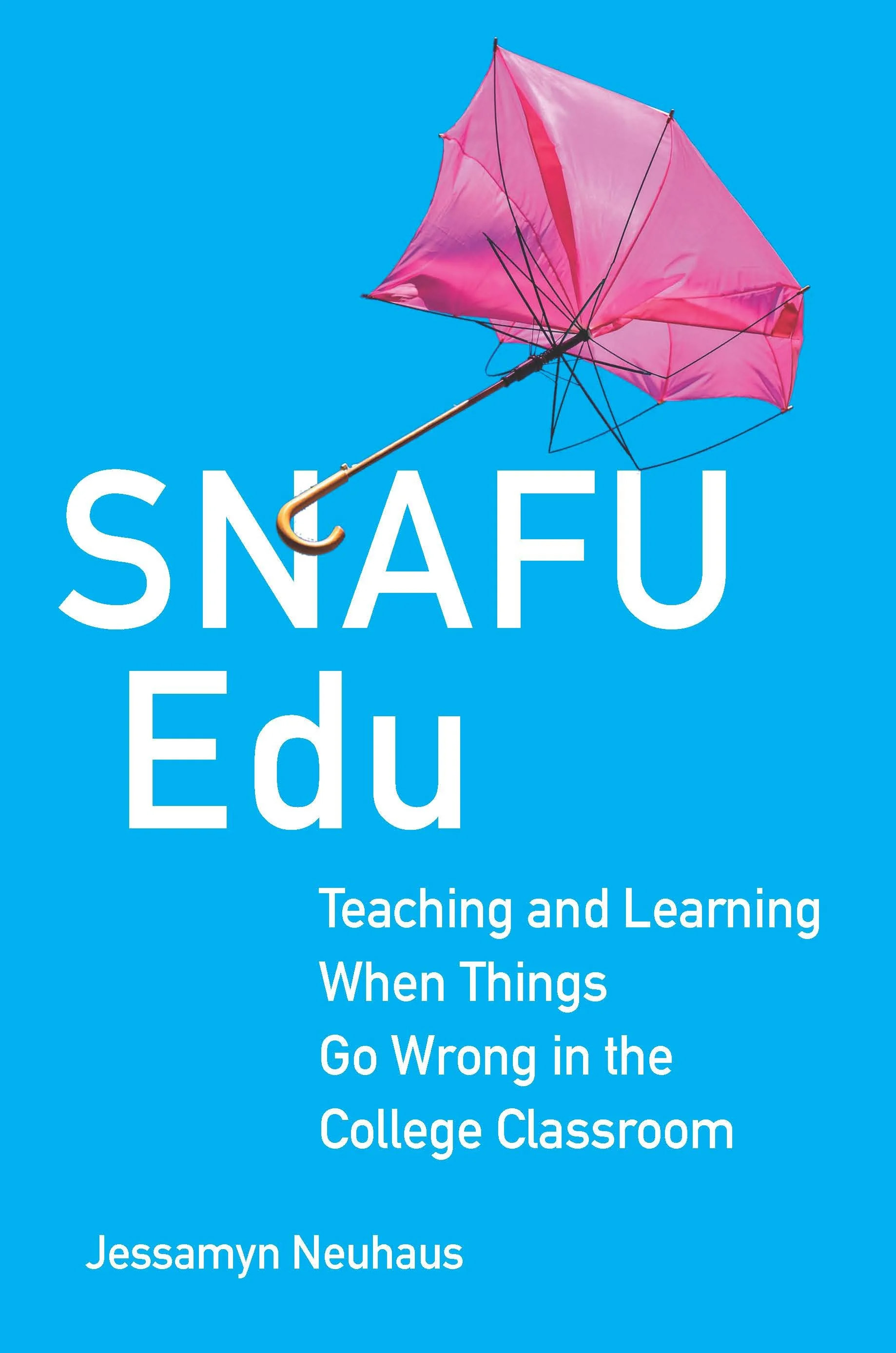
Snafu Edu: Normalizing Educators' Setbacks, Struggles, and Professional Faceplants
In this presentation, Jessamyn Neuhaus examines the myths and misconceptions that contribute to the popular and the scholarly discourse depicting teaching as a perfectible activity. She shows why we urgently need to normalize the ongoing challenges of effective teaching, including the ways that things can routinely go wrong in the college classroom. While evidence-based course design and teaching practices can reduce the odds of snafus, in the context of inequities, disconnection, distrust, failure, and fear in higher education, struggles and setbacks are "situation normal" for teaching and learning. Neuhaus argues that one specific, proven way we can normalize mistakes as both individuals as well as institutions is by talking more about teaching. Building and strengthening our pedagogical communities of practice, including improving and diversifying our methods for evaluating teaching efficacy, is a sure-fire way to begin normalizing educators' setbacks, struggles, and snafus.
Interactive Sessions 3: 2:30 - 3:45 p.m. (Union)
STIR (Stop, Think, Identify, and Repair) Strategies When Things Go Wrong in Teaching and Learning
In this workshop, Jessamyn Neuhaus will give an overview of the six repair strategies for many widespread, commonly experienced missteps, mistakes, and muddles detailed in her book Snafu Edu: Teaching and Learning When Things Go Wrong in the College Classroom. Workshop participants will then engage in reflection, discussion, and individual planning to identify their own recurring teaching and learning situations in need of a STIR, brainstorm ways to implement a STIR repair strategy, and set a specific goal for classroom use.
Facilitated by Jessamyn Neuhaus (Syracuse University)
Making Space for Joy: Reflecting on the Academic Year
The end of the academic year is an ideal moment for reflection. In this interactive workshop, facilitated by the CFI Well-being Team, participants will have opportunities for conversation around learning from the things that were challenging, as well as opportunities to make space for joy. Join us to collaboratively explore ways we can intentionally cultivate authentic joy, purpose, and meaning in the year(s) ahead.
Facilitated by Daisy Breneman (CFI and CAL), Joe LeBlanc (CHBS and CFI), Eric Magrum (CHBS and CFI), and Mollie Stambler (CAL and CFI)
