

19th Annual REDI Fall Food Drive
News


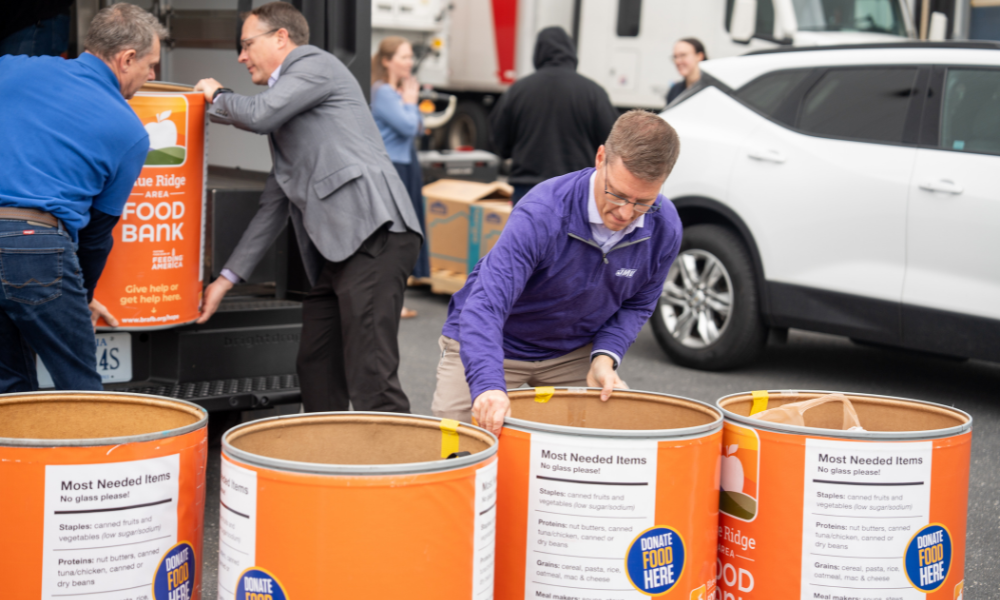
SUMMARY: REDI recently spoke with organizer Tyler Hendricks about the 19th annual REDI Fall Food Drive, running from Oct. 26-Nov. 6.
According to the Blue Ridge Area Food Bank (BRAFB), one in three neighbors in the Shenandoah Valley and Central Virginia is food insecure. BRAFB addresses that vital need by serving an average of over 178,000 people per month through their services. Research, Economic Development and Innovation is contributing to that effort through the 19th annual REDI Fall Food Drive, which is running from Oct. 26-Nov. 6. To learn more about the drive, REDI recently spoke with organizer Tyler Hendricks, administrative assistant for Research and Economic Development.
REDI: Tell us more about the Blue Ridge Area Food Bank (BRAFB) and the neighbors they serve.
Hendricks: The BRAFB is a non-profit headquartered in Verona that started in 1981 as a “rural experiment in food banking” and has grown to the largest hunger-relief organization in central and western VA. It is one of seven food banks across the state and is a partner with Feeding America. They are also partnered with our very own JMU Food Pantry. They help serve anyone in our local community who is currently experiencing a lack of food security, whether that be retired veterans, young children in a single parent home, college students who are in between paychecks and anyone in between.
REDI: Why does REDI partner with BRAFB to run this drive every year?
Hendricks: REDI has had a long-standing partnership with the BRAFB because of connections built by our late colleague, Ben Delp, who helped lead this food drive for many years before he passed last year. We continue in the legacy that he built not only to honor him, but also because he laid the groundwork for JMU to have the biggest impact possible to our neighbors who are in need. BRAFB is a wonderful partner who helps facilitate so much of what’s possible with the drive because they’re focused on the right things, which is helping those who are hungry first and foremost.
REDI: How do people’s donations help neighbors in need?
Hendricks: Once a donation goes into the barrel, it is transported to the BRAFB headquarters in Verona to be sorted by item type. Then BRAFB partners with pantries across the state, whether they be in churches, community centers, or TDU at the JMU Food Pantry, to help disseminate to those who are in immediate need. These donations can be literally life giving, especially as we head into the colder months, because many are unable to afford or access food for several legitimate reasons. Not only does the food help sustain their life and give energy to survive, but the household items also immensely help people feel human and give a sense of normalcy. I personally grew up in a home that had food insecurity and then had a season in college while working where I experienced it again, and both times donations like what we’re accepting in the JMU Food Drive directly led to me surviving and being able to graduate when I wouldn’t have been able to otherwise.
REDI: What kinds of donations are needed?
Hendricks: Non-perishable food and household items, like cereal, oatmeal, nut butter, canned meat, canned veggies, beans, boxed items that don’t expire like mac & cheese and pasta, anything like that. For household items, anything you would use daily, like paper towels, toilet paper. Baby food and formula are a huge thing because that stuff is so expensive.
REDI: What goes into organizing a campus-wide drive like this?
Hendricks: It is truly a collaboration on every level between nearly everywhere on campus that you can imagine. To make this happen, we’ve had the support and efforts of dozens of folks — administrators, department heads and student volunteers — who are willing to work together to make an impact on our local community. It is a perfect example of what it means to be a Duke: selflessly giving for the one beside you. I’m a firm believer that the phrase “Dukes hold doors” means so much more than holding the door to SSC, and the JMU Food Drive is the culmination of that meaning being lived out with grace and love.
REDI: What does the organizational process for the drive look like?
Hendricks: We start in September or August to have those discussions on ways we want to adapt it or what went well in the previous year. Then we start out by making a connection with the food bank to see how their efforts are going with all their other drives; they can only give us so many barrels because they have so many other drives happening around the same time.
We start that coordination effort relatively early, and then we start engagement and coordination with campus partners, such as Athletics, or the Community Engagement & Volunteer Center (CEVC), Dining Services, and many others just try to get volunteer efforts together. Then it’s coordinating with Virginia Clean Cities (VCC) to help with delivering and picking up the barrels. The VCC team feels a special connection to this effort because they were so close to Ben. We rely on people in several different roles: building coordinators, student and staff volunteers who gather donations across ~20 campus collection sites, marketing and promotion, and community contributions.
REDI: How can people get involved?
Hendricks: Primarily, by bringing in donations to the barrel that is closest to where you normally frequent. We have placed barrels across campus in high-traffic spots to make it as easy as possible to donate. If you have already donated or are unable to, then getting the word out to others helps just as much! You never know what a simple invitation can spark in someone’s heart. If you’re interested in volunteering beyond donations, then I would recommend reaching out to myself via email (hendritl@jmu.edu) because there’s always ways that we can help share the load together.
REDI: For folks who might not be close to a barrel, what would be a useful way to donate?
Hendricks: If you’re able to, give online at https://give.brafb.org/jmuredi. That money goes directly to the Blue Ridge Area Food Bank; they have additional bulk purchasing power to leverage donated funds to better serve a greater population.


