

Supporting international student success at JMU: the research journey of Marlee Meikrantz Sharp
Center for Global Engagement



In the years following the pandemic, there was a noticeable shift in the behavior of international students at JMU. Before the COVID-19 lockdowns international students had been eager to attend programming and events hosted by the Center for Global Engagement’s International Student and Scholar Services (ISSS) team and active participants in culturally adjusting to life in the U.S. After the University’s return to normal operations the students were less engaged socially and staff noticed that GPAs and retention rates were lower than their domestic peers. The staff of ISSS, and especially Associate Director Marlee Meikrantz Sharp, were determined to better understand these changes. Making sense of this observation would lead Meikrantz Sharp down a long path of assessment and research and would result in her and her co-authors publishing an article, “Factors Affecting International Student Success in Higher Education: A Needs Assessment to Guide Differentiated and Intentional Programing” in the peer-reviewed Journal of College Student Retention: Research, Theory, and Practice.
What made this work especially significant was how little existing research focused on these challenges faced by international students. While research around different non-cognitive factors (e.g., sense of belonging, self-efficacy, help-seeking, growth mindset, etc.) and college student retention is plentiful, none of it touches on international students specifically. As Meikrantz Sharp notes, “Even when international students are studied, they’re often treated as a single group, which really misses the nuance. There is no singular international student experience.” While it’s understandable to think of international students as a monolith, they actually comprise a wide range of groups that each have different values, cultural practices, mindsets, and religious beliefs that could impact how they acclimate to JMU.
In order for the research to account for these differences, Meikrantz Sharp and her co-authors needed to find a novel approach to answering the underlying questions. Their findings would have relevance far beyond JMU. The assessment method they landed on would ultimately break new ground in understanding the varied experiences of international students and offer guidance for higher education institutions seeking to better support students through the adjustment and acculturation process.
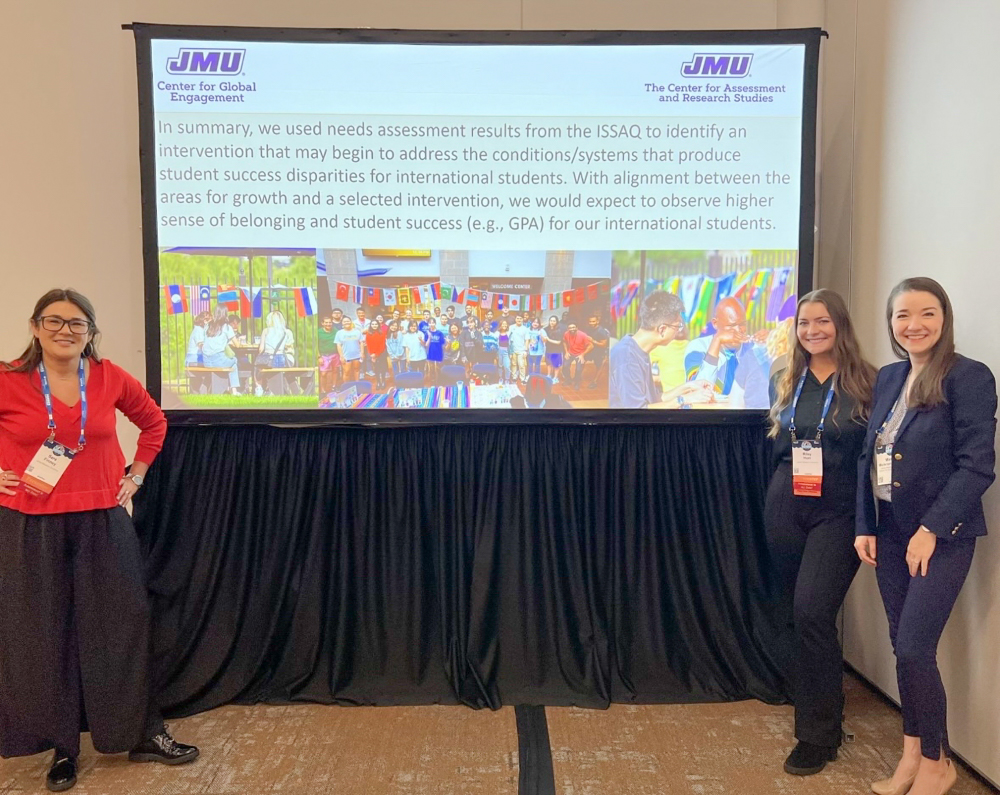
Backing up to the genesis of the research, the change in behavior of international students coincided with Meikrantz Sharp’s College Student Personnel Administration master’s program and her practicum with Dr. Sara Finney in the Center for Assessment and Research Studies (CARS). According to Meikrantz Sharp, “We realized we no longer had a good sense of our student population, what they were doing, or what concerns they had.” She brought up what she was noticing with Dr. Finney, who suggested a needs assessment to learn more. After exploring their options, they decided to use the Incoming Student Skills & Attitudes Questionnaire (ISSAQ) to measure 12 non-cognitive factors that might shed light on the noticed changes in international students.
The next step was to perform a survey with the ISSAQ, which was no easy task. Since international students at JMU are not a monolith, they all have their own interests and social groups that do not all come together as a unified group. Many are athletes or musicians; some are graduate students with families, and all students have extra demands on their time. Getting them all to take the ISSAQ required an extra push from Meikrantz Sharp and the ISSS team to get enough participation to have a good sample size that would form the foundation of the research. “We tried to get everyone in one room with food, t-shirts, whatever it took,” she said. Ultimately, they received an impressive 52% response rate from international students, which was enough for them to work with and extract meaningful insights.
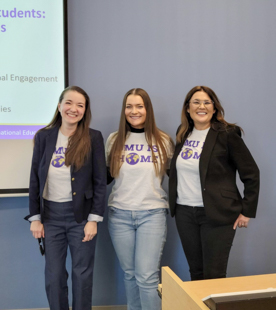 After the survey portion of the research was finalized, making sense of the data was the next step in the process. This is where Meikrantz Sharp was thankful for the expertise of Dr. Finney, Graduate Assistant Riley Herr, and the rest of the CARS team. “They do magic” Meikrantz Sharp joked, “I don’t know how they do it.” Part of understanding the data was figuring out if their survey was representative of the larger population and where student groups were over or under-represented. For instance, did they have too many respondents who were native English speakers, or too few respondents from Africa? All the different variables factor into what they can confidently conclude from the research. “The collaboration with CARS was huge” Meikrantz Sharp said, “They brought expertise we didn’t have, and we provided context that brought the data to life. It made the research far stronger.”
Once the analysis was complete, the research would change how Meikrantz Sharp and the ISSS team approach their work. The results were striking: the 12 non-cognitive factors assessed in the ISSAQ account for 23% of GPA variation among international students. Of the factors they looked at, sense of belonging was the most impactful factor affecting student success. In other words, how connected students feel to their campus community has a measurable effect on how they perform academically. The strength of this finding was shocking for the team, so much so that Dr. Finney re-ran the analysis to make sure what they were seeing was accurate. The surprising strength of this connection was the aha moment for Meikrantz Sharp and the staff of ISSS. If you want international students to succeed, they need to feel a sense of belonging. A simple but powerful result from their months of work.
Once convinced of their results, the next step was two separate things: publish the findings and, more importantly, reshape the mix of ISSS programming to strengthen international students’ sense of belonging. This shift was not immediate. ISSS had long balanced social events, career readiness initiatives, and expanding professional networking opportunities, so rethinking the mix took some time and effort.
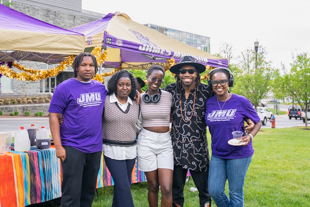 Armed with the research, they began incorporating new kinds of programs, knowing that success could mean better student outcomes. They created more opportunities to interact with domestic students, social gatherings designed to help foster relationships, like the Global Café and Ramen Rendezvous events. They also responded to student feedback to organize an international variety show and add more trips off campus to explore the region. Together, these events complemented their existing offerings, but placed more emphasis on deepening connections, increasing engagement, and helping students build authentic relationships that underpin a true sense of belonging.
 On the publishing side, the process was not as smooth. Even with compelling results and a novel subject, finding the proper forum for their research proved difficult. It was a tough introduction to the world of academic publishing for Meikrantz Sharp. “We spent months just waiting. That was one of the most frustrating parts of the process” she said, “I have so much respect for people who publish regularly.” Despite the waiting, revisions, and a change of publishing venue, they eventually settled on the Journal of College Student Retention: Research, Theory, and Practice as the home of their paper, which ended up being a much smoother process. There are international student offices in almost every college and university who could benefit from this research, and because the topic is still relevant, Meikrantz Sharp hopes this will be used as a reference point for her colleagues in the field beyond JMU to positively affect programming for students.
What began as a simple observation evolved into research that is now shaping how international students are supported at JMU. It was a years-long process for Marlee Meikrantz Sharp, and the work is far from over. Her dedication to understanding the challenges took her many places to find answers, the most noteworthy elements being the robust collaboration with her co-authors in CARS, her commitment to using established assessment practices, and her perseverance despite challenges during publishing. The end result being not just a landmark finding for international student success in higher education, but also a significant change in programming that bolsters the sense of belonging for international students at JMU.


