

Dr. Joanne V. Gabbin: A Rare Container of Unconditional Love
Love took center stage during the Furious Flower Broadside Gallery Exhibit launch, Oshun Rising, curated by Dr. Joanne V. Gabbin
News


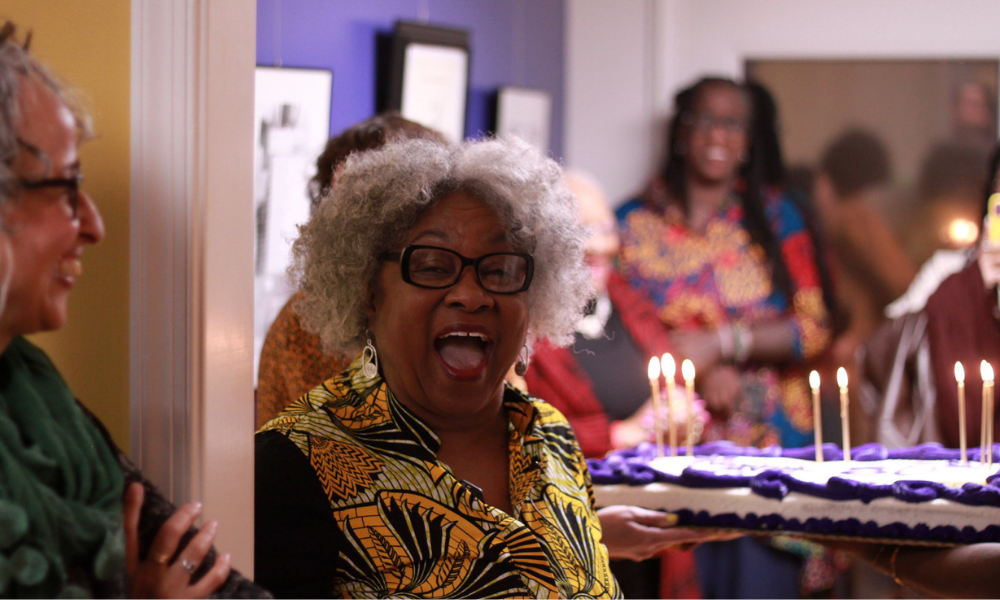
SUMMARY: Love took center stage during the Furious Flower Broadside Gallery Exhibit launch, Oshun Rising, curated by Dr. Joanne V. Gabbin. Unbeknownst to her, the event doubled as a party for her 80th birthday.
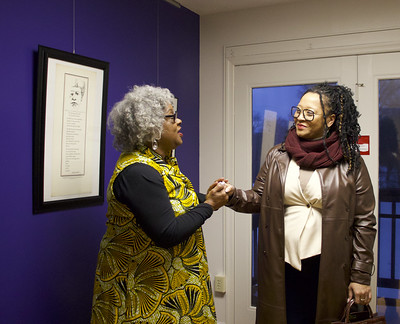
Love took center stage during the Furious Flower Broadside Gallery Exhibit launch for Oshun Rising, curated by Dr. Joanne V. Gabbin. The exhibit features eight poetry broadsides about different types of love: love between friends, familial love, romantic love, and self-love, all inspired by the West African deity of love, Oshun. Unbeknownst to Dr. Gabbin, the event doubled as a party for her 80th birthday. Cardinal House filled with one unexpected face after another, and each new guest entered with their own story of how she had changed their life through her work at Furious Flower and beyond. It was her night, but in the true spirit of Dr. Gabbin, she included others during her curatorial talk. She invited friends, mentees, and her daughter, Jessea Nayo Gabbin, to share their thoughts about what love and Oshun meant to them, their descriptions reflecting that everything she knew to be true about love came from others.
For Dr. Alexander Gabbin, her husband, the roots of her love ethic started with her mother: “The thing that is obvious about Joanne from the very, very beginning is she is clearly her mother’s daughter,” Dr. Alexander Gabbin said. Dr. Joanne V. Gabbin, a Baltimore native, saw the power of unconditional love for one’s community under the tutelage of her mother, Miss Jessie Veal. Her mother’s love was demonstrated through the unlikely avenue of real estate acquisition. Following a negative encounter with a landlord who raised their rent after seeing the improvements they'd made to the home, disgusted with his greed and opportunism, Miss Veal started purchasing auctioned-off properties to renovate and rent them, most particularly, to single Black mothers, a population vulnerable to housing exploitation. These initial lessons in place-making, backed by a desire to see one’s community prosper, shaped Dr. Gabbin's early worldview and created an ethic she has carried throughout her entire life.
Dr. Gabbin took these lessons and set about the work of identifying the lack and creating spaces for others through the lens of her own passions. The most obvious results of this are the Furious Flower Poetry Center and the Wintergreen Women Writers Collective. Before all of the legacy building that has made Dr. Gabbin a living legend, her husband remembered her earlier campaigns, like the fight to create space for George E. Kent at the University of Chicago, a prolific professor of African American Literature, who had not received the designation of full professor. “She went ahead and got together all these other Black students, me included, out of the business school and other places to go ahead and sign a letter saying we wanted George Kent to be there in the English Department as a full-time faculty member,” he recalled, “Sure enough, she got enough motivated folk around the school to sign on to the letter to say we thought this very qualified, highly competent, very good professor should be there as a doggone professor in the English department…he became a professor, just like that,”. Thanks to her efforts, George E. Kent became the first Black tenured professor of English at the University of Chicago, serving from 1970 until his passing in 1982.
This is just one example of Dr. Gabbin’s ability to create a way where previous perceptions said there was none, thelove that she had for black scholars and creatives, and her ability to advocate for space for them. In her quest to create and take up as much space as possible for Black Literature, she also found herself becoming a mentor and literary mother by proxy to many. One such person is Dr. Jamiee Swift, Assistant Professor of Political Scienceat JMU. As Dr. Gabbin celebrates her 80th year of life, many are working diligently to give Dr. Gabbin the flowers she provided for others, including Dr. Swift, who is the editor of a forthcoming anthology, A Furious Flower Blooms, comprised of papers written to honor the intellectual and political leadership of Dr. Joanne Gabbin. “People look at her as a light, a beacon,” Swift replied when questioned on what surprised her about the submissions to her anthology, “People just have the utmost respect for her and hold on to the wisdom that she’s imparted.”
Looking at Dr. Gabbin’s CV might cause some to question their own work ethic; after all, she has the same amount of time in her day as everyone else. Some may glance at her success and downplay it as luck, destiny, or the guilty acquiesce of others, but those who have taken the time to get to know Dr. Gabbin and study her work find encouragement in her struggles as well as her triumphs “It’s funny how people look at their North Stars and see the very polished, the books, the success, the prestige, but they don’t get to see the tears, the trials, the things that she’s overcome,” says Dr. Swift, “People should know that she has overcome a lot and paved the way for so many of us and it has required sacrifice.” It’s a sacrifice that’s often silent, because Dr. Gabbin manages to exude true joy even in times of hardship, and she has spent years dedicating her life to cultivating this unbridled joy in others. Like the Mourning Katrina Project, released just one year after the powerful Category 5 hurricane that devastated the city of New Orleans. Many of its residents, whether they had the means to evacuate or not, were left to fend for themselves by the very government that promised them protection and recovery. Released first as an audio CD, then as an anthology, the project provided a therapeutic and public outlet for those affected to memorialize their experiences, lest anyone try to efface their suffering.
Her impact is clear before ever addressing the first Furious Flower Conferences, and the resulting academic center that transformed the landscape of recognition and opportunity for Black poets everywhere. Within the framework of JMU, Dr. Gabbin’s work with the Furious Flower Poetry Center and her insistence on documenting everything have led to what Professor and Dean of JMU Libraries Dr. Bethany Nowviskie called “the greatest audiovisual collection of black poetry and spoken word in the world.” Together, these two women spearheaded the writing of a 2-million-dollar grant that was awarded from the Mellon Foundation, ensuring over three decades of work at Furious Flower be digitized and made more readily accessible.
Summarizing the legacy and impact of Dr. Gabbin into a single article is simply not possible, but there are many ways available for researchers, scholars, and poetry enthusiasts to engage more deeply with her work. A great
place to start is the Furious Flower Poetry Center’s Website, where an entire section of the site is dedicated to Dr. Joanne Gabbin’s life and legacy as it relates to poetry and the Center. There, researchers will find a brief bio alongside an extensive resource of articles and books written by and about Dr. Gabbin, as well as video interviews and a timeline of her life. Those seeking a deeper, more interior focused view can comb through the JMU Library’s special collections, where Dr. Gabbin has donated all her papers, manuscripts, email communications and more, “It’s a tremendous honor for us as a university library, not only to house Dr. Gabbin’s personal and scholarly papers, but also the records of the Furious Flower poetry Center,” Dr. Nowviskie wrote in an email interview, “Her influence is threaded throughout our humanities research and teaching collections, which themselves adapted and grew as she showed this campus what deep, interdisciplinary engagement with Black poetry could look like,”.
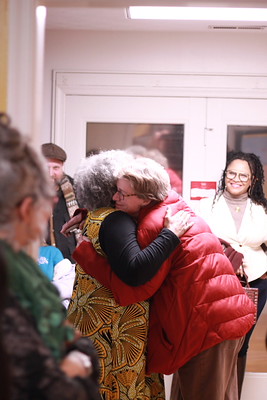
What is obvious about Dr. Gabbin is that there is room in her heart for all people and all things. It was felt in her enthusiasm as she brought several shy friends and loved ones to the center of the Broadside Gallery to talk about love, Oshun, and decades of life dedicated to community. It was also evident in the many hugs, gifts, andlaughter that circulated around the room. Sometimes, the amount of love a person has is best seen through the people who love them.
The official festivities have ended, but you can still visit the Furious Flower Broadside Gallery to view Oshun Rising through the end of March 2026. Their hours are Tuesday – Friday, 9AM to 5PM or by appointment.


