

Why research should move beyond the journal
Madison Scholar discussed ways to ensure the lasting impact of research
News


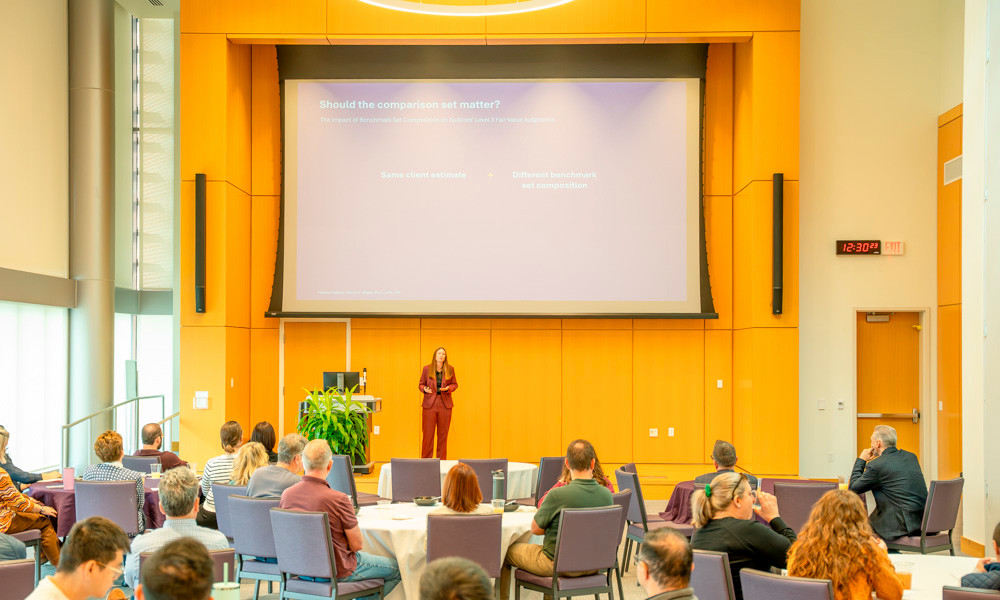
SUMMARY: Dr. Nicole Wright, this year’s Madison Scholar, examined how information, communication, social context, cognitive demands and stakeholder perspectives influence professional judgments.
Every year, professors from each college at JMU nominate a member to be recognized as a Madison Scholar. The award winners exemplify excellence and scholarly achievement in their respective disciplines, and winners present a lecture on their area of expertise during the academic year.
The College of Business Madison Scholar for 2026 is Dr. Nicole Wright (’02), from the School of Accounting. She delivered her presentation “The Things We Don’t Think Should Matter: Why Good Research Should Leave the Journal” on October 23 in Hartman Hall Forum as part of the College of Business Research Advancement (COBRA) Series.
A CPA, Wright earned a Master of Accounting and Information Systems and her Ph.D. in Business, Accounting from Virginia Tech and a B.B.A. from James Madison University.
Wright said her presentation “explored my research philosophy and how my work connects auditing practice, the classroom and our broader understanding of professional judgment. Through five research studies, I examined how information, communication, social context, cognitive demands and stakeholder perspectives influence professional judgments.”
Taken together, she hoped these studies illustrated her broader research focus: understanding how and why people make decisions, particularly in auditing. Before her presentation, Wright gave a little more in-depth preview of her topic.
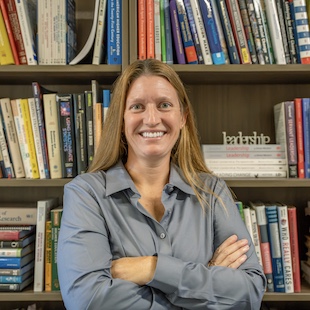 College of Business: You talk about your belief that research should be relevant to practice and inform teaching. Can you expand on that?
Wright: I was fortunate enough to gain a wealth of experience during my time in practice and I always want to give something back to the wonderful accounting profession. I feel like I can do that some with my research. I want to study questions that not only look at possible issues occurring in practice but also seek ways to deal with the identified issues that are practical.
From a teaching perspective, I strive to study current issues or phenomena that will have a lasting effect. As we believe we are preparing our accounting graduates for their future careers, I want my research to have a place in the classroom to make them better at their jobs and aware of potential issues and how to deal with them before they encounter them in the workplace.
CoB: Why do you recommend looking beyond the popularity of a particular topic or technology when pursuing research?
Wright: I definitely think that as scholars we need to look beyond settings and rather to the phenomena. A good example is AI right now. That is a really hot topic, but rather than only focusing on AI, I think a better approach is to try to understand what has changed because of AI. Is it impacting how decisions are being made due to it changing how people critically think? Has AI fundamentally changed communication styles and thus impacts how decisions and judgments are being made? Etc. I think if one only focuses on AI and not the bigger fundamental questions, the study will not have a lasting impact. Technology is constantly changing so chasing the hot topic can become dated very quickly – understanding the impact to specific phenomena will ensure the lasting impact of research.
CoB: As a Madison Scholar, what advice or recommendations do you have for early-career faculty?
Wright: The best advice I can give is to focus on what you find interesting and build a program of research from it. Research is a long, hard process. There will be revisions and there will be rejections, but if you are interested in the topic and believe in the question, a good paper will find the right home. And don’t take things too seriously! We actually have a pretty fun job where we get to focus on what we choose and we can pull from our experiences, what we learn from employers of our graduates and questions that students raise in class. So make sure you’re working on things you enjoy and have fun with it.
CoB: The value of research is often viewed as publication, but you believe good research should do more than that. Can you elaborate?
Wright: Big picture, I think good research should have the capability of “leaving” the journal. By that, I mean I think research should be practical. From my personal experience, I get frustrated with what would be considered a publication from a top tiered journal, but it is meaningless for practice because of the low external validity. I don’t want to knock a creative testing method or a theory heavy paper, but as a previous practitioner I think it is our duty to take realistic applicability to practice into account. With that said, I also think it is our duty to not only point out the problems but realistic interventions or solutions that practice can reasonably implement. With a partnership between practice and academia, I think we can make accounting professionals better. I think this links nicely to the classroom. Students want to understand what their potential careers will look like, even their day-to-day. By focusing on how research can leave the journal and aid in teaching either by making students aware of biases or impacts to judgment and decision making, we can prepare them better for their careers.


