

Marketing students partner with Dian Fossey Gorilla Fund
News


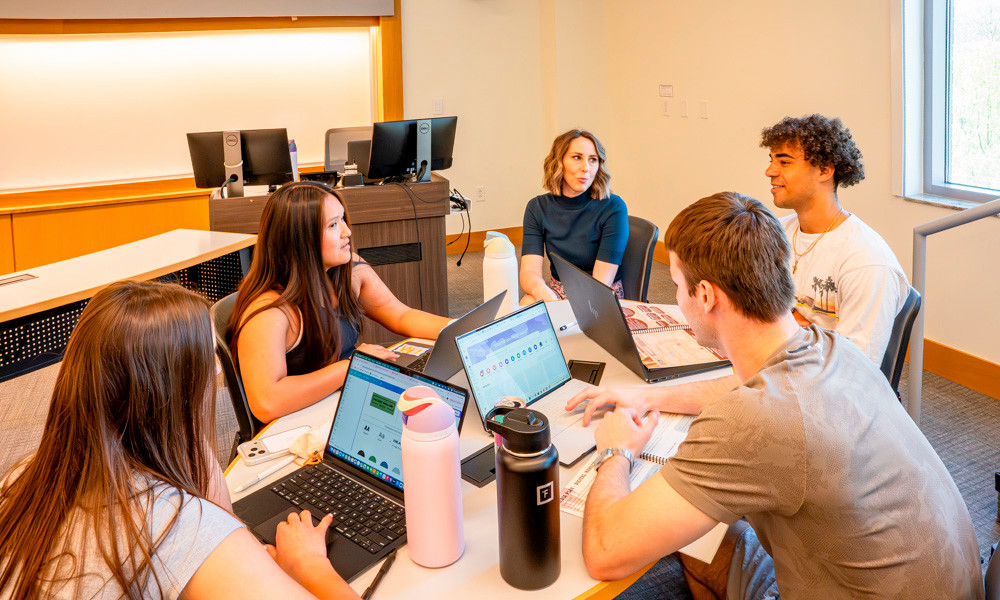
SUMMARY: Through a semester-long project with the Dian Fossey Gorilla Fund, JMU marketing students gained hands-on experience creating nonprofit marketing strategies while exploring a different side of the industry.
For students in a James Madison University marketing course, a semester-long assignment became an opportunity to apply their skills beyond the classroom with a global organization.
In MKTG 384: Integrated Marketing Communications, student teams developed marketing plans for the Dian Fossey Gorilla Fund, a globally recognized nonprofit with decades of conservation impact. The project concluded with students presenting their ideas directly to a representative from the organization.
Over the course of the semester, students developed their plans step by step, starting with in-depth research into the organization, its audiences and the broader conservation landscape. From there, teams identified target audiences, developed core messaging and creative direction, and built out campaign ideas across platforms such as social media, digital, video and print, along with a budget, timeline and plan for measuring success.
Cecilia Bolling, a junior marketing major, explained that oftentimes students are asked to work on projects for hypothetical clients or businesses, but working with an established brand offered something more concrete. “That makes everything feel more real,” she said. “It’s easier and harder at the same time—easier because there’s a real story to tell, but harder because everything has to be factual and accurate.”
That emphasis on accuracy and accountability is a key part of the learning experience, said Erika Archibald, communications specialist at the Dian Fossey Gorilla Fund. “Real-world work is something you just can’t replace,” she said. “You can learn concepts, but until you apply them, you don’t fully understand what matters.”
The nonprofit partnership also challenged students to rethink what effective marketing looks like. “I feel like marketing can get a bad rap sometimes,” Bolling said. “People think of urgency or sales-driven tactics. This flips that idea—it’s more purposeful.”
Rather than promoting a product, students focused on communicating the organization’s mission and impact, developing strategies to engage donors and raise awareness of conservation efforts. “They understood that these are donors, not customers,” Archibald said. “There wasn’t really a sales feel to it.”
Along the way, students also built practical skills in areas such as audience targeting, digital strategy and cross-platform messaging.
For Bolling, those lessons are already translating beyond the classroom to her internship, where she applies similar strategies to reach different audiences on platforms like Instagram and Facebook.
While the project centered on student learning, the collaboration also gave the Dian Fossey Gorilla Fund a fresh perspective on its own communications.
“We rarely get that many people studying what we’re putting out and telling us what they understand,” Archibald said. “That’s incredibly useful.”
Student teams developed a range of campaign ideas, including concepts tied to the organization’s upcoming 60th anniversary, while also navigating real-world challenges such as shifting timelines and evolving information.
For Archibald, the partnership reflects a broader benefit of working with academic collaborators.
“If we help educate students about communication or conservation,” she said, “then we’re furthering our mission in another way.”


