

Students lead as JMU hosts national AIS conference
News


SUMMARY: James Madison University hosted the 2026 AIS Student Chapter Leadership Conference, welcoming students from 18 universities nationwide.
For two days in late March, James Madison University became a national hub for emerging leaders in information systems as it hosted the 2026 Association for Information Systems (AIS) Student Chapter Leadership Conference (SCLC), welcoming student chapter members and faculty advisors from across the country to compete, share ideas and connect with one another.
Co-hosted by JMU’s College of Business and the Department of Computer Information Systems and Business Analytics, the conference brought 180 students from 18 universities nationwide to the halls of the Learning Complex. Hartman and Showker Halls buzzed with team presentations, interactive workshops and speaker engagements as students moved between competition rooms and networking sessions.
The AIS SCLC is the premier national gathering for undergraduate students pursuing careers in artificial intelligence, business analytics and cybersecurity. Each year, the conference blends leadership development with active learning, challenging students to turn complex case prompts into practical, ethical and data‑driven solutions.
After attending the AIS SCLC for multiple years, JMU’s AIS student chapter was inspired by the quality of the conference and the impact it had on students and corporate partners. “We felt that JMU could provide a similar experience, given the renovated Learning Complex and the accommodations we’re able to provide,” said Jessica Reeves, president of JMU’s AIS chapter and the conference’s financial coordinator.
The JMU AIS student chapter leadership team worked with faculty advisors and the College of Business to submit a formal proposal to host the 2026 conference. After review, the AIS committee selected JMU based on its location, available facilities and ability to support a national‑level event—a process that required demonstrated student leadership, institutional commitment and financial planning.
While the conference brought national attention to campus, much of its success stemmed from months of student‑led planning. JMU’s AIS student chapter leaders coordinated nearly every aspect of the event, including budgeting, sponsor outreach, conference scheduling, volunteer coordination and program design. The team worked closely with faculty advisors, industry partners and alumni to manage logistics and ensure a smooth, engaging experience for all attendees. “Being part of this process as an undergraduate was incredibly rewarding,” said Shaina Lim, conference committee program lead. “It challenged me to think critically, collaborate across teams and take real ownership of a national‑level student conference.”
At the center of the conference were four industry-sponsored competitions that challenged student teams to address real-world scenarios:
- Artificial Intelligence: AI Driven Talent Optimization, sponsored by EY
- Business Analytics: Data-Driven Decision Making, sponsored by CGI
- Cybersecurity: Strengthening Cyber Defense in Financial Services, sponsored by KPMG
- Cybersecurity & Risk Analysis: Securing Critical Infrastructure Supporting Data Centers, co-sponsored by Mr. James Elliott and Microsoft
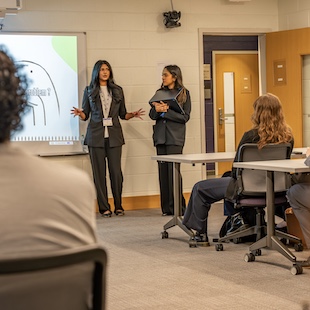
Student competitors presented their solutions during multiple rounds of judging and responded to questions posed by a panel of academic and industry judges. Top teams were recognized with first‑, second‑ and third‑place awards in each competition category, with prize amounts ranging from $500 to $2,000. JMU’s team took third place in the Cybersecurity: Strengthening Cyber Defense in Financial Services challenge, and JMU’s chapter won awards for Outstanding Communications and Outstanding Membership Activities.
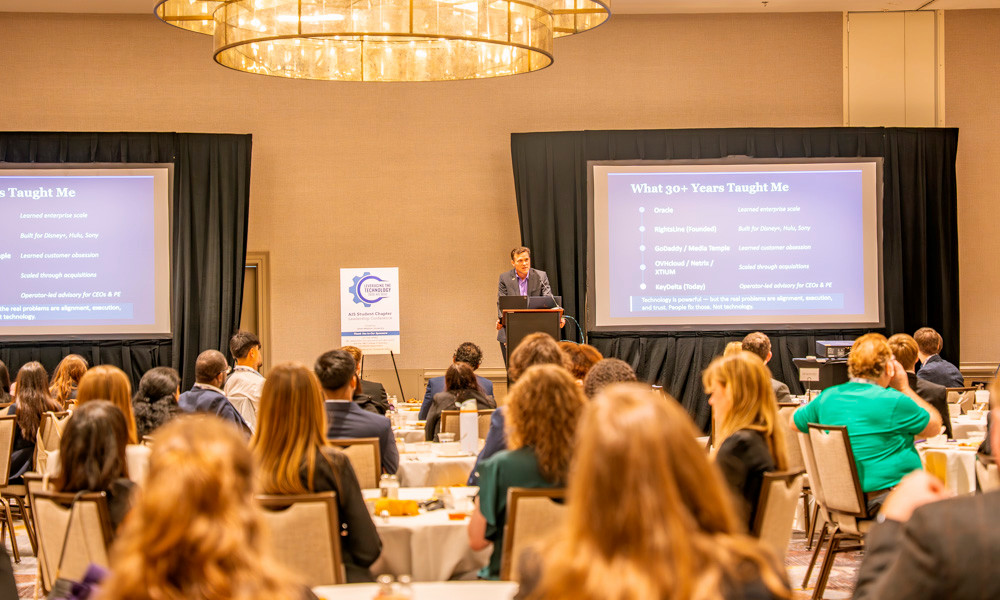
Beyond the competitions, students participated in hands-on workshops focused on leadership, artificial intelligence and career development. The conference concluded at Hotel Madison with a formal awards dinner and keynote address by JMU alumnus and technology executive Russ Reeder (‘94), who spoke about responsible AI adoption, career pathways within the industry and the importance of adapting with changing technologies.
The conference’s impact extended beyond awards and presentations. For visiting students, the event offered collaboration, unique challenges and professional growth. For JMU students, it was proof that they could lead at a national level—managing logistics, engaging industry partners and shaping an experience for peers.


