

ISAT student develops portable water purification system for disaster response
Chart a New Path as a National Research University


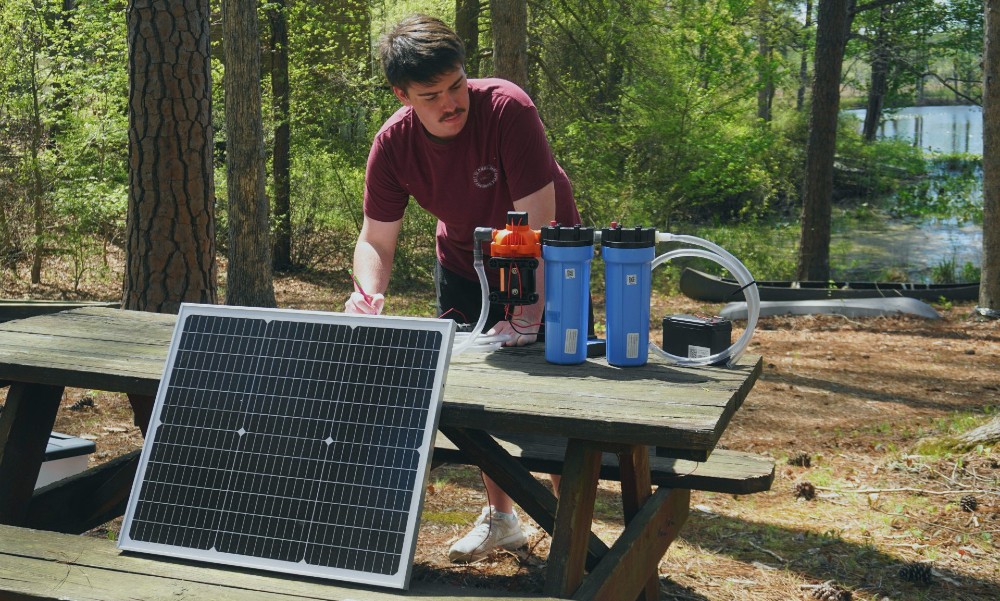
SUMMARY: Landon Pumo ('26) develops a portable, solar-powered water purification system designed to provide safe drinking water after natural disasters. The affordable prototype provides families with a practical way to access clean water while communities recover and critical infrastructure is restored.
Natural disasters can devastate entire communities, damaging homes, roads and critical infrastructure. In the aftermath, one of the most urgent challenges is often access to safe drinking water.
Landon Pumo ('26), an Integrated Science and Technology major, had long been interested in water purification. The widespread devastation caused by Hurricane Helene and water supply issues in Richmond inspired him to channel that interest into his capstone project: a portable, solar-powered water purification system designed for disaster response.
"Those events kind of shifted my focus more toward natural disaster relief rather than just a broad purification device," Pumo said.
As communities struggled with damaged infrastructure and limited access to clean water, Pumo began thinking about how engineering and technology could help people navigate the difficult days following a disaster.
Under the guidance of Dr. Steven Frysinger, ISAT professor and capstone advisor, Pumo set out to design an affordable, portable water purification system using readily available materials and off-grid power. His goal was to help families secure their own drinking water while waiting for infrastructure repairs or emergency assistance.
Before building the prototype, Pumo researched emergency water supply standards set by organizations such as the World Health Organization and the Sphere Association, which helped him understand the requirements for providing safe drinking water during disasters. To keep the system practical in disaster situations, he intentionally designed it around standard components available at local hardware stores.
Throughout the design process, Pumo weighed performance against practicality. While UV disinfection was an option, he ultimately chose chlorine because it offered a lower-cost solution for users who may already be facing financial hardship after a disaster. “I went with bleach to keep it as affordable as possible,” he said. “UV disinfection would work, but it would drive up the price.”
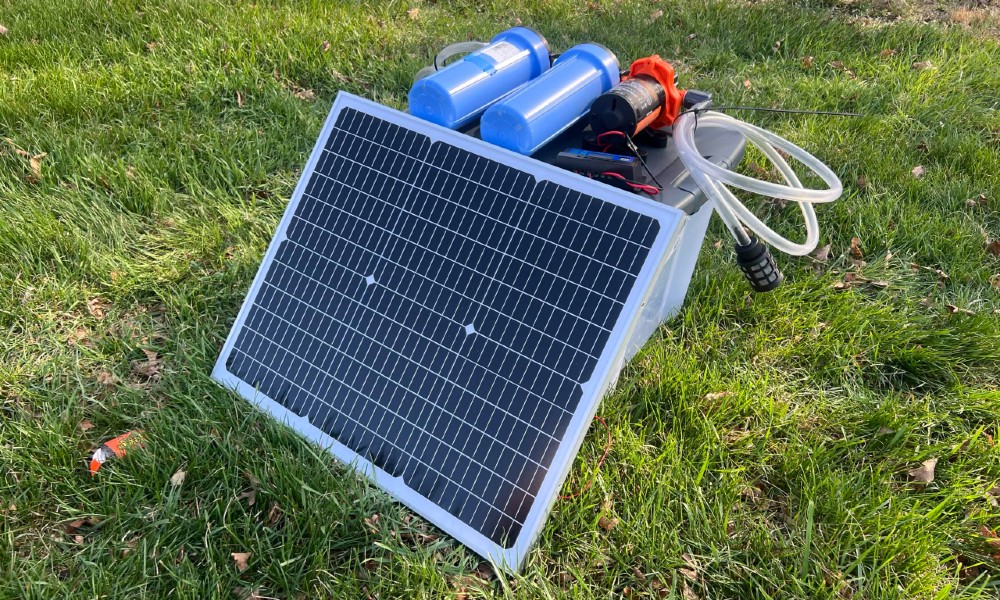
While the final design appears straightforward, creating a working prototype proved challenging.“It was hard,” Pumo said. “Taking a conception and figuring out how I was going to make it a physical prototype.”
One of the biggest setbacks came when the wrong water pump arrived, delaying construction and limiting the amount of testing he could complete before the project deadline.“I had the wrong pump come, and that really cost me,” he said.
After months of research, sourcing parts and troubleshooting challenges, seeing water successfully move through the system validated the effort required to transform an idea into a working prototype.“When I got it put together and finally ran some water through it, that was a big moment for me,” Pumo said. The finished prototype reflects the priorities that guided the project from the beginning: affordability, portability and ease of use.
The solar-powered filtration and disinfection system is designed to operate off-grid. Using a rechargeable lithium-ion battery and solar panel, the device powers a water pump that moves water through multiple purification stages before a final disinfection step.
Based on average household size data from the U.S. Census Bureau, Pumo estimates the system could provide roughly three days of drinking water for a typical household on a single battery charge.
“The biggest thing left is lab testing,” he said. “Taking real samples and running them through the device. Introducing known contaminants and testing its effectiveness.”
He also hopes to improve portability through features such as foldable solar panels and a more compact carrying case. “A foldable solar panel could be effective,” Pumo said. “I would like to see how I could scale it up to help more than just one family at a time.”
For Pumo, the project has always been about more than building a filtration system. It's about giving families a practical way to secure safe drinking water when they need it most.


