Beyond the bedside: Ayana Brown's RN-to-BSN journey
College of Health and Behavioral Studies


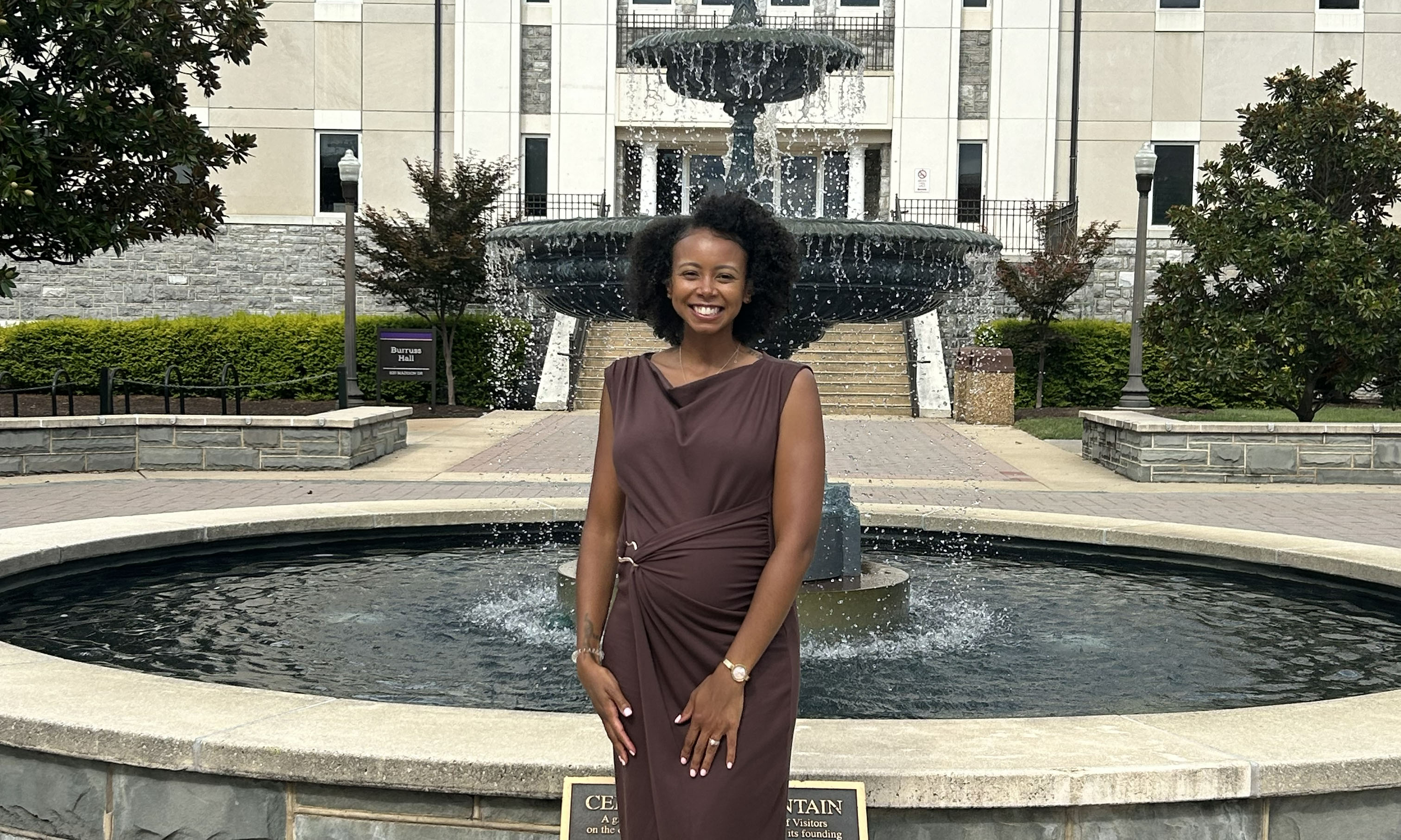
SUMMARY: Through James Madison University's RN-to-BSN program, Ayana Brown transformed her nursing experience into a foundation for leadership, patient advocacy and community service.
For Ayana Brown (‘22), a James Madison University (JMU) Bachelor of Science in Nursing (BSN) alumna, nursing has always been about more than providing medical care. It is about showing up for people during some of the most vulnerable moments of their lives and making sure they have the support they need long after the immediate crisis has passed.
Brown first began to understand the power of that support as a child. She watched her grandmother care for two family members living with dementia, witnessing firsthand the physical and emotional demands of caregiving. But she also noticed something else: when those family members were met with patience, attention and compassion, their behavior often changed.
“I was like, this is what people need,” Brown said. “Just being available, someone being vulnerable and just taking the time to be present with them.”
These early experiences shaped her desire to become a nurse, and ultimately, her commitment to advocating for patients and their families.
Today, Brown’s journey reflects how a JMU education can help healthcare professionals expand their leadership knowledge and turn that knowledge into meaningful community impact.
For Brown, a JMU degree was a goal worth pursuing, even when her path looked different than she had initially imagined.
After earning her associate degree, she continued working toward her goal of completing her BSN at JMU.
“I know this is a part of my calling and my purpose and what I’m supposed to do,” she said.
Her connection to JMU began with the environment she experienced during her first campus visit.
“It felt very welcoming, just in that transition of coming in and doing an orientation or doing a tour,” Brown said. “If you had questions, they could be answered seeing the simulation lab and how involved you can get. It was like real life.”
JMU remained her goal throughout her educational journey.
“I knew after I got my associate degree, I still wanted to finish at JMU,” she said.
The university’s online RN-to-BSN pathway offered a way for Brown to continue her education while building on her experience as a practicing nurse.
“Even though the program wasn’t in person, I still felt like I could reach out to my instructors,” she said. “I felt like I had that support I needed, even being all the way in Baltimore."
For Brown, returning to school was not simply about earning another degree. It was an opportunity to better understand the reason behind the care she was already providing.
She said one of the most valuable aspects of earning her BSN was developing a stronger understanding of evidence-based practice: the research and clinical evidence that inform decisions about patient care.
“I think in the traditional associate’s program, you’re getting hands on experience, you’re doing your clinicals and things like that,” she said. “But with the BSN, I was able to understand the evidence behind a lot of things and then implement that at the bedside.”
That deeper understanding helped Brown see patient care in a broader context. Nursing was not only about responding to immediate medical needs; it also involved evaluating care, asking questions and considering how healthcare systems could better support both patients and the professionals who care for them.
Her BSN has helped prepare her for opportunities beyond direct patient care, including utilization review nursing. In that role, she reviewed medical records and clinical documentation to help determine whether a patient’s care met the criteria required for insurance coverage.
The experience gave Brown another perspective on the many decisions that shape a patient’s healthcare journey. It also reinforced how nursing knowledge can be applied in different settings, from the bedside to administrative and leadership roles.
“I think having a BSN makes me more well-rounded so I could be able to go in these different positions and to these different rooms that maybe I'd never thought I would be in,” she said.
For Brown, the degree represents more than a professional credential. It has helped her develop the knowledge and confidence to contribute in settings she might not have considered earlier in her career.
“Someone sees RN BSN and they’re like; she spent time doing this,” Brown said. “It’s not just letters behind her name, but she took the time to educate herself so now she can be a better asset to the community or the people that she’s serving.”
She encourages nurses who are considering returning to school not to let the process become a reason to delay their goals.
“You’re already doing the work as a nurse,” Brown said. “Just enroll!”
That commitment to serving people beyond the immediate moment of care has become central to Brown’s work as a business owner.
Alongside her husband, she founded KinBridge Senior Solutions to help older adults and their families navigate the transition from a hospital or skilled nursing facility to the next stage of care. Depending on their needs, that transition might involve independent living, assisted living, memory care or additional support at home.
For families who want their loved ones to remain at home, KinBridge helps them connect with resources such as companion services and home health care. The business also helps families identify assistance for essential equipment and supplies, including accessible wheelchairs, glasses, adaptive equipment and other assistive devices, particularly when financial resources are limited.
Brown sees this work as an extension of the advocacy she developed as a nurse. A hospital discharge may mark the end of one phase of treatment, but for patients and their families, it often marks the beginning of a new set of questions and challenges.
“I feel like there’s such a gap for the nurse, she does her discharge paperwork, and the patient’s gone. You don’t know what happens,” Brown said. “And there’s a lot of patients and families that are left in the dark and they don’t really know what to do after discharge or they may not feel like their loved one is safe.”
“The RN to BSN path, becoming a nurse, being at the bedside, all of it has helped me to become a better advocate for patients and their families,” she said.
Brown’s commitment to care extends beyond her professional work. She also wants to help the next generation of healthcare professionals find their own paths.
In 2017, while working at Sentara Rockingham, Brown received support from We Believe in Your Child Too, a nonprofit organization that recognized her determination to enter healthcare. The organization helped her secure the funding she needed to participate in the nursing care partner program, giving her an important source of encouragement as she pursued her goals.
“They saw my motivation and how intentional I was about getting into healthcare and becoming a nurse,” she said. “And so, this nonprofit (We Believe in Your Child Too) decided to help me and give me assistance, basically starting their own foundation to kind of help me get the funds that I needed to get through the nursing care partner program.”
That support became part of Brown’s story, and now she is helping extend similar opportunities to students. A scholarship established in her name supports students from her former high school who are interested in healthcare or health sciences and are enrolled in the Health Sciences Academy program.
The scholarship considers not only students’ interest in healthcare but also their perseverance through adversity.
“We see who would uphold the scholarship, through perseverance and through adversity, and ask, ‘What are some of the things that you’re going through that the scholarship could help you with?’” she said. “Because that’s all part of my story.”
Brown has also had the opportunity to speak in her hometown about the range of career opportunities available in nursing. For her, sharing those possibilities with younger students is another way to help others see a future in healthcare, even if their paths are not straightforward.
“It gave me an opportunity to be a leader in that way and share with another generation about what’s out there,” she said.
Brown knows firsthand that the path to becoming a nurse, and continuing to grow as one, does not always unfold as planned. Looking back, she is grateful that an alternative path allowed her to reach a goal she had held onto from the beginning.
“It was a very difficult journey for me to get here,” Brown said. “Like I said before, getting deferred by JMU, not being able to get into the traditional program, having the option to even do the RN and BSN program; I’m even grateful that that was another option. Not all schools offer that.”
For nurses considering their next steps, Brown encourages them to keep going, even when the work feels difficult.
“It’s easy to stop. It’s harder to keep going even when it’s hard. How can you really embrace this learning for yourself?” she said. “It’s not just for you, it’s for everybody around you, even your parents, your grandparents and your family. You can educate them, you know, and having that education I think just makes all the difference. Don’t lose hope, don’t lose faith because if it’s meant for you, it’s going to happen.”
In many ways, this work brings Brown back to the lesson she first observed in her grandmother’s caregiving: people need more than medical interventions. They need someone willing to listen, understand their circumstances and help them determine what comes next.
For Brown, the value of her JMU education, and the RN-to-BSN path is reflected in what she can do with it. Today, Brown carries all she has learned with her, ensuring that families and patients do not have to navigate what comes next alone.