

For 25 years, a JMU class has made a difference far beyond campus
Caregivers Community Network builds connections across generations
College of Health and Behavioral Studies


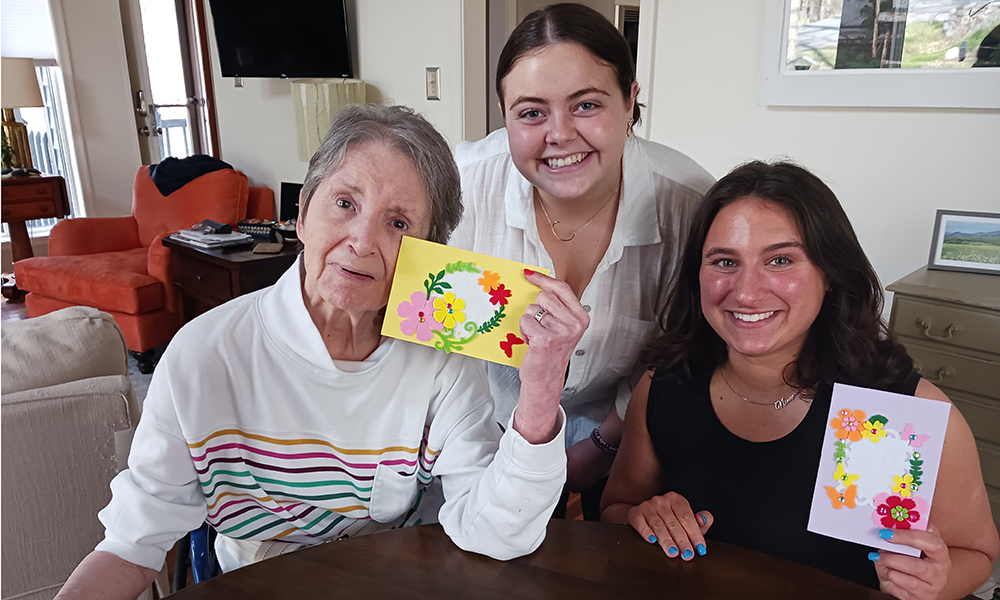
SUMMARY: For 25 years, JMU’s Caregivers Community Network (CCN) has connected students with older adults and family caregivers, providing companionship, support and respite while giving students hands-on experience in aging, caregiving and dementia. Launched in 2001 by retired School of Nursing director Merle Mast, the program has grown into a collaboration between the Valley Program for Aging Services and JMU’s Institute for Innovation in Health and Human Services. Along the way, CCN has created lasting relationships, supported local families and helped shape JMU’s interprofessional approach to health and human services education.
When professor Merle Mast launched a class in 2001 for James Madison University students to learn about and to help meet the needs of older adults and their family caregivers, it was immediately popular, but she didn’t know how long it would last.
The program needed a director to identify families, pair them with students and schedule visits. "From year to year, I never knew if we would have the funds to hire directors and sustain the program. But I knew it had a powerful impact on both students and the families they served,” said Mast, retired director of JMU's School of Nursing, reflecting on the birth of the Caregivers Community Network.
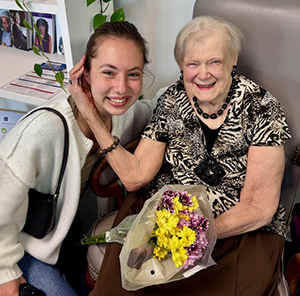 Now in its 25th year, the class has evolved into a collaborative effort between Valley Program for Aging Services, which often recommends families for CCN, and JMU's Institute for Innovation in Health and Human Services. Students enroll in CCN (IPE 313) as either a one-credit course or, for those with a gerontology focus, a two-credit capstone experience.
While students provide companionship and support for adults 60 and older, they also offer valuable respite for family caregivers, many of whom spend much of their time caring for a loved one and have little time for themselves.
Students benefit by gaining a strong educational foundation in aging, caregiving and dementia. Trained to make weekly home visits throughout the fall and spring semesters, they earn college credit while building relationships that often leave a lasting impression.
Nina Cinotti, a recent student in the course, said spending time with an older adult opened her eyes.
"I used to have a lot of assumptions, but it just shows how much individuality and life experience a person has, and I truly learned a lot by just hearing what these families had to say," she said.
Another student, Abigail Flowers, found something unexpected: friendship.
"A lot of the older adults in my life were my family, my grandparents, things like that, but I truly became friends with these families," Flowers said. "I consider Miss Susie to be my friend, and I think that relationship was so unique compared to others I've had in the past."
Rachel Myers said her experience taught her to be humble. "Learning about dementia, caregiving and our older adults is so beneficial to college students because it teaches you how to serve others. You quickly learn that you don’t need recognition in everything you do. You don’t need a thank you each time you complete something. And you don’t need any sort of medal for what you do. Caring for others has truly grown my heart and has taught me to practice humility daily."
Although the course might seem geared toward students pursuing careers in health care, it is open to students from any major.
"I have students repeat the course," said Kathy Guisewite, who has directed CCN since 2017. "It's always amazing to me because a lot of times it's a student who is sort of, 'I'm not sure about this.' Then the following semester or a year later, they're getting permission from their advisor to take it again because they loved it so much."
The roots of CCN date back even further than its first class.
In 1998, Mast and Cathy Thomkins, a fellow faculty member, received faculty development funding to conduct a study titled "Disabled Elders and Their Family Caregivers: Perceptions of Unmet Needs." Their research highlighted the challenges faced by family caregivers and reinforced the need for affordable respite services in the community.
The findings helped inspire a program that would benefit both local families and JMU students.
Getting it off the ground required more than a good idea.
 An initial four-year, $340,000 grant from the Virginia Department for Aging provided funding for a director, supplies, publications and other operating expenses.
But sustaining the program proved far more difficult.
"I will say that I was new to nonprofits, and I was pretty naive," Mast said. "I assumed funding would be the easy part. I thought we'd partner with churches, attract donations and keep the program going. What I quickly learned is that nonprofit fundraising is incredibly competitive, and earning sustained support takes a great deal of work."
Over the years, Mast secured a series of grants that helped keep the program alive, including an Alzheimer's Demonstration Model grant from the Virginia Department for Aging, United Way support and research grants that allowed the program to measure outcomes and develop educational toolkits for students and families.
Beyond teaching, Mast's role included strategic planning, budget management and grant writing.
"The sustainability was really the biggest challenge for the program over the years," she said.
The work paid off. CCN earned the Commonwealth Council on Aging's Best Practices Award in Education in 2006, the MetLife Foundation and National Alliance for Caregiving Award for Caregiver Support in 2009, JMU's Provost Award for Excellence in Outreach and Engagement in 2013 and a Commonwealth Council on Aging Second Place Best Practices Award in 2018.
Emily Akerson, an associate director of JMU's Institute for Innovation in Health and Human Services, said CCN also helped lay the foundation for the institute's distinctive interprofessional approach to education.
"Caring for older adults, some of whom are experiencing dementia, is one of the large problems of our time," Akerson said. "It takes more than one discipline. It takes all of our best wisdom and all of our best knowledge."
Just as important, she said, students regularly described the experience as transformative.
"They regularly said not only what they learned, but how they were changed," Akerson said.
For some families, accepting help can take a little convincing.
“When older adults are hesitant about students visiting,” Guisewite said, “they are often swayed when they understand they are contributing to the education of those students. They're helping teach the next generation of health and human services professionals."
Many participants end up staying with the program for years.
"There have been families here almost as long as me," said Guisewite. "There's always new families coming in, too."
In addition to overseeing the student/academic aspects of CCN, Guisewite interacts with the families, including visitng the homes of families that apply to be served by CCN to ensure placements will serve students and the families well. Despite occasional concerns about matching enough students with enough families, the formula has continued to work for a quarter century.
"CCN is a program that is beautifully reciprocal in nature. It offers students the unique opportunity to spend time with older adults each week where they give to and learn from those of a different generation," Guisewite said. "And for the family member who visits with the students, they reconnect with joy and memories and the chance to give back in ways that reconnect them to feelings of purpose. As each person in this equation steps forward, they leave with more than they ever expected."
A 25th anniversary celebration of CCN is scheduled for 1-3 p.m. Thursday, Oct. 29 at the Institute for Innovation in Health and Human Services, 2031 Deyerle Ave., Harrisonburg.


