

How the Wienermobile put one alum on the road to a career in PR
College of Arts and Letters


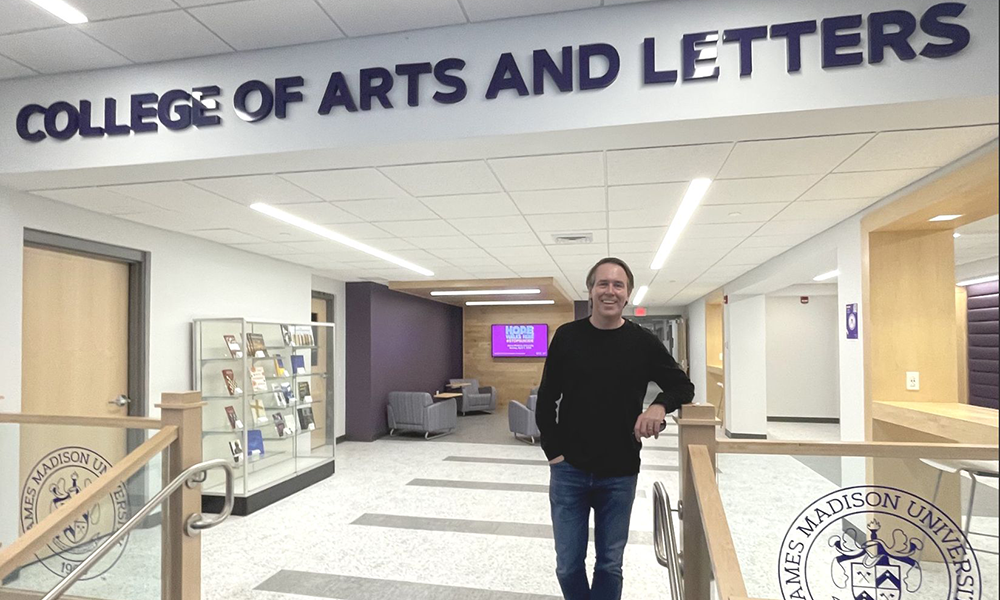
SUMMARY: For Jonathan Rhudy ('95), an unconventional job right out of undergrad — serving as an Oscar Mayer Wienermobile Hotdogger — was exactly what he needed to transition his classroom knowledge into real-world results and start a decades-long career in PR.
As an alum, Jonathan Rhudy (‘95) understands the feelings of uncertainty of the post-grad career hunt. Having a career that dipped into numerous industries and job titles, Rhudy is proof that a college major can be one of many stepping stones in a career journey, rather than the immutable determining factor of a student’s long-term future.
Rhudy’s time with The Breeze, covering the crime beat for three years before becoming the advertising manager for his last year at the publication, gave him real-world experience that translated into his professional life after graduation.
Developing tangible skills, building strong portfolios, and gaining practical experience are hallmarks of the CAL experience. Through opportunities that extend beyond the classroom, the college helps students cultivate the professional skills needed to thrive in a competitive workforce. As he transitioned from college to career, Rhudy drew on the knowledge, tools, and hands-on experiences gained through his coursework, enabling him to find success in a variety of roles, including some of the most unconventional opportunities.
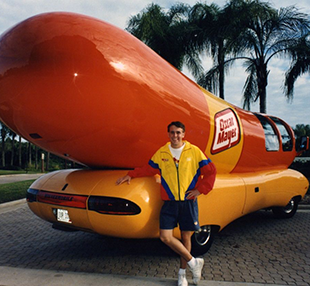 Hotdogging across America
Rhudy’s first job postgrad was serving as Oscar Mayer Wienermobile Hotdogger, driving a 27-foot-long hotdog car across 38 states, totaling around 65,000 miles. This unique work environment helped him understand PR, mobile marketing and advertising at every level and helped Rhudy incorporate his classroom knowledge and student organization experience into real-world results.
“Working as Wienermobile Hotdogger meant driving a giant hot dog, coordinating dozens of events weekly, pitching media and serving as an on-camera spokesperson while serving up meaty puns,” explained Rhudy. “I even brought the Wienermobile back to campus in 1995 to see some of my favorite journalism professors and Pi Kappa Alpha fraternity brothers.”
After completing his year-long contract with Oscar Mayer, Rhudy’s career path took him to more traditional communications and PR roles with Dominion, Capital One and an employee-owned PR firm that is now called Padilla.
Since 2003, Rhudy and his wife, Michele, a 1994 University of Virginia graduate, operate their own strategic communications firm, Rhudy & Co. Strategic Communications serving a wide variety of corporate, nonprofit and entrepreneurial clients. Their oldest daughter, Morgan, a ’25 Honor’s College graduate, also works at the family-run firm.
Tips for imagining your future
When students stand right on the other side of graduation, Rhudy knows firsthand that it can be hard for students to see how their education will translate to a traditional 9-to-5. “I think it's trying to envision, ‘what am I actually going to do with these courses?’ That's always a tough spot for someone who's 20, 21, 22.”
However, Rhudy himself is proof that students can shape their own futures. “The reality is: the job that you may really love may not even exist quite yet. The benefit of this, though, is that the options are limitless and up to each student.”
Rhudy also firmly believes that everybody is creative, despite what they may think. The skill of creativity looks different to everyone and is valuable in many capacities to employers. Employers look for soft skills (like creativity) and may even value these more than a high GPA on a resume. When candidates have developed their soft skills, it shows levels of competency and understanding that can’t always be taught.
“It's important to have diverse work and volunteer experiences that challenge you and make you just a tad uncomfortable,” Rhudy said. “That’s how we all learn and grow regardless of your career path. The world is constantly changing and evolving, and we all need to be lifelong learners.”
Rhudy serves as an outstanding example that through CAL, the most valuable thing a student can graduate with isn't just a degree, but the resilience to navigate a world that is still being written. Currently, he serves on the CAL Alumni Advisory board and loves connecting with JMU students and graduates in person and via LinkedIn.


