


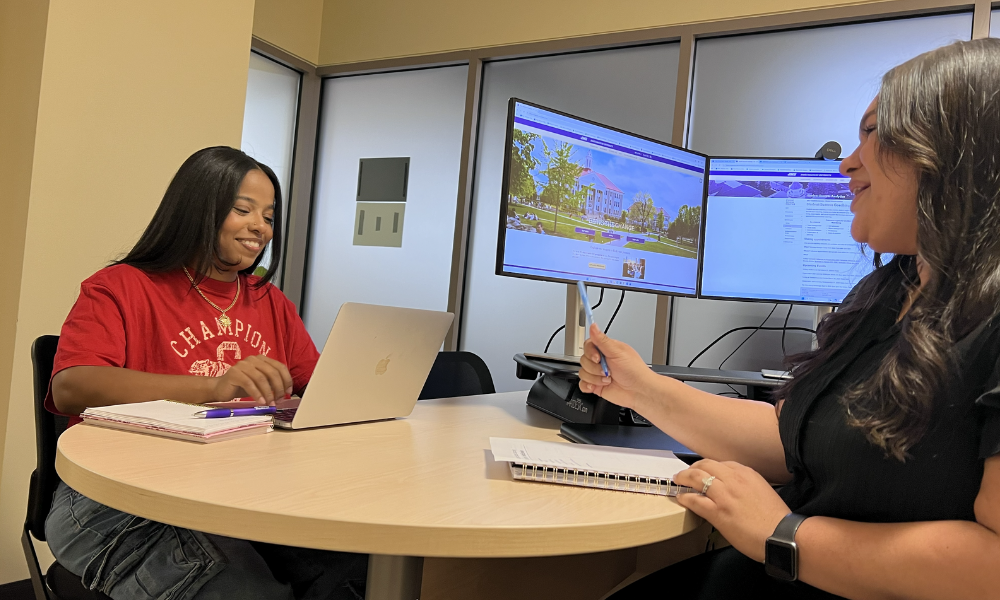


Going to high school in Northern Virginia, Sumu Vadrevu (‘26) was a star student. She earned top-notch grades and set her sights on becoming a finance major at Virginia Tech. It wasn’t until she was waitlisted at VT that she visited JMU for the first time and fell in love. She committed to JMU the same day.
Vadrevu was proud to be a Duke. But something about not getting into her first-choice school shook her confidence. She finished her first semester on academic probation. By year’s end, when she calculated the grades she needed in the coming year for admission into the College of Business, she wasn’t sure she could make it. Everyone was telling her to brace herself for disappointment. “I got super depressed. I didn’t know what I was going to do,” she said.
She knows now what she needed then: a success coach. She needed someone who would work with her one-on-one to help her discover and articulate what was important to her, to support her on her journey to well-being, and to prompt her to set and stay accountable for manageable weekly goals.
At the time, though, she hadn’t heard of coaching, and JMU didn’t have a formal academic coaching program. So, she did it for herself. She soul-searched. She prioritized her physical and mental health. She doubled down on academics by going to the library, attending office hours, and making friends in her classes. She taught herself how to learn. She started a student organization focusing on self-care.
Within a year, not only had she brought up her GPA enough to be admitted to the College of Business, but she was invited to return as a study session leader for one of her most difficult courses. That was how she met Matt Trybus, JMU’s Peer Assisted Study Session Coordinator. The next year, he invited Vadrevu to serve as a peer coach for the new Peer Academic Coaching program he was developing. She said yes: She wanted to help other students connect with the same kind of support she had once needed.
The peer academic coaches focus on goal-setting and accountability when they meet with clients, specifically through what they call the five fundamentals: sleep, fuel, focus, breathing and movement. Each week, students set goals related to one of those areas to impact their motivation and discipline. When they return for their next meeting, Vadrevu asks how it went. “I’ve had people walk in because they’re stressed out, and they don’t know where to start,” she said. “Once that habit builds, they can continue it.”
Coaching emerged as a practice in higher education in the early 2000s and has been gaining traction ever since, with nearly 1,000 colleges and universities offering programs by 2020. Success coaching is distinguished by its open doors—any student can seek out coaching—and its shared power relationships. The student and coach form an alliance that calls on the student to take ownership of the process for getting from point A to point B. Coaches offer holistic, individualized, long-term support as students build the skills, confidence, and resources needed to realize their potential.
The peer coaching program employs five student leaders and operates in one corner of the Learning Centers. In another part of the center, you’ll find the offices of two other Success Coaches: Maddie Martin and Ashley Gerhardt, who are professional staff members on the Student Success Analytics team.
The pro success coaches use similar approaches as the peers, drawing on the strengths-based theories of appreciative advising as they work with students in areas of academics, well-being, basic needs, or social support. They see walk-ins, students on academic probation, and students who are referred to them through partners across campus or through email and texting outreach campaigns.
Gerhardt starts meetings with students by “reminding them of their why, reminding them we are rooting for them.” Even after a hard week when a student might not meet their goals, she encourages them to keep the next appointment: “We will pivot from that plan, revisit those ideas, break it down more. ... You’re already a step closer just by being here.”
Dilsy Rodriguez Sanchez, a transfer student who started this spring, met with Gerhardt after learning about coaching through a texting campaign. “JMU is so big and different from community college,” Rodriguez Sanchez said. “It was really nice to see that I was able to get help. It was an amazing text for me to get right then.”
The peer and professional success coaches all work within the area of Student Academic Success, and they are also part of a broader coaching network at JMU that includes Well Dukes Coaching, hosted by the University Recreation Center, and Learning Success Strategies coaching, hosted by the Dean of Students Office.
Coaches within JMU’s network provide one-on-one assistance, group sessions, and topic-based workshops, and they are experts at referring students to JMU's vast array of student services. Gerhardt tells students: “‘You can work with one, you can work with both, you can work with all—think of us as your support network.’ We want to implement those habits inside and outside the classroom that you can utilize for your well-being and success.”
Rodriguez Sanchez was grateful for that wider network after Gerhardt referred her to the Learning Success Strategies coaches for specific support with her calendar, time management, study skills, and learning strategies. “I didn’t imagine I’d have this support system at JMU, and it’s been my favorite part about being here,” she said. “I feel like I belong here because of the people around me.”
Vadrevu lit up as she recounted her first experience as a peer coach. She met with a student whose goal was admission to the nursing program. “Week by week, we would meet. We created a schedule together; we went through study habits together; we studied together,” Vadrevu said. “She ended up getting into the nursing program. That was really rewarding for me to see. Not only was she my first appointment, but I saw her discipline and her achieve the goal she set for herself. I saw her wearing scrubs the other day, and I was like, ‘You deserve that. You earned that.’”