

Advancing Understanding & Connection: Students Grow Through JMU's First-Year Research Experience
News




A transfer student finds her calling in neuroscience. A history major helps illuminate the past. A budding storyteller contributes to a published textbook. Through FYRE, students are discovering that research does more than expand knowledge. It opens doors, builds confidence, and transforms lives.
Advancing Nuanced Numbers: Laura Paschetag
Transferring from one university to another is never an easy feat, but Laura Paschetag (’26) made it look easy by immersing herself in classes, extracurricular activities, and research from the moment she arrived at James Madison University.
“JMU was not part of my original plan,” Paschetag said. After high school, she earned an associate degree from Northern Virginia Community College and expected to stay close to home for her bachelor’s degree. “However, when I visited JMU, I completely fell in love with the culture here.”
Paschetag arrived in the fall of 2023 as a psychology major with a fascination for the brain, which she calls “the ultimate puzzle.” She initially doubted whether she could dedicate her career to studying the brain because she felt intimidated by the sciences. “To be completely transparent, I didn’t think I was smart enough for a career in neurology or neuroscience,” she said. However, a 300-level neuroscience course stoked both her passion and her confidence.
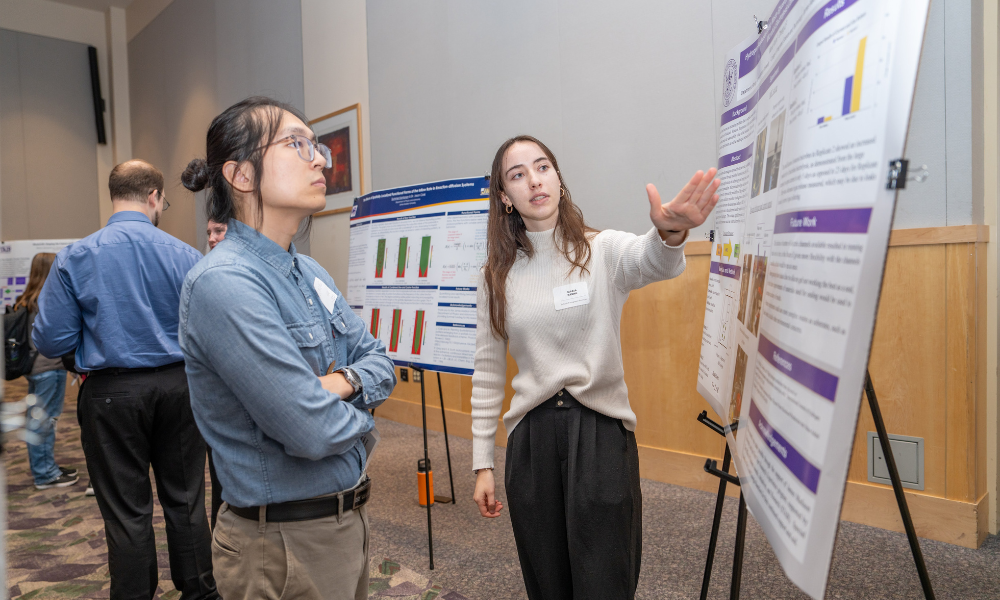
Paschetag applied to and was accepted into the First-Year Research Experience program, or FYRE, a flagship initiative available to first-year and transfer students at JMU. She worked with Dr. Jessica Salvatore to investigate systemic bias in psychology research stemming from rule-of-thumb numerical reporting practices. She had the opportunity to present her findings—and advocate for changes in disciplinary practices—at an international video conference.
Her enthusiasm for research led her to join an evolutionary biopsychology lab, where she began work on her thesis. As she described it, her learning shifted from lecture-based to discovery-based.
Eventually, she added biology as a second major and now plans to pursue graduate study in neuroscience with the goal of becoming a professor. “I never thought I would be giddy at the idea of explaining action potentials or oligodendrocytes, but I absolutely love it,” she said. “I went from being intimidated to tutoring others.”

Advancing History in Virginia: Edward Tomlinson
“If your question does not keep you up at night, it is not a question worth pursuing.”
History major Edward Tomlinson (’28) embraces this philosophy and chose JMU for its distinctive opportunities to engage in research as a first-year student. In high school, Tomlinson’s early research experiences led him to appreciate how research helped him “synthesize ideas and coursework,” he said. Upon entering JMU, his goal of building relationships with professors through his interest in discovery motivated him to apply to FYRE.
Through FYRE, Tomlinson worked with Dr. Jonathan Jones on an ongoing, multi-institutional research project examining the historical connections among the Virginia Military Institute (VMI), the Confederacy, and the Lost Cause. As described on the FYRE webpage, the project seeks to support efforts toward reparative justice at Southern Colleges by identifying expressions of the Lost Cause, a movement that attempted to reinterpret and defend the Confederacy.
Tomlinson contributed to the public digital database Locating Slavery’s Legacies at VMI. Specifically, he focused on the role of Major General Francis H. Smith—the superintendent of VMI before, during, and after the Civil War—in institutionalizing Lost Cause ideology at the institution. Tomlinson analyzed Smith’s writings to critically examine his support for slavery and his efforts to rebuild VMI after the war.
“I chose my project because it is a unique subject that, while I had heard about it, was still unfamiliar to me,” Tomlinson said. “I also wanted to explore a topic that is deeply relevant to where I live and have grown up.”
Tomlinson’s experience in FYRE has inspired him to pursue additional opportunities to conduct and share research. In collaboration with Dr. Rudy Molina Jr., vice provost of Student Academic Success (SAS), Tomlinson helped develop a project to create a research database to connect more undergraduate students to research and scholarly projects led by JMU faculty.
“This makes research opportunities at JMU more accessible to students, whose community and voice are growing in the academic world,” Tomlinson said. Through this partnership with SAS, he has helped bring his vision of connecting students to research opportunities to fruition.

Advancing Facilitative Leadership: Grace Puma
Grace Puma (’27) is a communicator.
Double-majoring in philosophy and media arts and design, with a concentration in digital video and cinema, Puma is developing an academic portfolio of communication skills across storytelling platforms. Her participation in FYRE introduced her to an academic storytelling experience typically reserved for faculty.
Eager to engage with the many opportunities offered at JMU, she applied to work in the spring of 2025 with Dr. Lori Britt, director of the School of Communication Studies, on a multi-institutional project focused on finalizing a textbook.
Puma reviewed the manuscript, curated questions for the end of each chapter, and developed corresponding answer keys. The publisher told Britt that the book’s chapter questions were among the best they’d seen. “I said, ‘They were written by a student, 90 percent of them,’” Britt said. “She would read each chapter, think about what students needed, and write questions to get them to do some nuanced reflection. She did an amazing job.”
The book, Facilitative Leadership: Building Capacity for Divisive Times, by Britt and co-author Lisa-Marie Napoli, was published a few months later in October 2025.
Through her contributions, Puma learned about both academic publishing and leadership theory. “I learned so much about the importance of self-awareness as a leader,” she wrote in her poster for the FYRE Symposium. “It made me more mindful of my role in guiding groups and ensuring that all voices are heard.”