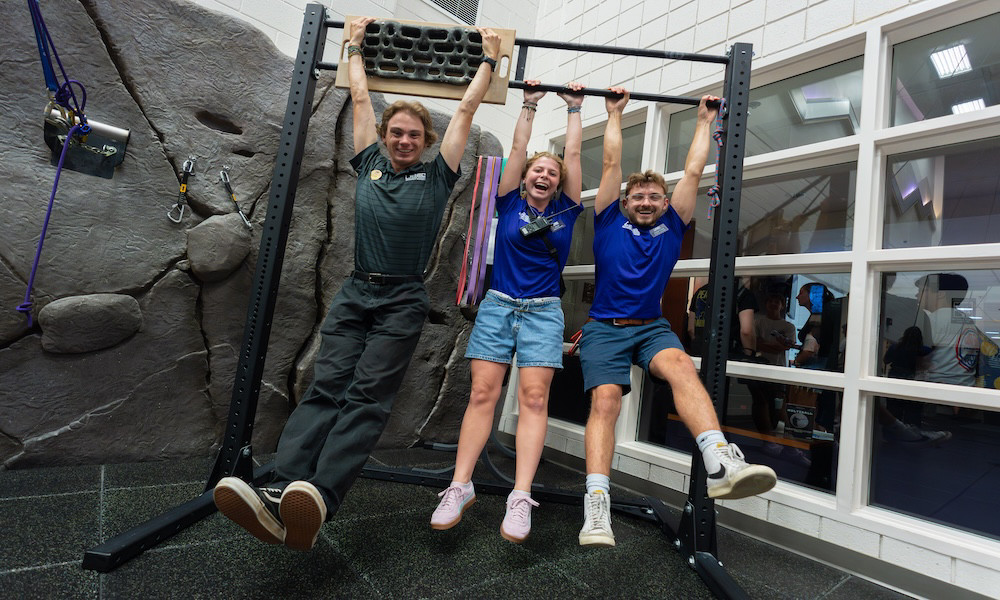
A legacy of leadership built through recreation

UREC celebrates 30 Years

News
 

Shortly after arriving at James Madison University as a first-year student, Stevie Lee (‘17) thought she had signed up for a yoga class.

Instead, she walked into an adventure trip leadership course.

"I show up on the first day, and the professor is like, 'OK, everybody, welcome to adventure trip leading,'” Lee recalled during a recent alumni panel celebrating UREC's 30th anniversary. “And I was like, 'I don't know anything about the outdoors.'" 
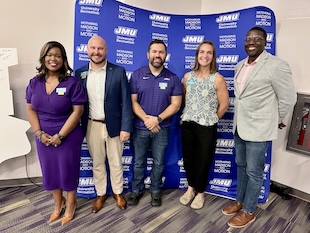
Five people pose smiling in front of a purple JMU-branded step-and-repeat banner at an indoor event.
(left to right) Sophia Marshall, Drew Loso, Bryan Zopp, Stevie Lee and Dirron Allen.

Lee stuck with the class, eventually joined UREC's Adventure Program and discovered a passion that would shape her future career.

"Thinking back on that, I just think I'm so thankful that that seemingly random experience happened because it really did change the course of where I was headed," said Lee, co-founder and director of Appalachian Forest School.

Over the past three decades, thousands of students have their own version of that story.

As UREC celebrates its 30th anniversary, the milestone is not only about a building that opened in 1996 or a recreation program that grew into a nationally recognized department. It is also a celebration of the generations of student leaders who discovered career paths, learned professional skills and gained confidence through experiences that often started with a campus job. 

While recreation has a long history on campus, the department’s story began in 1994 when construction started on the university's recreation center under then-President Ronald Carrier. In 1995, Donna Harper, former Director of Health & Recreation hired Eric Nickel as the Associate Director for Health and Recreation. UREC officially opened its doors to students in September 1996, and Nickel was named the first director of university recreation in 1997. More than 30 years later, Nickel remains the department's only director, having guided its growth from a single recreation facility into a nationally recognized program.

His contributions were recognized this year with the President's Purple Star Award for Career Achievement for more than 30 years of leadership, including overseeing multiple construction projects such as the 2016 expansion and renovation that effectively doubled the size of the facility. The grand reopening in 2016 coincided with UREC's 20th anniversary celebration, marking two decades of growth and setting the stage for an even broader student experience.

Today, UREC plays a central role in student life and wellness. Nearly 1 million visits are recorded annually at UREC and University Park, and last year 97.65% of first-year students used UREC facilities or programs. The department is home to 45 sport clubs, vibrant intramural sports leagues and nearly 5,000 individual programs and classes annually, including group fitness classes, adventure trips, cooking classes and safety certification courses.

Along the way, UREC earned multiple national facility awards and became recognized as a leader in collegiate recreation in student leadership and the utilization of student learning outcomes in program development. What began as a recreation center has evolved into one of the university's most comprehensive student-engagement enterprises.

For alumni like Sophia Marshall (‘97), director of the Center for Wellness Promotion at UNC Charlotte, who taught group fitness classes before the facility even opened, the growth is remarkable.

"I think [about] being a part of opening this wonderful facility, going from teaching classes in racquetball courts in Hillside to being in this incredible building," Marshall said. "I got to teach in this space for a year. That was a memory that I will never forget. Just the excitement and the pride that all of us felt when we came into this building was unmatched."

But the physical growth only tells part of the story.

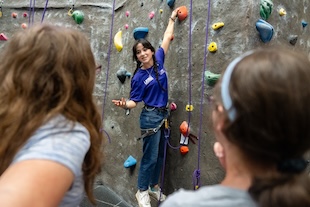
Climbing instructor wearing a harness gestures while standing on colorful holds on an indoor rock wall, with two students watching from the foreground.UREC employs approximately 550 students each year across a variety of leadership roles and is recognized nationally for its student development efforts. The department also earned the Virginia Top Employer for Interns award for the third consecutive year in 2026 for its work-based learning and internship programs.

Years before colleges began emphasizing work-based learning, UREC was already putting students in positions to lead.

Student employees supervise facilities, manage programs, officiate sports, lead outdoor adventures, coordinate events and mentor fellow staff members. At the highest level of UREC student employment are Operations Supervisors, known throughout the department as "Op Sup," who oversee facilities and programs, respond to emergencies and help lead a workforce of hundreds of student employees.

For many alumni, UREC served as their first proving ground for leadership.

Dirron Allen (‘00), JMU's associate vice president for student affairs, said one of his most valuable leadership lessons came from receiving difficult feedback as a student supervisor.

"I'm thinking about a mentor who gave me some really difficult feedback at a point in time early in my career here as an intramural supervisor," Allen recalled. "I had probably one of the worst basketball teams out there, and he had pulled me aside one day and he was like, 'Hey man, if you're going to lead, if you're going to be a part of this team, you got to get your team in check.'"

The conversation pushed Allen to hold his peers accountable, teaching him leadership skills that have remained relevant throughout his career.

"It's one of the things that I developed because of my time here at UREC that really shaped me and that I use to this day," he said.

Lee experienced a similar lesson through performance evaluations.

"I remember being a manager and we were involved with performance evaluations ," she said. "I remember thinking, ‘This is so weird, giving my peers feedback.’"

At the time, it felt uncomfortable. Years later, it became foundational to her leadership style.

"Looking back, I'm so thankful that that was part of the job requirements because it did prepare me for what would come next of starting my own business, hiring employees, giving performance evaluations to people my age, older than me and younger than me," she said. "At the time, I didn't see the value in it, and now that's kind of the foundation for how I lead."

For Sarah Hogan (‘04), chief of staff for the Washington Commanders, UREC provided leadership opportunities that continue to influence her work today.

"Starting with the leadership program that I was able to take part in, two years as a sport club president ... I was able to really understand how to manage a team of people from our leadership team and our basic roster as a whole," Hogan said. "I gained a lot of experience that I'm still using today with my operations background."

She also pointed to the trust professional staff places in students.

"As an Op Sup, I feel like the staff put a lot of trust into us to run the building," Hogan said. "And really that developed a great team environment on a very high level that I really cherish that experience to this day."

Bryan Zopp (‘08), president and owner of Zopp Family Dental Center, said UREC taught him how to work with and communicate effectively with people from different backgrounds and perspectives, a skill that has remained critical throughout his career.

"From a professional standpoint, from a technical standpoint, you might be the best engineer that's ever been. But if you cannot communicate to other people, if you can't work with other people, you're going to struggle," Zopp said.

He described UREC as a place where students can learn through trial and error before entering higher-stakes professional environments.

"This is a time and a place where you can actually work on this," Zopp said. "The risk-reward is worth it. There's not much risk, but there's a lot of reward."

Reflecting on his own experience, he added, "We were in a place in a very impressionable time where you could make those mistakes and then you have the grace to recover from. And that's a blessing that you don't understand until you sit on the other side of it."

Drew Loso (’11, ’13M), associate director for recreational sports at the University of Notre Dame, said the values he developed at UREC remain central to his leadership approach.

"We would always talk about take a little UREC and spread it with you wherever you go," Loso said. "For me, it was learning how to lead with empathy, but also with integrity."

He believes the department's culture is what continues to set it apart.

"What you have here and what you are able to experience through your student employment, being surrounded by the professional staff that truly care about you, is special," Loso said.

As UREC looks toward its next 30 years, Marshall urged professional staff to continue investing in student development opportunities, particularly through conferences, mentorship and leadership experiences.

"I can't tell you how invaluable it was to go to Southeast Collegiate Fitness Expos and my first NIRSA conference," she said. "That experience, being in the car or van rides and getting to know my peers better. That's where I got my sense of belonging."

She continues to notice the department's commitment to exposing students to professional conferences.

"When I'm at conferences and JMU UREC comes in," Marshall said, "I'm like, the way that they are showing up and showing that they are investing in their students is second to none.'"

That investment remains visible through UREC's internships, graduate assistantships, leadership programs and student employment opportunities, which continue to provide hands-on learning experiences for students across a range of academic disciplines.

Thirty years after opening its doors, UREC's facilities, programs and footprint have changed dramatically. What has not changed is the department's commitment to developing leaders.

Allen believes that mission is what connects generations of students across decades.

"What makes this special as well is this: you have a network, an incredible network across the country," he said. "You are empowered and you are empowered to lead and lead well."

Lee experienced that firsthand when an unexpected class as a first-year student changed the trajectory of her career. That course led to a UREC job. That job led to skills, confidence and a career she never expected.

For thousands of students over the last 30 years, UREC has offered a similar opportunity: a chance to discover something larger than recreation, and in the process, discover themselves.

Back to Top

by Thomas Estes ('16)

Published: Tuesday, October 27, 2026

Last Updated: Tuesday, October 27, 2026

Related Articles