

International student part of United Nations graduate program
Featured Stories


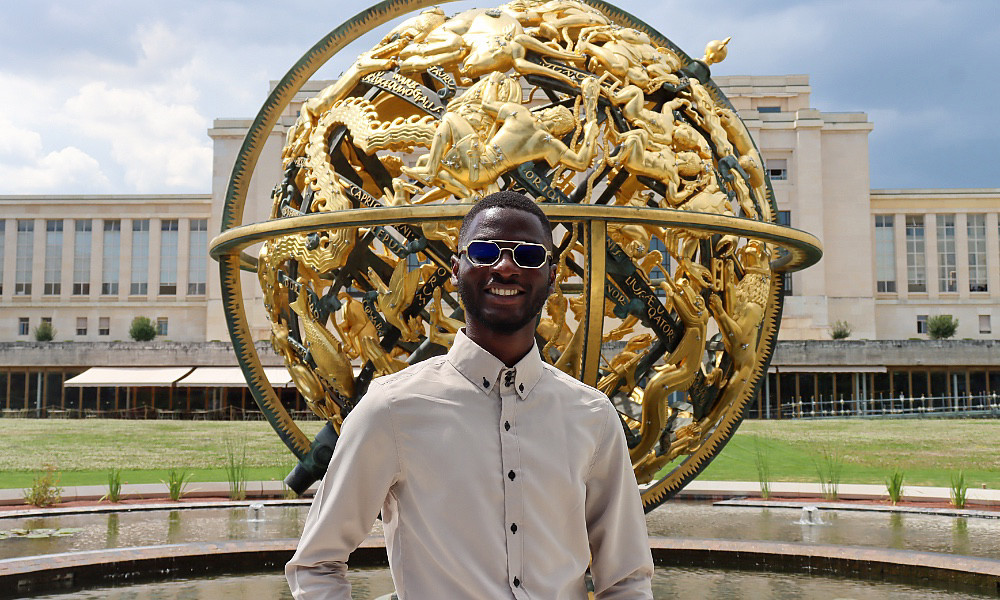
SUMMARY: Graduate student Ezekiel Olaniyan, of Nigeria, traveled to Geneva, Switzerland, this summer to participate in the United Nations’ Graduate Study Programme. There he learned from other students and leaders from around the world, also teaching them about his home nation and what it means to be a Duke.
For Ezekiel Olaniyan, applying to the United Nations’ Graduate Study Programme in Geneva, Switzerland, was an unlikely dream that came true.
Olaniyan, an international graduate student from Nigeria, came to the U.S. after earning a Bachelor of Arts degree from the University of Ibadan. Hoping to study communication advocacy, he found a way to pursue that passion at JMU. “In the whole of the United States,” he said, “James Madison University is the only university I feel has that practical connection between communication and advocacy.”
As a JMU student, he has contributed a unique perspective and personal drive — speaking at conferences in Pittsburgh, Pennsylvania, and Birmingham, Alabama, in a single weekend and receiving the JMU SOAR award in the Outstanding Individual Contribution to a Student Organization category through the International Students Association. Suffice it to say, this Duke is not used to being idle and aims to make a difference in the world.
“For us to make greater impact in life, we just need to make sure that we leave where we are better than we met it,” he said. “I try as much as possible to just engage, you know, in my own little capacity, my own little quota, to see that at least things are getting better.”
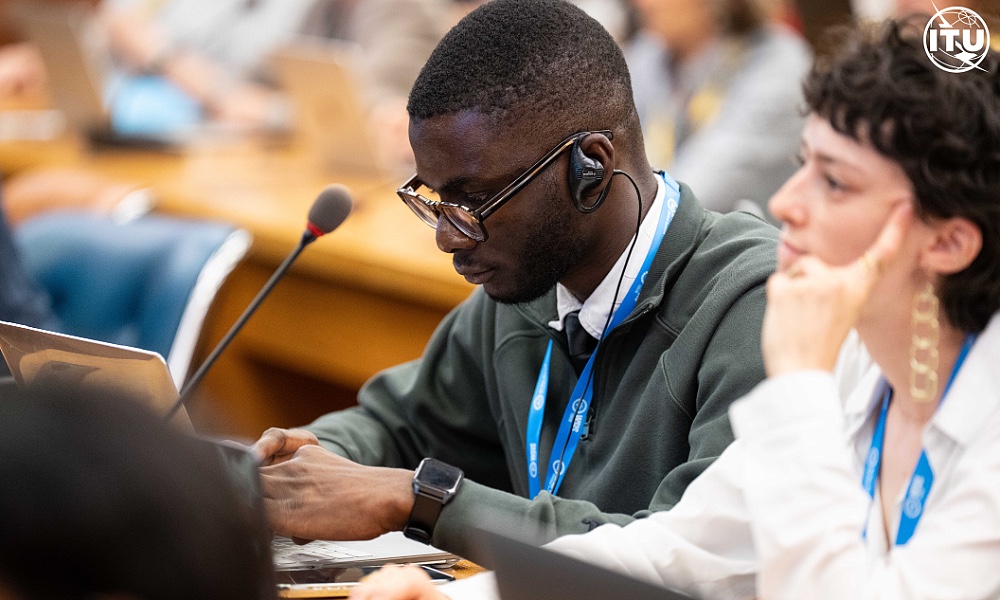
His unceasing dedication to making a positive impact led him to engage in artificial intelligence research, which, in turn, inspired him to apply for the U.N. program. Despite some initial doubts, the program’s theme of “AI and Emerging Technologies: Realities, Risks and Opportunities” pulled him in.
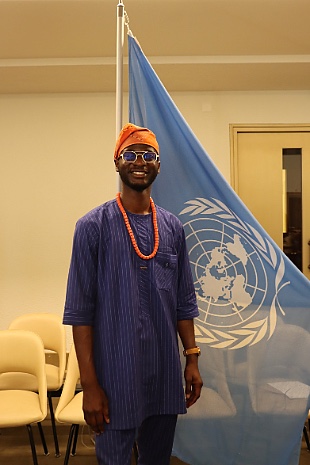
In Geneva, Olaniyan was surrounded by people from 42 countries. He says it was like having the world in a room. Still, Olaniyan was the only representative from his home country, so he took it upon himself to show the attire and share the culture of Nigeria. “I even got an award for the best dressed,” he said.
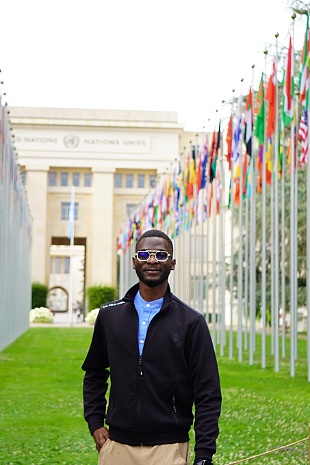
“It was a privilege to learn about a culture from its people,” he said, having realized that not everything can be known through research. Olaniyan also found ways to teach about his culture and learn from others. “I bring that perspective,” he said. “I bring that lived experience to 41 other nations that are represented in the room.”
The opportunity to visit Europe was something Olaniyan never anticipated, and he found the fusion of culture meaningful. Above all, he appreciated the people. Despite a different background, culture and language, he could relate and connect, with the program “literally uniting the nations,” as a common goal.
“The United Nations was our classroom for two weeks,” he said. “You get to challenge the system. You get to say, ‘Hey, this is happening. What is the responsibility of the United Nations?’” Attendees considered the role they would play directly representing and impacting the U.N. throughout the program.
Although conversations about the use of AI were often heated, he says, they were conversations worth having. “People talk about AI, but AI in their respective countries, AI as it affects them.” He says these diverse perspectives provided a range of important considerations.
During the program, the group visited various notable organizations such as the European Organization for Nuclear Research, the birthplace of the World Wide Web; the International Telecommunication Union, which facilitates global communication networks; and the International Labor Organization. They were present during Geneva Digital Week and attended the AI for Good Global Summit, where, by chance, Olaniyan met Ngozi Okonjo-Iweala, director-general of the World Trade Organization.
“This woman is a Nigerian, and I’m like, ‘Oh my God, I know you. From your dressing, it looks like you are from where I’m from,’” he recalled. “It was so exciting meeting her in person.”
At the end of the two weeks, working groups were created and tasked with completing a capstone in about 48 hours before presenting it to the secretary general of the ITU.
Olaniyan and his group authored a conceptual research analysis and recommendation, “Implications of AI and Emerging Technologies for Youth Wellbeing.” “What we came up with served as a recommendation on how AI can actually be used,” he said. The project was in keeping with the U.N. Graduate Study Programme’s effort to create impact by providing much-needed perspective into how AI is used around the world.
As a result of Geneva Digital Week, the ITU and the U.N. Youth Office signed a joint declaration to advance youth-inclusive digital policies.
To move toward digital equalization, Olaniyan believes it’s important to start with those who are not connected. More than 2 billion people around the world lack internet access, making it difficult for them to connect with the rest of society and each other. He hopes at least a fraction of these people will be able to cross borders — “not by physical transition, but by digital transition, and that exactly is what is going to cause digital transformation, particularly amongst youth.”
Olaniyan argues that the U.N. exists, in part, so those who want to make a difference can fuel change in their respective nations. “The conversations that took place during the two weeks in Geneva must continue,” he said. “It is beyond the [graduate program].”
Currently, he is channeling everything he has learned into his graduate thesis, examining AI recruitment among young Black men and asking how they interface with job rejections evaluated by AI.
Through his work, Olaniyan aims to help bridge the gap and contribute to the global body of organizational communication research. “I think it’s a good starting point for us to first bring awareness to some of these issues,” he said. After that, he hopes fellow researchers will present their findings at conferences, “entering rooms with relevant data and citing real articles that, ‘Hey, this is not just hypothetical. This is not abstract. This is happening.’”
Olaniyan also wants to provide evidence to push for policy change. As AI is increasingly integrated into hiring systems, affecting individuals regardless of industry or identity, he says the ILO currently lacks definitive labor laws for AI regulation. “How do they regulate this, and how do they ensure that they are fair and equitable?”
Regulation requires balance, he said. “[People] totally rely on AI technologies now. They rely on ChatGPT, they rely on Claude, they rely on Gemini.” Governance isn’t just about restriction; it is about preservation, he says. “How do we control the usage of some of these technologies to ensure that we still have at least our humanity saved?”
As an instructor of record, responsible for delivering and assessing students, Olaniyan advises, “The most important thing is to come as you are,” adding, “you have teachers who are passionate about helping you learn and grow.”
“Do what works best for you in terms of academic learning,” he continued, “and be open. There are no limits anywhere. Do it afraid. Do it risky.”
For Olaniyan, the U.N. trip was a risk — one he is now glad he took.
“If I wasn’t at JMU, this trip would not have been possible,” he stressed. “The support was massive.” Olaniyan is especially grateful to the Communication and Advocacy master’s degree program, the College of Arts and Letters, the School of Communication Studies, the Office of Innovation and Research, and the Center for Global Engagement.
Dr. Corey Hickerson, faculty director of global learning at CGE, played a big part in facilitating the U.N. program.
“Corey was really excited for Ezekiel to be accepted into this prestigious program and did not want financial obligations to prevent him from participating,” said Andrea Nutter, assistant director of global learning and partnerships. She says that they recognized how valuable the experience would be for Olaniyan, emphasizing how his achievement speaks to the value of a JMU education. “One of our primary goals at CGE is to help make global opportunities possible for all JMU students, so we were really happy that he reached out to us and that we were able to play a small part in making this a reality.”
Olaniyan hopes his story will encourage others to take unlikely chances. “Don’t you ever think that a room is too big for you to enter,” Olaniyan said. “There is a space reserved for you in that room, and that space is yours, so go take it.”


