

$500,000 gift creates first faculty endowed professorship in JMU’s College of Science and Mathematics
News


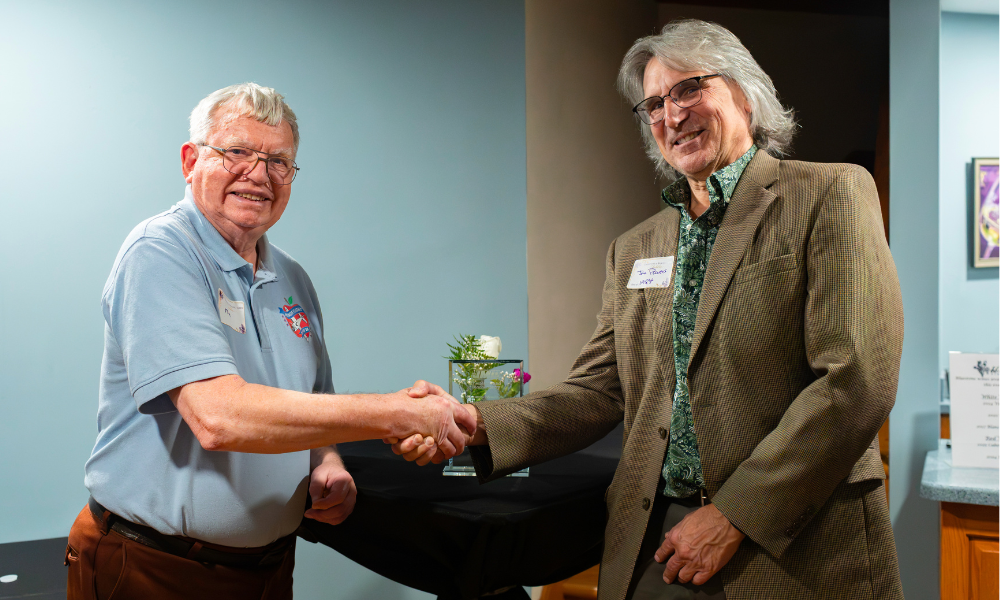
SUMMARY: A gift from chemistry alumnus John Powers (’84) establishes the John W. Powers Endowed Professorship of Materials Chemistry, honoring the mentor who first pointed him toward the field and expanding what faculty can do for the undergraduates they mentor.
John Powers (’84) didn't come to James Madison University planning to become a chemist. He arrived as a communications major. He switched to geology during his first semester. However, a conversation with his professor, Dr. Tom DeVore, changed the course of his career.
"Tom had this great balance of being a challenger and a cheerleader,” said Powers. “He was very encouraging, and yet he pushed and challenged you a little bit. I found that balance to be really good, and it worked for me," Powers said.
Powers switched majors to chemistry and went on to conduct undergraduate research in Dr. DeVore’s lab. Reflecting on conversations with friends at another university, he said JMU gave him unusual access to hands-on research experiences as an undergraduate. “I was telling [my friends] about the experiences I had at JMU — hands-on, using the instrumentation. They were all looking at me like, 'Wow, John, you don't get to actually use the scientific instrumentation until you're a grad student.'"
He later earned two master's degrees and built a career in materials and polymer chemistry, including work in Saudi Arabia’s oil fields, before semiretiring and teaching chemistry as a part-time adjunct instructor at JMU. Even while living and working across the country and abroad, Powers stayed connected to JMU and maintained contact with faculty mentors.
Now, four decades later, Powers is giving back to the department that changed his path. His $500,000 gift established the John W. Powers Endowed Professorship of Materials Chemistry, the first endowed professorship in JMU’s College of Science and Mathematics.
The award will provide a full-time tenure-track faculty member with expertise in materials and polymer chemistry with $20,000 annually to support their work. It is designed so that mentorship is supported at JMU and continues after graduation.
Powers chose to support students through the faculty who mentor them, hoping that the gift could multiply, reaching more students in turn. “What can we do that would affect more than one student a year?” he thought. “If there’s a professor interested in mentoring and developing students, they can do that with 10 to 30 people a year, maybe, and really get more of that [mentorship] relationship,” Powers said. To explain his choice to support materials chemistry, he said, “I really wanted to focus on something that I have a passion about, which is polymers and materials.”
For Powers, the impact of mentorship has never faded. On 2026 Giving Day, Powers gave $1,984 — inspired by his graduation year and license plate “84CHEM” — in response to a challenge gift DeVore created to support the Chemistry Undergraduate Research Endowment. That gesture grew into a bigger gift from Powers when he realized the difference investing in faculty could make.
Dr. Samantha Prins, dean of the College of Science and Mathematics, said the professorship will strengthen both faculty support and student opportunities. “Private philanthropy makes it possible for us to celebrate and support faculty members who are both teachers and scholars. This professorship helps us recruit, recognize and retain exceptional faculty in materials chemistry who combine innovative research with a deep commitment to fostering student development,” she said. “It provides students with opportunities to engage in cutting-edge research, receive outstanding guidance and develop professional relationships that continue to open doors throughout their careers.”

“What I’m really hoping is that this will help the department grow and be a place where students want to come because of the things they’ve heard about the professors — and the professors continuing to mentor students beyond their time here,” Powers said. As with his own relationship with his JMU professors, Powers hopes that stronger faculty-student relationships will encourage graduates to remain connected to the department throughout their careers.


