

JMU joins Virginia’s Lab-to-Launch accelerator program
Agreement is a nod to the university’s growing research and technology-transfer capacity
Education


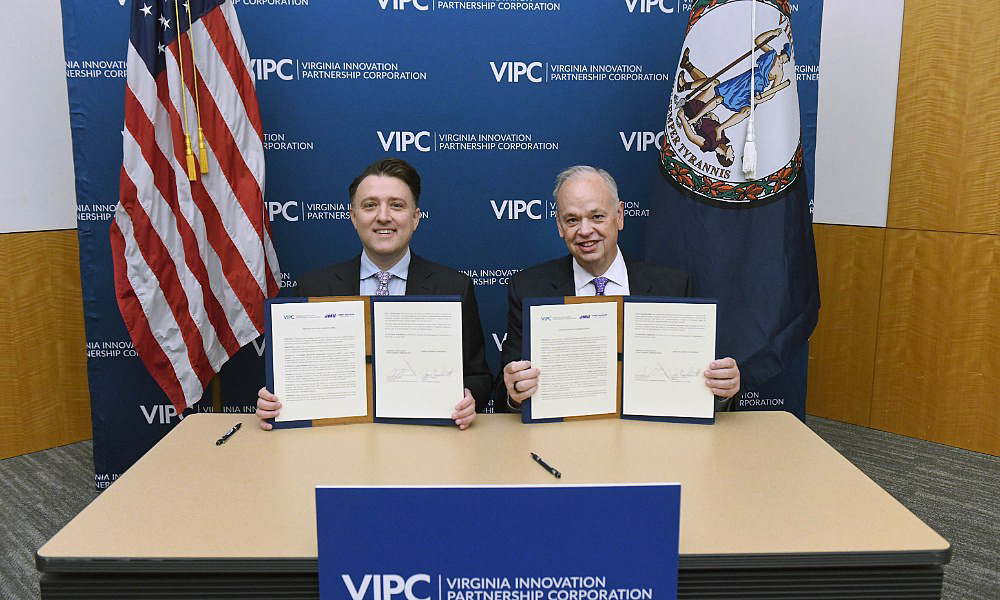
SUMMARY: JMU is Lab-to-Launch’s first R2 university partner in the Commonwealth, expanding access to resources and growth opportunities to researchers and innovators in the Shenandoah Valley.
James Madison University has joined the Lab-to-Launch initiative designed to move promising technologies from Virginia research universities into startups and the marketplace.
On Oct. 6, JMU President Jim Schmidt and Joe Benevento, president and CEO of Virginia Innovation Partnership Corp., met in Richmond to sign a ceremonial memorandum of understanding.
The agreement represents an important milestone for JMU.
The Lab-to-Launch initiative was initially developed as a collaboration between VIPC and six R1 research institutions in the commonwealth: George Mason University, Old Dominion University, the University of Virginia, Virginia Commonwealth University, Virginia Tech, and William & Mary. JMU is Lab-to-Launch’s first R2 university partner, a nod to its growing research and technology-transfer capacity.
“I’m delighted JMU is joining Virginia’s Lab-to-Launch initiative alongside the commonwealth’s R1 research universities,” Schmidt said. “Working with the Virginia Innovation Partnership Corporation will give our researchers and students more support to turn promising ideas into new companies and products. I’m especially excited about what this could mean for innovators here in the Shenandoah Valley.”
“This partnership is a welcome step for JMU and for Virginia,” Schmidt said, “and it helps us deliver on the work we’ve set out to do in The Madison Promise,” JMU’s new strategic plan, which includes the goal of charting a new path as a national research university.
Through Lab-to-Launch, JMU will have access to Virginia’s Fast-Track License to simplify and streamline university technology transfer and intellectual property licensing.
In addition, VIPC will support new Entrepreneurs-in-Residence at JMU to help connect entrepreneurial talent and industry expertise with university researchers and scientists and will collaborate with JMU to pursue opportunities with corporate partners, investor networks and public-private funding resources.
“By connecting promising research with entrepreneurial expertise, commercialization resources and capital, this initiative will help move more JMU discoveries to the marketplace while creating new opportunities for innovation, investment and economic growth in the Shenandoah Valley and across Virginia,” said Dr. Anthony Tongen, vice president and chief research officer of JMU’s division of Research, Economic Development and Innovation.
With the help of VIPC’s Entrepreneurs-in-Residence program, JMU already has several promising technologies and startups in the pipeline, including HGNsense, an eye-tracking system developed by a group of ISAT professors and students to combat drunk driving, as well as software for educational program management, audio encoding, and biological materials.
Dr. Keith Holland (’00), associate vice president for research and economic development, said although the valley is known for agriculture and manufacturing, increasingly companies looking to locate and expand in the region have been asking about the climate for innovation and commercialization.
“The Lab-to-Launch partnership with VIPC enhances the visibility of the research and innovation occurring at JMU and in the valley,” Holland said.


