

Alger Hall honors the legacy of JMU's sixth president
News


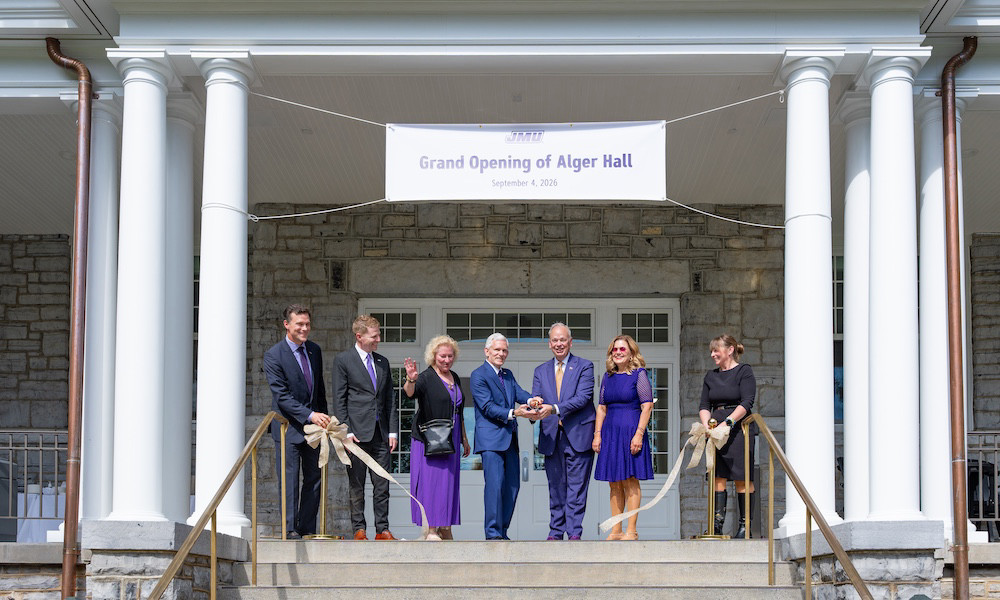
SUMMARY: Alger Hall, named for JMU’s sixth president, officially opened to the public during a Sept. 4 ceremony. It is home to the first living and learning community in Virginia entirely dedicated to preparing students for active participation in civic life.
Already nationally known as a leader in civic engagement, James Madison University is now home to the first living and learning community in Virginia entirely dedicated to preparing students for active participation in civic life.
Alger Hall, named for JMU’s sixth president, Jonathan R. Alger, officially opened to the public during a Sept. 4 ceremony. The building, formerly Spotswood Hall, houses 42 Civic Leadership Scholars as well as the Madison Center for Civic Engagement.
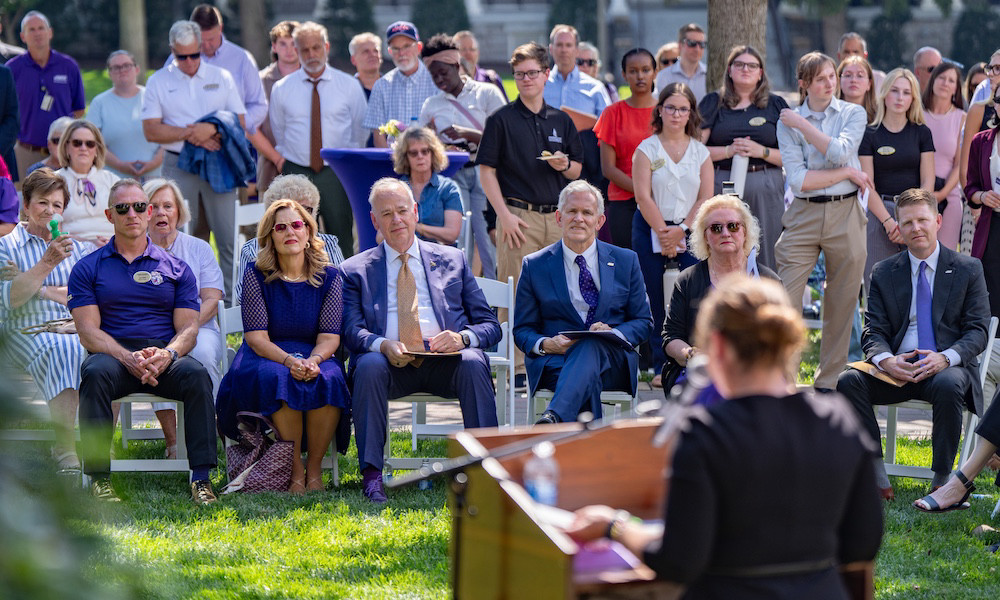
Dr. Kara Dillard, the center’s executive director, said Alger Hall will serve as “a living laboratory” for civic education and animate the ideals of its namesake.
“Jon Alger believed civic engagement was not peripheral to the mission of higher education but was at its core,” Dillard said. “Jon challenged us to think not only about our rights in a democracy, but about our responsibilities to each other if we’re going to live and learn and work together in peace.”
Dillard said her hope is that Alger Hall’s residential learning community scholars “will leave this place not knowing simply about civics, but how to do democracy — to listen, to deliberate, to lead, and to build a shared future with people who wear a different hat than you. That’s what’s important.”
Kathleen Campbell, assistant vice president for residence life, said the renovation of Spotswood Hall, which opened in 1917, “represents the renewal of one of JMU’s most historic spaces and a powerful investment in the future of our students.”
Reimagining a building that is more than a century old was no small undertaking, Campbell said. “Our goal was to preserve the character and history of an iconic structure while creating a modern environment that supports student success and meaningful engagement.”
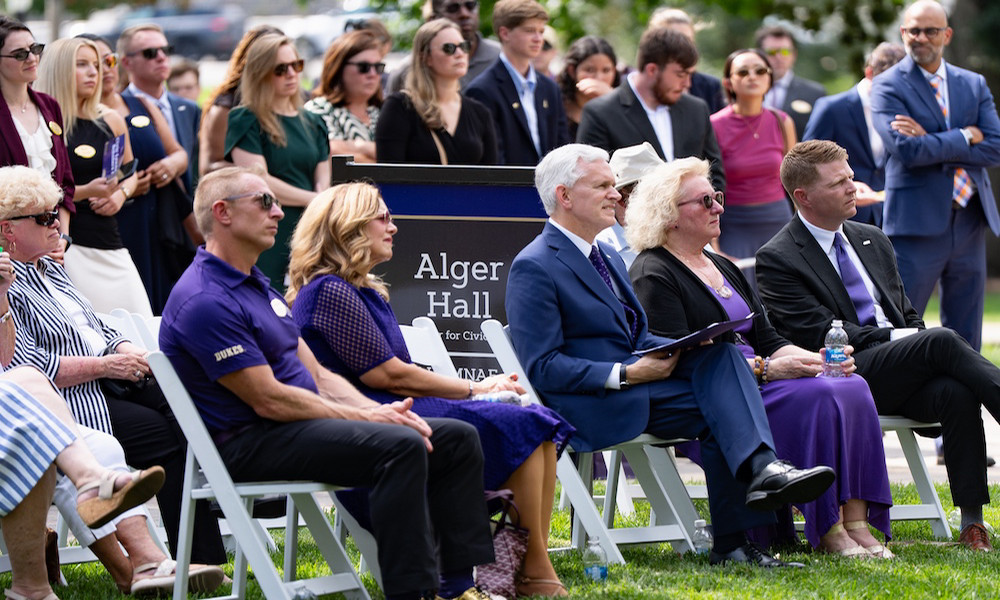
Russ Reeder (’94), chair of the advisory board of the Madison Center, described how his involvement with civic engagement at JMU began with a phone call from Alger 11 years ago.
After 20 years of building and selling businesses, Reeder went to go run an online civic engagement platform called iCitizen. In 2015, he accepted an invitation from Alger to speak at a Madison Vision Series event. “I stood on the stage and talked about why apathy is not acceptable,” he said. He also shared lessons from his grandfather, a World War II veteran “who taught me that in a democracy, silence isn’t neutral. If you don’t speak, someone else decides for you.”
Reeder noted that JMU recently received two grants totaling more than $5 million from the Department of Education to expand civic education efforts nationally, including its Better Conversations Together program, which is being held up as a model for civil discourse.
Since graduating from JMU, “I learned that leaders who have the largest impact are the ones who build something bigger than themselves,” Reeder said. “Jon built something bigger than himself. Then he left, and it kept growing. That’s the true test.”
Vice President and Chief of Staff Dr. David Kirkpatrick, who previously led the Madison Center, said civic engagement has successfully transitioned from being “a Jon Alger thing” during the early years of his presidency to a core JMU value and distinction today, adding, “We have a robust civic engagement ecosystem that is the envy of the nation, and that is because of your and Mary Ann’s leadership.”
President Jim Schmidt said he and his wife, Kim, are grateful for the Alger legacy, and Alger Hall is the clearest expression of that legacy.
“Jon never lost sight of a simple truth: An engaged university can change lives, strengthen communities, and our democracy,” Schmidt said. “This hall bears his name … because of the values he helped embed within JMU and the lasting impact those values continue to have on our students, our university, and our region.”
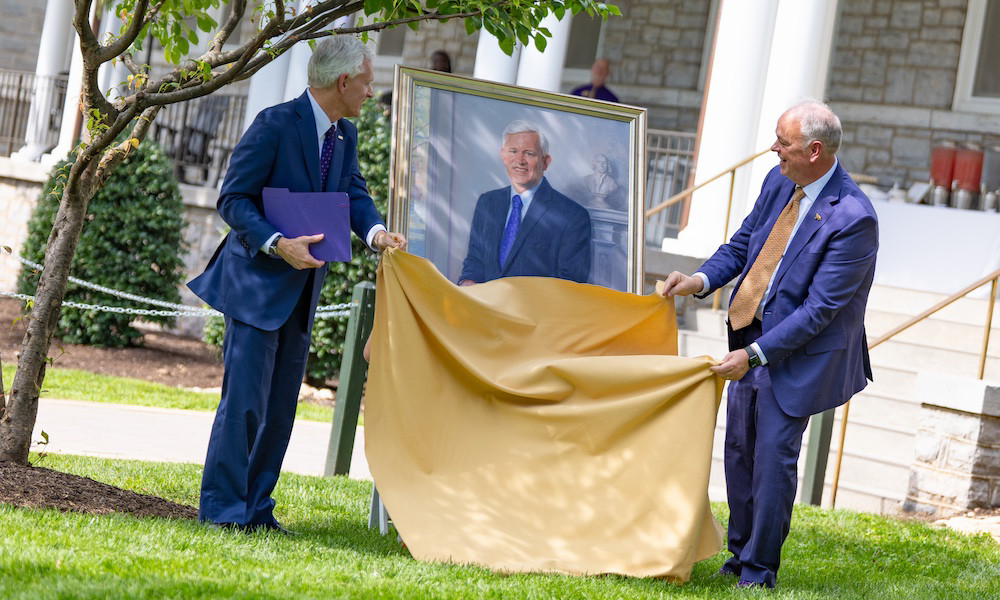
Alger, whose presidential portrait was unveiled during the ceremony, spoke about his passion for civic engagement and its importance in American life.
“To me, the American experiment with democracy has been one of the most important and impactful initiatives in all of human history,” he said. “It goes to the heart of what it means to be human. Our founders sought to create a new kind of society in which individuals would have freedom to develop to their full potential, and to have a voice in how they were governed. The experiment, of course, was incomplete from the very start, and the past 250 years have been a struggle to close the gap between our ideals and the reality on the ground.”
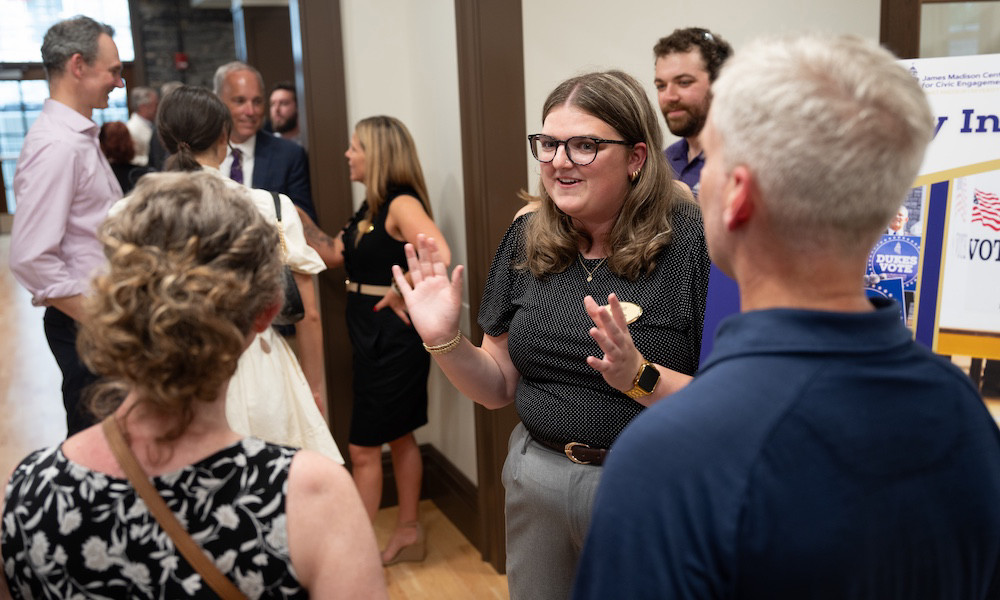
Bearing the name of James Madison, the father of the Constitution, means that JMU has a special responsibility “to be a model of how to seek that ‘more perfect union,’” he said.
“I’m so excited that students will live and learn together in this building,” Alger said. “Just imagine the impact that could be made by the students who will engage with one another right here and take those lessons out into the state and the country and the world. Our society needs JMU more than ever.”
Earlier in the day, Alger was part of a fireside chat at the Forbes Center for the Performing Arts titled “Educating and Leading for the Common Good.” The panel discussion, led by Schmidt, also included Raj Vinnakota, president of the Institute for Citizens and Scholars, and Bobbie Laur, president of Campus Compact.
The group discussed the role of colleges and universities in fostering a democratic society through a balance of rights and responsibilities.
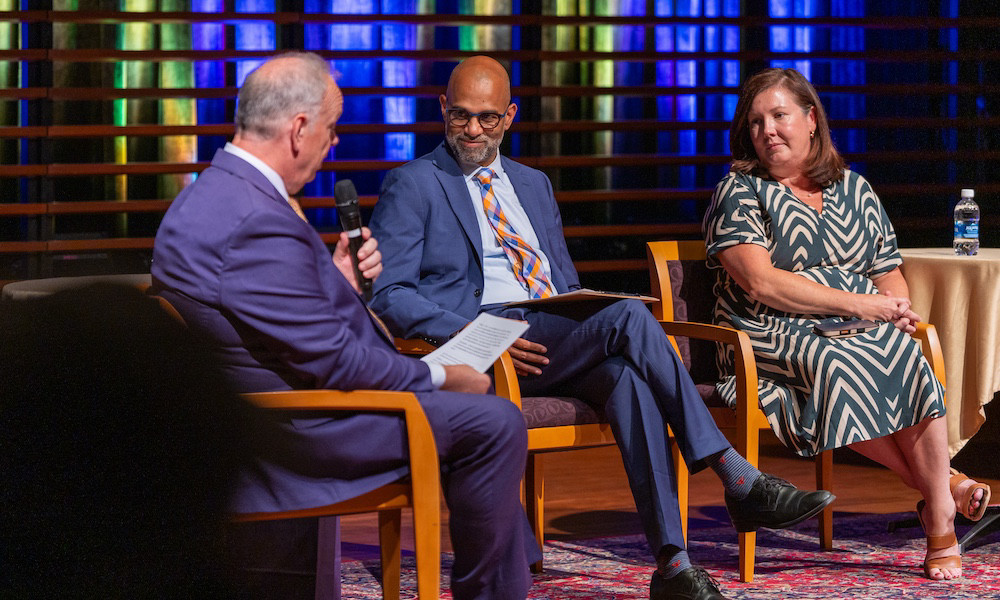
Vinnakota presented data from the institute’s Gen Z Civic Vibe Check survey indicating that 90% of young adults want to solve community problems but face barriers such as not knowing how to start and lacking peer models.
Laur emphasized that civic engagement should be part of an institution’s DNA rather than existing in isolated pockets of activity on campus. But she added there are often challenges in institutionalizing civic efforts due to complex university structures.
The group identified “power skills” — including active listening, ethical reasoning and collaborative problem solving — as essential for citizenship and career success in an artificial intelligence-driven era and suggested that faculty incorporate such skills in their teaching.


