

Toward ‘the free exercise of religion‘
Balance between established religion and religious liberty a delicate and fluid one in the American colonies
Being the Change


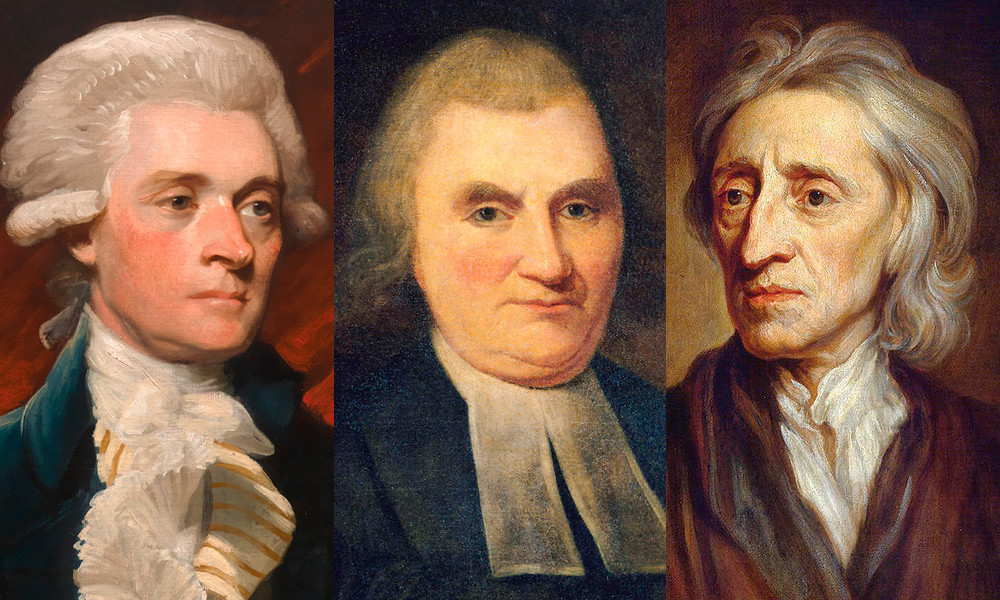
SUMMARY: James Madison played a pivotal role in establishing religious freedom in the U.S. as a fundamental civil right, rather than an indulgence from the government.
Hear more episodes and subscribe to the podcast at the Being the Change podcast page.
By Dr. Rebecca Brannon, professor of history; Dr. Robert Brown, professor of religion; and Dr. Kenneth L. Pearce, professor of philosophy and head of the Department of Philosophy and Religion
Founding Father James Madison drew inspiration from key thinkers of the Age of Enlightenment, such as the English philosopher John Locke, as well as his own experience and observations of religious pluralism in the American colonies. His vision of religious freedom proved to be persuasive for the nation and even beyond its borders.
Locke took what was, by the standards of the time, an expansive view of religious liberty. He argued that governments should be concerned only with worldly goods, such as life, liberty, health, money, land and houses. It followed, according to Locke, that religious beliefs and practices should not be prohibited or interfered with by the state unless they are damaging to other people or their property, or to the stability of the state.
Locke’s “classic liberal” vision of government triumphed in the Revolution of 1688-89, which removed King James II — who ruled England, Ireland and Scotland — in favor of his daughter, Queen Mary II, and her husband, King William III (also William II of Scotland), whose joint rule was known as the reign of William and Mary. Shortly after the revolution, Parliament passed the Act of Toleration (1689), allowing non-Anglican Protestants the freedom of worship.
Yet Locke’s vision of religious tolerance was limited in important ways. First, he refused to tolerate atheists on the grounds that citizens must be willing to swear oaths before God and fear divine wrath if they break them. Second, Locke refused to tolerate Roman Catholics, alleging that they were loyal to a foreign monarch — the Pope — and were therefore traitors.
Additionally, although Locke is clear in opposing attempts by governments to suppress religions they don’t like, he’s much less clear on whether governments can give special privileges to religions they do like. While some of Locke’s more radical followers argued that state-sponsored religion was incompatible with his ideas, these arguments did not succeed — at least not in England. The Test Act of 1673, which required any person holding a government office to receive communion in the Anglican Church at least once per year, was not fully repealed until 1863. Even today, the Anglican Church is supported by the state, and its bishops vote in the House of Lords.
The balance between established religion and religious liberty was a delicate and fluid one in the American colonies. British colonies were nominally under the auspices of the British state (Anglican) church. But Anglicanism was hardly an entrenched institution in the religious lives of colonists. Some colonies, such as Maryland, New Jersey and Pennsylvania, began as proprietary colonies, meaning their owners had a greater say on matters of religion. In the case of Pennsylvania in 1681, for example, William Penn, a Quaker, gave constitutional protection to religious liberty. Roger Williams, a Baptist, did the same for Rhode Island when it received its patent as a colony independent of Massachusetts Bay in 1644.
The Massachusetts Bay Colony occupied a curious position in religious matters. While the colony was technically an extension of the Anglican establishment, control of its original charter from 1629 allowed its Puritan leaders to reform or “purify” its churches from the “Catholic corruptions” of the Anglican Church, leading to dramatic changes in forms of worship, leadership, preaching and even church architecture. Thus, Puritans were allowed to exercise and protect religious liberty for themselves over traditional Anglicanism, even while they vigorously prosecuted religious dissenters such as Quakers and Baptists.

Anglicanism held its greatest sway in the Carolinas, New York and Virginia, though even in these instances its influence was frustrated by several factors, all of which contributed to a growing degree of religious liberty throughout the colonies. First, the Act of Toleration, which mainly affected England, extended to religious dissent in the American colonies. The Anglican Church may have held legal and political privileges, but it could not thereafter prohibit the presence of Baptists, Mennonites, Methodists, Presbyterians or Quakers in its territory. Second, the British government was most interested in the economic exploitation of American resources, and as it encouraged immigration there, it turned a blind eye to the religious identities of immigrants. Third, the Crown was happy to encourage religious dissenters to emigrate, as it offered the opportunity to remove religious malcontents from England itself. In many ways, the British government itself interfered with the establishment of a religious monopoly by its own official church, protecting some measure of religious liberty as a means toward colonial development.
In the decades leading up to the American Revolution, advocacy for legally protected religious liberty took on new force. Influenced by the work of political theorists such as Locke, leaders began to advocate for religious liberty as a God-given, principled human right — an idea notably promoted by Madison’s teacher and mentor at Princeton University (then the College of New Jersey), the Presbyterian minister John Witherspoon.
Madison, together with Thomas Jefferson, worked alongside crucial allies from the Baptist and Methodist communities to implement religious freedom in Virginia and the greater United States. Specifically, in the 1776 debates over religious life in Virginia, Madison made a crucial intervention to the legal language that George Mason had written calling for the “fullest toleration” of religion. This language was in keeping with the Enlightenment norms of the day, but Madison pushed his contemporaries to replace “toleration” with the “free exercise of religion.”
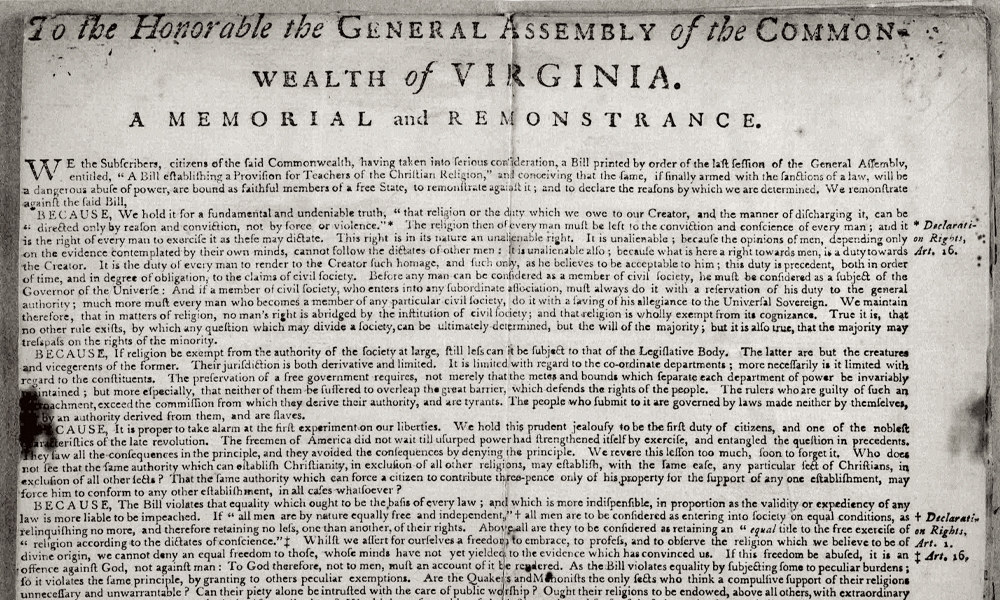
With this change, Madison paved the way for the evolution away from religious toleration — an idea that the state granted some or most people the ability to practice their religion without constraint, but could take it away — to religious freedom — a natural right guaranteed to all that the state could not diminish. This laid the groundwork for the later abolition of the Anglican Church as the official government-supported church.
Despite being Anglican themselves, Madison and Jefferson pushed to end the Anglican Church’s legal position as the state church from 1779 onward, ultimately achieving passage of the Virginia Statute for Religious Freedom in January 1786. Madison led the public persuasion campaign in a spirited pamphlet war that drew more writing than any other issue in Virginia politics. He published anonymously to avoid controversy and ensure that the most prominent voices for church disestablishment would remain believing Baptists and Methodists. Many hoped for a position of compromise in which state tax dollars would fund ministers of all Protestant faiths. This compromise was anathema to Madison, who favored the complete separation of church and state. Jefferson would eventually write in the legal act that “Almighty God hath created the mind free,” and therefore any attempts to compel religious belief or practice had always, and would always, fail. Any society that believed people could freely choose the best way to govern themselves should also be able to choose the best way to achieve salvation. Madison’s intellectual commitments and his lived experiences in a Virginia with diverse Christian communities convinced him that free people could remain religious and moral without government compulsion. This experience was also at the heart of his commitment to the idea that diverse groups of people with different ways of life would, in working out their differences, serve as the best protection for a vibrant democracy. In Federalist No. 10, Madison extended his advocacy for religious freedom into government. His insistence on complete liberty of conscience helped shape the First Amendment’s guarantee of religious freedom to all.
Madison believed religion helped us be moral people. He also believed in the power of free markets in everything, including goods, ideas, government, and religious faith and practice. He would be pleased, but not surprised, to learn that to this day, Americans are some of the most religious people in the industrialized world.



