

How time and deliberation built a nation
As the new nation found its footing, the underlying goal shifted from state-building to state-maintaining
Being the Change


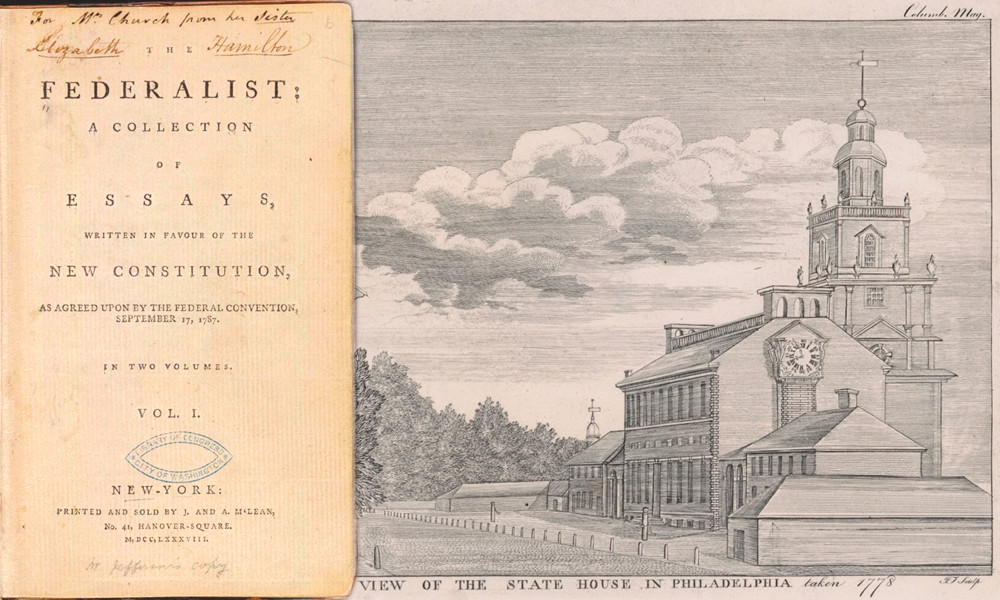
SUMMARY: In the summer of 1787, with the fledgling nation teetering on the brink of collapse, the delegates to the Constitutional Convention met in Philadelphia to revise the failing Articles of Confederation. But the Virginia delegation brought their own plan, which called for a stronger central government.
Hear more episodes and subscribe to the podcast at the Being the Change podcast page.
By Dr. Marty Cohen, professor of political science, and Dr. Kevin Hardwick, professor of history
On May 29, 1787, the delegates gathering in Philadelphia’s State House knew they were at a crossroads. The American union had survived 11 years of independence, but its future remained uncertain. The Articles of Confederation, the frame of government that had carried the United States through the Revolutionary War, was failing, and many observers wondered openly whether the American experiment in self-government could survive. Some delegates, including the meticulous Virginian whose name our university bears, worried about the inability of state governments to protect the rights of their citizens. But the problem that loomed largest for many who had served the continental cause was more elemental: whether the fragile union could survive at all in an Atlantic world where European empires remained powerful, watchful and frequently hostile.
Into this moment stepped Edmund Randolph. The 33-year-old governor of Virginia was, by every account, a commanding presence. He was tall, handsome and possessed of what fellow delegate William Pierce called “a most harmonious voice.” A French diplomat covering the Constitutional Convention once described him as one of the most distinguished men in America by virtue of his talents and influence. On this late spring day, Randolph rose to deliver what would prove to be one of the most consequential forensic performances in American history.
Randolph’s argument was stark and urgent. A sound continental government, he told the delegates, must above all secure the union “against foreign invasion” and against “dissentions between members of the Union.” These were precisely the protections the existing confederation had proved unable to provide. Individual states could violate treaties with foreign powers, threatening to drag the entire union into wars it lacked the financial and industrial means to fight. States could act against their neighbors without check or remedy. Delegate Robert Yates of New York recorded that Randolph showed the existing government to be “totally inadequate to the peace, safety and security of the confederation,” and argued “the absolute necessity of a more energetic government.”
Randolph’s argument did not emerge from thin air. In the weeks before the convention opened, James Madison had orchestrated a series of conversations among the Virginia delegates, hammering out collectively the broad outlines of what would become the Virginia Plan. Later, Madison himself said as much, remembering late in his life that “the Resolutions introduced by Governor Randolph were the result of a Consultation on the subject.” George Mason, who arrived in Philadelphia nearly two weeks before deliberations began, described the process in a letter to his son: The Virginia delegates, he wrote, met together “two or three Hours, every Day; in order to form a proper Correspondence of Sentiments,” supplemented by conversations with delegates from other states and with officers gathered for a meeting of the Society of the Cincinnati. Randolph was the Virginia Plan’s public voice, but the enterprise was collaborative. The founding was less the product of isolated genius than of sustained deliberation among men who had thought hard about the problem of union.
What Randolph was describing, though he would not have used the term, was state-building. The United States had declared its independence and fought a war to secure it, but it had not yet built the institutional machinery that sovereign nations required to survive. European powers had spent the previous century building what modern scholars call “fiscal-military states,” developing the governmental apparatus capable of raising revenue, fielding armies and projecting force across oceanic distances. Britain, France and Spain could mobilize enormous resources in defense of their interests; the American confederation could do none of these things reliably. Randolph’s diagnosis was less a meditation on rights and liberties than a hardheaded assessment of national vulnerability.
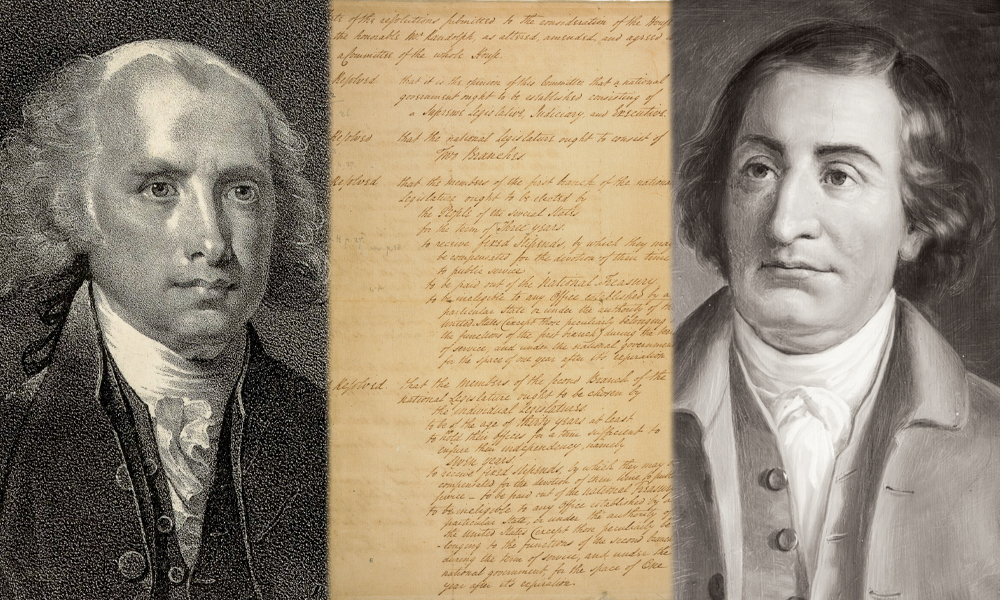
The delegates listened, and they were persuaded. With remarkably little debate, the convention adopted the framework Randolph proposed as the basis for its deliberations. That these famously contentious men moved so quickly and unanimously is testimony enough to the force of Randolph’s performance. He had made the crisis feel inescapable.
The convention that Randolph’s speech set in motion worked through the summer of 1787, ultimately producing the Constitution that Americans live under today. The document they created was in many respects a response to precisely the vulnerabilities Randolph had identified. The new government could levy taxes, regulate commerce and raise armies. It could speak with a single voice in foreign affairs and compel the states to honor their treaty obligations. It created, in short, the institutional machinery that the confederation had lacked.
In the new government’s first years, George Washington and the first Congress built an executive branch organized around the core functions Randolph had identified as dangerously absent. They created departments devoted to foreign affairs, finance and war. Washington appointed Alexander Hamilton as secretary of the treasury, and Hamilton moved quickly to build the fiscal foundations of American power. He funded the national debt, established a national bank and promoted domestic manufacturing. Hamilton’s program provoked fierce opposition at the time, but it was above all a state-building enterprise, designed to give the new republic the financial scaffolding that sovereign nations required to survive and protect their interests in a violent world.
Scholars have long debated what the founders were really doing in Philadelphia. The popular imagination tends to picture them as philosophers of liberty, preoccupied above all with rights and the dangers of tyranny. More devoted students of history might also be aware of Progressive-Era portrayals of the founders as a narrow economic elite mobilized against broader democratic opposition to protect their status. These frames are not wrong, but they are incomplete. What Randolph’s speech reveals is that many of the men in that room were also hardheaded realists who understood that liberty without security was an abstraction. The nation that the Declaration of Independence had called into being needed to survive in a dangerous world, building the governmental capacity to ensure that survival was necessary to fulfill the promise of the Revolution’s ideals.
Madison left the convention with reservations. In a long letter to Jefferson, written in late October 1787, he confessed his disappointment that the delegates had rejected his proposal for a federal veto over state legislation. Without it, Madison feared, the new government would struggle to restrain the kind of unjust and shortsighted state lawmaking that had troubled him throughout the 1780s. The Constitution, in his view, was a compromise that fell short of what the moment required. The man whose preparatory work had done so much to shape the convention’s agenda was not entirely satisfied with what it had produced.
Randolph never signed the Constitution. After months of deliberation, he concluded that the document concentrated too much power without adequate safeguards, and he withheld his signature in September 1787. Yet the Constitution the delegates signed that day was, in large measure, the product of the framework he had championed in May. Together, Randolph and Madison illuminate something important about the founding: It was not a moment of serene consensus among far-sighted philosophers but a hard-fought, imperfect effort by practical men grappling with urgent problems.
As our new nation found its footing, the underlying goal evolved from state-building to state-maintaining. The existential threat of the American Civil War arose before the nation was a century old and was followed by numerous difficulties of varying magnitude. There were foreign wars to fight and domestic economic crises to mitigate. But ever since the surrender of Robert E. Lee in Appomattox, Virginia, reasonable observers hardly contemplated the dissolution of the union. They did not imagine a complete and total failure of the system produced by the careful consideration of Madison, Randolph and their contemporaries.
As we approach the 250th anniversary of the Declaration, it is not interstate conflict or imperial competitors threatening the very survival of the union but extreme partisan polarization. There have been three government shutdowns this fiscal year alone, costing the nation roughly $15 billion and precious reserves of public trust. More ominously, political violence has spiked in the past decade, with threats to members of Congress reaching an all-time high in 2024. Longstanding norms are being shattered, and with them the sense of comity and stability that supported our democratic system of government. Presidents threaten to pack the Supreme Court with partisan judges, majority-party senators float the elimination of the filibuster, and Republican and Democratic states attempt mid-decade partisan gerrymanders that would further distort the representative nature of our legislature.
Many of the institutional safeguards installed by our Founding Fathers have been rendered impotent in the face of intense party loyalty. At this, the framers may have only been surprised that it took so long. Many contemporaries of the late 18th century were outspoken about their fear of what has ultimately befallen this nation. In Federalist No. 10, Madison cautioned against the “mischiefs of faction,” and in his farewell address to the nation, Washington warned of the dangers of political parties. The men who framed and implemented the American state understood something the civics textbooks often obscure. Constitutional machinery, regardless how ingeniously designed to embed institutional checks and balances, could, in the end, only function if the people operating it chose to let it.
The Declaration had announced the founding generation’s ideals to the world. It took another 11 years, and the determined work of men like Randolph and Madison, to build the institutions that gave those ideals a solid foundation. This story suggests we may not need political genius to restore what has been damaged. It may once again simply require sustained deliberation on what it will take to reinforce an increasingly fractured union.



