

Q&A with Madison Center for Civic Engagement’s Kara Dillard
JMU News


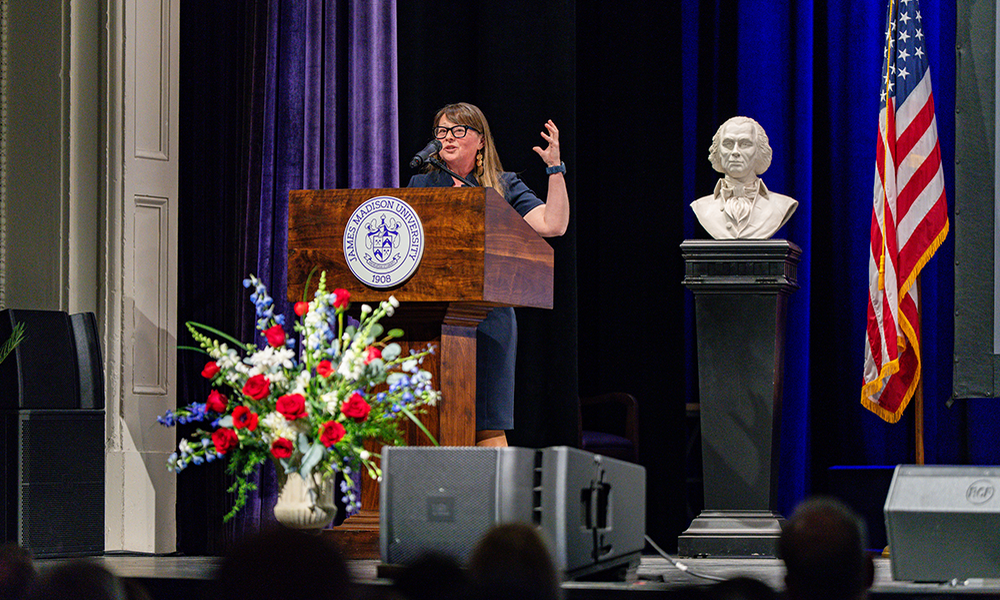
Kara Dillard, executive director of the Madison Center for Civic Engagement, is helping lead the university’s efforts to commemorate the 250th anniversary of Virginia. Through a series of events, discussions and community partnerships, JMU’s VA250 programming connects the state’s founding history to conversations about civic participation today.
Dillard discusses how the university’s programming fits into the broader statewide initiative and why it matters for the JMU community and the commonwealth.
Q: How does JMU’s VA250 programming fit into the larger statewide commemoration, and what role does the university play in that effort?
JMU’s VA250 programming is designed to complement and amplify the commonwealth’s and America’s overall commemoration by bringing academic expertise, regional partnerships and public-facing events into the statewide narrative. As one of Virginia’s major public universities—and the namesake institution of James Madison—JMU serves as a convening hub for scholarship, civic learning and community engagement. Our role is to translate the themes of the 250th anniversary into accessible programming that connects history to contemporary civic life, while also elevating the stories and perspectives distinct to the Shenandoah Valley.
Q: Why is it important for a public university like JMU to participate in a milestone of this scale for Virginia?
As a public institution, JMU has a responsibility to support statewide civic education and to foster informed and engaged citizenry. Milestones like VA250 and America250 are opportunities to examine our shared past with honesty and depth as well as charting our next 250 years together. Participating in this moment underscores JMU’s commitment to public purpose, academic inquiry and service to Virginia.
Q: What opportunities does VA250 create for collaboration between JMU and partners across the state?
Each region has a VA250 commemoration committee that has been working diligently over the past 3-4 years for this moment. Locally, the Harrisonburg-Rockingham County committee includes JMU, both local school districts, Rocktown History, City of Harrisonburg Tourism office, the Brethren Mennonite Heritage Center, the VA Quilt Museum and many other partners. The VA250 effort is unique in its encouragement of interdisciplinary partnerships—such as combining expertise from history, political science, education, music and the arts—to create rich, thoughtful programming. These relationships extend JMU’s reach across the commonwealth while strengthening shared capacity for public engagement. For our March 2 kickoff event, we partnered with VPM, Virginia’s Public Media, and James Madison’s Montpelier to bring journalism, public storytelling and history together.
Q: How does this initiative elevate JMU’s visibility and engagement beyond the Shenandoah Valley?
By participating in statewide events, hosting major public programs, and contributing scholarly expertise, JMU becomes an active voice in a much larger conversation. Our programming positions the university as a resource not only for our region, but for Virginians across the state who are seeking opportunities to learn, reflect and participate in civic life. It signals that JMU is committed to shaping the future of democratic engagement at the state level.
Q: In what ways are these events designed to connect local history to the broader story of the American Revolution in Virginia?
We intentionally highlight stories, people and events from the Shenandoah Valley that intersect with the statewide revolutionary narrative. On March 5, JMU, through the Madison Center for Civic Engagement and JMU’s philosophy and religion department, is partnering with the Brethren and Mennonite Heritage Center to bring to life the stories of religious groups in the Shenandoah Valley during the Revolution. Mennonite groups have been traditionally pacifist, so the story of revolution and battle as it intersects with faith is a unique-to-this-region story to tell.
Q: How do you hope VA250 will shape the way people across the state think about JMU’s contributions to civic life and education?
I hope VA250 demonstrates JMU’s dedication to fostering civic engagement and meaningful public dialogue around difficult issues. Ideally, people across Virginia will see JMU as a trusted convener—an institution that brings communities together to understand the past, grapple with the present and imagine the future. This commemoration offers a chance for JMU’s leadership in civic education to shine at the statewide level.
Q: How has planning VA250 brought together different areas of campus and the surrounding community?
VA250 planning has been a deeply collaborative effort, engaging faculty, staff, students, local historians, museums, government partners, community organizations and regional leaders. At JMU, our campus committee involved faculty and staff from the JMU history department, the Office of Creative Propulsion, the division of Research, Economic Development and Innovation, Facilities and other units. Such a cross-campus effort allowed us to bring the best of campus to this effort. For example, the VA250 Mobile Museum will be coming to Harrisonburg High School (HHS). For JMU students without a car, there is no good way to get from campus to HHS. Thanks to JMU Facilities Management, JMU shuttles can take students to HHS every 30 minutes, so they get to participate in this event. We’re also excited to showcase art’s role in telling America and Virginia’s story through elevating the work of the Office of Creative Propulsion. This cross campus and community coordination has built new relationships, fostered interdisciplinary thinking and encouraged shared ownership of the commemoration. It has united many areas of the university around a collective purpose.
Q; What does this initiative allow faculty, staff, students, alumni and local residents to experience together?
I’ve heard from so many local residents who were part of America’s 200th celebration in the 1970s about how excited they are to celebrate the 250th with JMU’s student and faculty. As a nation deeply polarized about how to interpret our past and define our future, it's important to take time during these hallmark moments to find, as Thomas Paine said, “a small spark” that can pull people together across divides to seek shared solutions and a common cause. The Madison Center, in partnership with the National Issues Forums Institute, will be launching a “What’s Next, America?” deliberation series for our broader community to think together about what values we want to continue defining the American experience and what new values and ideals we want to help chart our next 250. These moments of finding common cause despite divides are critical to our democracy.
Q: How does VA250 strengthen JMU’s role as a convening space for dialogue, learning and public engagement?
JMU is the national model of an engaged university, and the Madison Center is the nation’s leading center for teaching civic discourse and dialogue. As part of this mission, the Madison Center wants to be the Shenandoah Valley’s premier nonpartisan convener of difficult community conversations, whether it is through candidate forums during election season or having conversations about uniting for a common cause during a showing of “The American Revolution.” While lectures, symposia and cultural events celebrating the 250th are important, JMU’s distinctive contribution to this time is to be the place for robust, difficult yet productive conversations across divides about who we are as a nation and who we want to be going forward.
Q: What long-term impact do you hope these programs will have on JMU’s relationships within the region and across Virginia?
I hope VA250 leaves JMU, Harrisonburg and Rockingham County with lasting partnerships, stronger trust with community stakeholders, and a deeper recognition of JMU’s value as a statewide civic institution. By investing in relationships and shared projects over the last 2-3 years, we are laying the groundwork for ongoing collaboration—well beyond the anniversary itself. The long-term impact should be a more connected, engaged and civically-minded Virginia.
Q: How are students participating in or helping to shape VA250 events?
Students are contributing through event planning, public history work, artistic performances, and service learning. The Madison Historians are planning a celebration of James Madison’s birthday to coincide with the kickoff week and help their peers understand who our university’s namesake is and what his contribution is to this time. At the Madison Center, our Democracy Fellows have been developing student-focused programming to engage peers. Their participation ensures that VA250 is not just reflective, but forward-looking—shaped by the next generation of civic leaders.
Q: What do you hope students take away from engaging with this commemoration during their time at JMU?
I hope they leave with a deeper understanding of how history informs their role in society today. Engaging with VA250 should help students see themselves as active participants in democracy, capable of contributing to civic life in meaningful ways. If the experience inspires curiosity, critical thinking, and public purpose, then we have succeeded. As I said on March 2 during my framing of “The American Revolution” film, there are probably students on our campus looking at a deeply divided nation and thinking, “Why should I seek common cause with people whose values seem so different from my own?” One of the lessons of the Revolution is that disagreements are necessary to create change; but if we fail to engage in conversations where we will disagree with others, we fail to position ourselves to be the change. At the time of the Revolutionary War, Madison was 25 years old (not much older than our college students!), living at Montpelier and thinking of a career in politics. He was wrestling with a question that is just as resonant today: What would freedom actually mean in practice for a diverse and pluralistic society - one that deeply disagreed yet in need of common cause? This question inspired Madison to write the First Amendment, our nation’s defining right. That question about the meaning of freedom in a pluralistic society in desperate need of common cause is now up to this generation of young people to decide and make happen.
Q: Why does this commemoration matter right now — for JMU, for Virginia, and for the nation?
At a time when civic trust is fragile and communities are grappling with complex questions about identity, history and democracy, VA250 offers a constructive space for reflection and engagement. For JMU and Virginia, it is an opportunity to bring people together, to explore our shared past and to imagine a more informed and inclusive civic future. Nationally, it aligns with broader conversations about the foundations of American democracy and the responsibilities of citizenship today.
Q: How does VA250 reflect JMU’s identity as the university that carries James Madison’s name?
James Madison championed constitutional governance, civic responsibility, and the pursuit of knowledge, values that remain central to JMU’s mission. VA250 provides a powerful platform for embodying these ideals. By engaging communities in learning, dialogue, and public reflection, JMU honors Madison’s legacy in ways that are relevant and forward-looking. The commemoration underscores our responsibility to carry Madison’s principles into the 21st century.


