

Q&A: COE faculty spotlight global perspectives in mathematics
JMU News


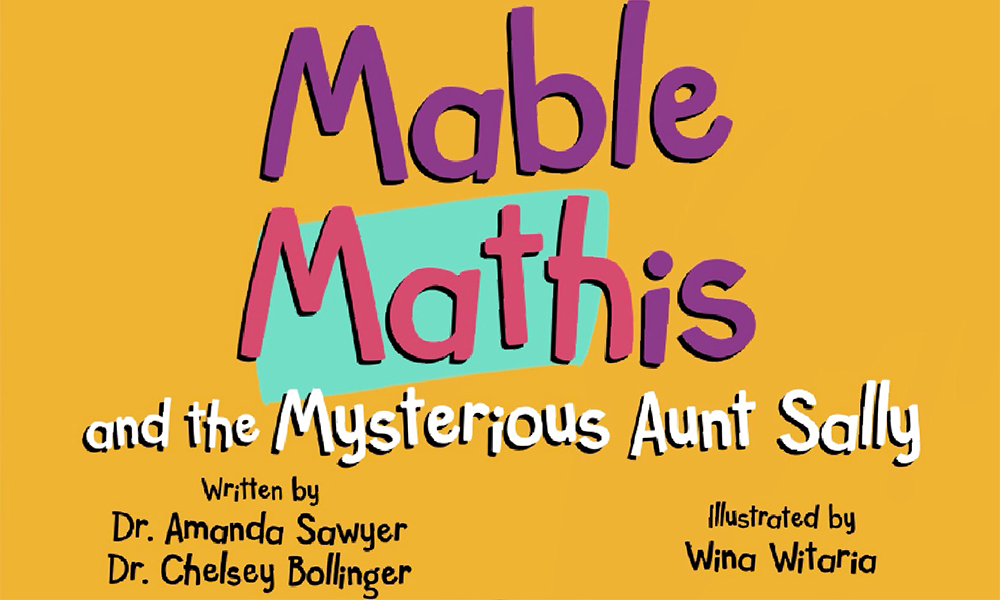
SUMMARY: James Madison University faculty members Amanda Sawyer and Chelsey Bollinger recently co-authored “Mable Mathis and the Mysterious Aunt Sally,” a children’s book that uses storytelling and global perspectives to rethink how mathematics is taught and understood.
Amanda Sawyer and Chelsey Bollinger, who teach in the Department of Early, Elementary, and Reading Education, recently co-wrote “Mable Mathis and the Mysterious Aunt Sally,” a children's book that encourages teachers and students to learn more about mathematics through inquiry, storytelling and a global perspective.
University Communications spoke to Sawyer and Bollinger about the book's inspiration, how it mirrors their approach to educating future teachers, and how narrative may help students grasp mathematics and cultural differences.
Q. What inspired you to write“Mable Mathis and the Mysterious Aunt Sally,” and what gap did you hope it would fill in mathematics education?
Sawyer:
I was inspired to write this book with Dr. Chelsey Bollinger by my friends from around the world! From my experiences at the University of Georgia, the University of South Carolina, and James Madison University, I attended school with, conducted research alongside, and worked with individuals whose backgrounds and cultures were different from my background in Columbia, South Carolina. As a result of these friendships, I was exposed to how mathematics is taught differently in other countries. Yet once I started teaching mathematics education courses, I found that many of my preservice and in-service teachers were unaware of a global understanding of mathematics.
In the first mathematics methods course I taught, I began the class with a discussion of the viral math problem circulating on Facebook, which said, "Let's see who is really smart. Can you solve 60/20(5-2)?” The post required the students to understand that multiplication and division must be performed in left-to-right order in the order of operations, rather than following the Parentheses, Exponents, Multiplication and Division, Addition and Subtraction (PEMDAS) method by process alone.
During our class discussion, I shared responses from others online, including methods from other countries such as Brackets, Indices, Division, Multiplication, Addition, Subtraction and Brackets, Order, Division, Multiplication, Addition, Subtraction. This surprised many of my students. I distinctly remember one student saying, “But how can it be different? Math is a universal language.” From this interaction, I became aware of the need to share this understanding that math is a universal language because it follows the same mathematical properties, not because it is completed the same everywhere.
Teachers will have students from around the world in their classroom, and I want all their perspectives and methods to be valued. Therefore, the book, “Mable Mathis and the Mysterious Aunt Sally” was born to help support these educators and parents to explore how students can learn mathematical concepts conceptually through a global perspective.
Bollinger:
Amanda came to me with the original idea for the book; she’s the math expert. My role in the project came from a different place: my background in children’s literature. In my doctoral program, I studied children’s literature deeply, and for the past decade I’ve reviewed children’s books for the International Literacy Association’s Children’s Literature Special Interest Group. I know how powerful story, character and illustration are for helping children make sense of complex ideas.
What we realized together is that there’s a gap in mathematics education when it comes to narrative. Many math resources focus on procedures, but children learn through story. We wanted to create a book where mathematics wasn’t presented as a set of rules to memorize, but as a mystery to explore through engaging characters and visual storytelling. From a literacy perspective, the book invites children to read closely, notice clues, make inferences, and talk about their thinking.
Our hope was to fill a gap by creating a children’s book that treats math as something children can read, interpret, and make meaning from, not just memorize.
Q. How does this book reflect your approach to teaching mathematics and preparing future educators?
Sawyer:
Research in mathematics education has shown that an effective understanding of mathematics involves examining why different properties occur. Math educators help their students understand this through inquiry and exploration of multiple methods to support why individuals can solve various problems. For example, when teaching multiplication, students explore the concept through addition properties, such as arrays. Therefore, we wrote the book to support this understanding by incorporating global mathematics perspectives and to support future teachers in valuing these differing methods of solving problems.
Q. The story highlights how mathematics is taught differently around the world. Why was it important to include global perspectives in a children’s book about math?
Sawyer:
The United States political climate is very divided, and we wanted others to view differences as positives rather than negatives. Therefore, we decided to share this global mathematics understanding with other educators and parents in a format appropriate to support learning for all, a children’s book.
The book portrays the message that just because we might solve problems differently does not mean a person is wrong. I hope this small book can help others understand how to value other individuals’ perspectives regardless of origin.
Bollinger:
It was important to include global perspectives because children’s books are often where young readers first learn how the world works beyond their own community. From a literacy standpoint, stories shape what children see as normal or correct. We wanted readers to understand that mathematics, like language and culture, is taught and experienced in different ways around the world.
As children notice these differences in the story, they practice key comprehension skills such as questioning, comparing and making connections. At the same time, they learn that there is more than one way to understand something. This helps build flexible thinking and respect for diverse ways of knowing.
Q. How can this book be used in classrooms or learning settings to support both mathematical understanding and cultural awareness?
Sawyer:
The book can be used to launch discussions around order of operations and mathematics, being a universal language, to any group of students. At the end of the book, we provided a discussion question guide for teachers and parents explaining the mathematical background knowledge around why the different methods are used and answering questions that their own students might come up with around the content in the book.
Teachers or parents can read the book out loud and then ask their students the discussion questions provided to promote inquiry, mathematical communication, and understanding the concepts around the order of operations.
Q. How does this project reflect the work being done at JMU to prepare globally minded educators?
Sawyer and Bollinger:
At JMU, we have both been part of the development of the concentration in Global Studies within the Department of Early, Elementary, and Reading Education. This program offers a timely and innovative opportunity to prepare educators for diverse and interconnected classrooms. The program focuses on methodological courses, ensuring that students acquire practical tools that we both plan to teach.
We value these multiple perspectives and intend to foster this with future teachers through our research and teaching in this program.
Q. What surprised you most during the process of writing and developing this book?
Sawyer:
The most significant surprise is the continuous response I have received from others whom I talk to about the book, explaining that they, too, did not know that other countries didn’t use PEMDAS.
From the book, I have had some wonderful in-depth conversations that have really helped me see even more perspectives around mathematics. I love learning about other people's experiences, and this book has made it even more possible to discuss math with a new population.
Bollinger:
What surprised me most was how much fun it was to create a children’s book together. Bringing story, illustration and mathematical ideas to life felt playful and creative in a way that academic writing rarely does.
I was also struck by how naturally literacy and mathematics intertwined as we worked. It reinforced for me that a story is a powerful way to make complex ideas feel meaningful and approachable for children. The process was so energizing that we already know this will not be our last book together.
Q. What conversations about mathematics and culture do you hope this bookwill encourage among students and educators?
Sawyer:
I hope the conversation about mathematics and culture will encourage others to change the argument around, “Who’s right?” to “How can I learn from others?” By listening to how others were taught mathematics and how others view the world, we can change our own perspectives to include everyone because mathematical understanding should be an inclusive, not an exclusive set.
Bollinger:
For educators, I hope it opens dialogue about using story and discussion to help students think more deeply about both math and culture. The book creates a natural entry point for talking about perspective, flexibility in thinking, and respect for diverse ways of learning and knowing.


