

JMU project preserves veterans’ voices for future generations
JMU Headlines


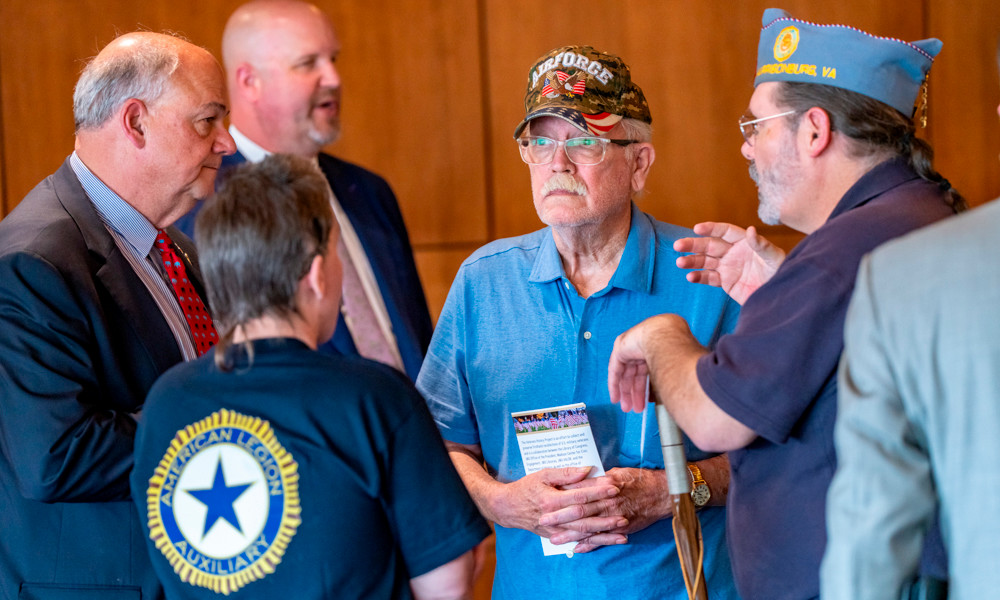
SUMMARY: JMU’s Veterans History Project is an initiative to archive veterans’ stories for preservation in the Library of Congress.
A project at James Madison University is giving voice to generations of American veterans through interviews, written accounts and photographs being collected for the Library of Congress.
JMU’s Veterans History Project is an initiative to archive veterans’ stories for preservation in the Library of Congress. The project began after Congressman Ben Cline’s office contacted the university in April 2023. The university was selected because of its strong public history program and experience conducting community-based oral histories.
“When they reached out to us, we had people who were well prepared to conduct interviews, who know how to do it, and we had some people who were very engaged with the topic,” said David Dillard, a U.S. Army veteran and head of JMU’s history department.
The project operates under the Library of Congress’ Veterans History Project guidelines, which follow the “30-20-10 rule.” Each collection must include at least a 30-minute interview, 20 pages of written material, or 10 original photographs or letters, with the option to include additional materials.
Dillard, who served as an infantry officer from 1984 to 1995 and commanded an infantry company in the 101st Airborne Division during the Persian Gulf War, helped guide the project’s development. As a veteran, he understands how personal the storytelling process can be.
“I often got people who wanted to talk to me, but wouldn’t necessarily want to talk to other people,” Dillard said.
Interviews for the project began in fall 2024, with nine completed that semester and 10 more in spring 2025.
“The interviews collected so far span a broad range of historical events from the Cuban Missile Crisis to Desert Storm, 9/11 and Hurricane Katrina,” Dillard said. “Vietnam is particularly well represented, with members of several different branches of the armed forces sharing their unique perspectives.”
For many veterans, the interviews provide a chance to reflect on experiences they rarely share.
“Most veterans I know don’t tell you that they did anything special,” Dillard said. “Most of them say, ‘I did my job. I did what I was supposed to.’ But as they talk, they often tell you about things that seem pretty extraordinary to civilian audiences.”
He recalled one interviewee who insisted she “didn’t do anything,” though she had served as a nurse in Vietnam and Germany, treating wounded soldiers for two years in each place before returning home to continue her nursing career in the Valley for three decades.
Graduate students in the public history program are trained to conduct and transcribe the interviews, gaining hands-on experience in oral history methods and archival documentation. The transcription process is labor-intensive.
“For about every hour of video of somebody talking, you’re talking about four hours at least to transcribe it and get it formatted and uploaded to meet Library of Congress standards,” Dillard said.
Beyond preserving history, Dillard said the project reveals how military service continues to shape the lives and outlooks of those who served.
“Overwhelmingly, what we get is the way that this shaped people, how they see the world,” he said. “It’s different for everybody. It doesn’t always mean it ruined them. A lot of them would tell you it made them.”
The project’s long-term goal is to conduct 20-to-25 interviews annually to ensure a steady flow of preserved stories for future generations. Dillard said the project welcomes community involvement.
“We are happy to train people who would like to conduct interviews, and we would really like help identifying veterans who would like to participate,” he said. “Through these stories, we’re not only documenting history, we’re helping people see the world through the eyes of those who lived it.”


