Heroes: Music Inspired by Bravery and Courage
Thursday, November 12, 2026
7:30pm
Forbes Concert Hall
Please silence all electronic devices.
Unauthorized videotaping or any other recording of this production is strictly prohibited in adherence with Federal copyright laws.
Program
Auguries of Innocence - William Pitts (b. 1986)
Hannah Caraker, graduate conductor
A Movement for Rosa - Mark Camphouse (b. 1954)
Mark Camphouse, guest conductor
Glimmerglass Concerto - Kevin Day (b. 1996)
Dr. Beth Chandler Cahill, flute
J'ai été au bal - Donald Grantham (b. 1947)
Summon the Heroes - John Williams (b. 1932)/arr. Paul Lavender
The Stars and Stripes Forever - John Philip Sousa (1854-1932)
Auguries of Innocence (2015) - William Pitts
"When I was asked to write a piece in honor of one of the legends in our field, the task was immediately more daunting than any other so far in my career as a composer. Eugene Migliaro Corporon is a name that I read on the CD covers of some of my favorite recordings, dating back to my earliest days in school band programs. He has been a part of the development of some of the best educators and performers throughout the country, and to say that I am honored to write a piece recognizing his commitment and impact on music would be an incredible understatement.
Auguries of Innocence takes its name from that of one of my favorite poems of the great William Blake. Blake offers the idea that the natural world can be regenerated in time and that nature itself can be an augury, or omen, to the lost vision of innocence. The poem is filled with randomly organized couplets of paradoxical imagery, all focused on the idea that it is wise to see the world through two eyes rather than one. Innocence is juxtaposed with evil, big with small, long with short. In my opinion, the most powerful words, and those that most motivated my decision to honor Blake's work with my title, come from the opening stanza:
My musical interpretation uses the idea of these paradoxes to create numerous competing elements presented in various instrument groups, textures, tempos, tonalities, etc. The most notable dichotomy is the use of one of my favorite chorale figures, happily borrowed from Chopin's Scherzo in C# minor. The chorale is first presented in major from the woodwinds, only to be immediately usurped by the minor tonality and contrasting rhythm from the low brass. From here, the rest of the piece presents numerous musical paradoxes and opposing forces: conflicting rhythms, contrasting timbres, contrary motion, etc. I even attempt to honor Professor Corporon with the use of a Morse code figure found in the mallet percussion (EMC, or . -- -.-.).
The piece does not follow the poem in any specific way, but rather seeks to present what I believe is one of the most important messages of Blake’s work: there are numerous ways to interpret a single idea, or to form our opinions of a concept, whether it be musical or otherwise. However, what we may deem as unsavory or less satisfying may, in turn, be most satisfying to another."
- Program Note by composer
A Movement for Rosa (1992/1994) - Mark Camphouse
A Movement for Rosa was commissioned by the Florida Bandmasters Association honoring civil rights heroine Rosa Parks and was composed and orchestrated over a three-month period: August-November, 1992. With a duration of approximately 11 1/2 minutes, this 'movement' -- a quasi-tone poem -- contains three contrasting sections. Section I evokes Rosa's early years, from birth Feb. 1913 in Tuskegee, Alabama, through her marriage in 1932 to Raymond Parks in Pine Level, Alabama. Section II portrays years of racial strife in Montgomery and the quest for social equality. Section III is one of quiet strength and serenity. The work's final measures serve an ominous reminder of racism's lingering presence in modern American society.
Camphouse provides the following notes about A Movement for Rosa:
"On December 1, 1955, Rosa Parks was arrested for refusing to give up her seat to a white man on a segregated city bus in Montgomery, Ala. Mrs. Parks earned the title “Mother to a Movement” for her act of personal courage, sparking the Civil Rights movement of the l950s. So significant and inspiring was her peaceful act of defiance that the Rev. Dr. Martin Luther King, Jr., inscribed the following words on the frontispiece of his book, Stride Toward Freedom, a copy of which he gave to Mrs. Parks: “To Rosa Parks, whose creative witness was the great force that led to the modern stride toward freedom.”
Throughout the history of our great nation, we have glorified (and rightly so) various heroes, most frequently presidents, military figures, and athletes. But we must not forget heroes who are perhaps less conspicuous but every bit as significant. Rosa Parks, who worked as a tailor’s assistant in a men’s clothing store, became secretary of the Montgomery NAACP and the impetus to a major social movement.
America’s proud heritage and the accomplishments of its people have been and continue to be darkened by racial discrimination. This blight on our country takes many forms, whether subtle or more overt, as with cowardly acts of intimidation and violence by various extremist hate groups. Mrs. Parks addresses this continuing problem in her 1992 book entitled Rosa Parks: My Story. The final three paragraphs of that book:
I look back now and realize that since that evening on the bus in Montgomery, Alabama, we have made a lot of progress in some ways.
All those laws against segregation have been passed, and all that progress has been made. But a whole lot of white people’s hearts have not been changed. Dr. King used to talk about the fact that if a law was changed, it might not change hearts but it would offer some protection. He was right. We now have some protection, but there is still much racism and racial violence.
In recent years there has been a resurgence of reactionary attitudes. I am troubled by the recent decisions of the Supreme Court that make it harder to prove a pattern of racial discrimination in employment and by the fact that the national government does not seem very interested in pursuing violations of civil rights. What troubles me is that so many young people, including college students, have come out for white supremacy and that there have been more and more incidents of racism and racial violence on college campuses. It has not been widespread, but still it is troublesome. It seems like we still have a long way to go.
Clearly, Rosa Parks met those challenges and responsibilities with great dignity and courage. As Congressman John Conyers aptly said: 'Rosa Parks moved civil rights issues from the back of the bus to the front of America’s conscience.'"
- Program Notes by Travis J. Cross for the UCLA Wind Ensemble concert program, 29 April 2015
Glimmerglass Concerto (2025) - Kevin Day
"Glimmerglass is my ninth concerto collaboration, this one being for solo flute, chamber winds and percussion. The concept for this flute concerto had been in my mind for several months, as I was grasping how to feature this virtuosic and beautiful instrument. In my comparison to my previous concertos, I wanted this one to have a brighter and shimmery texture of sound, one that could match the timbre of the flute. This led to the naming of this piece Glimmerglass Concerto, where the definition of glimmerglass is a “vibrant reflection of sunlight on a watery surface.” Through this naming, the two movements (Mirrors and Echoes) play with different reflections of sound and lyricism. This is most reflected in the percussion writing, where I wanted to have this shimmery cacophony of sound while the flute can soar above.
This piece was commissioned by the University of Colorado Boulder College of Music for the CU Boulder Wind Symphony and their professor of flute, Christina Jennings."
- Program Note by composer
J'ai été au bal (1999) - Donald Grantham
"J’ai été au bal is a celebration of some of the popular/folk music styles of Louisiana, in particular Cajun music and the brass band tradition of New Orleans. The dance flavor of much of the music is suggested by the title (“I went to the dance”), and two traditional Cajun dance tunes are employed. The first appears near the beginning and later at the end. “Allons danser, Colinda” ('lets go dancing, Colinda') is a boy’s attempt to coax Colinda into going dancing, and part of his argument is “it’s not everyone who knows how to dance the two-beat waltzes." The touching little tune does work better in a syncopated two, but is usually represented in the notation as 3+3+2. The second Cajun song is “Les flames d’enfer” ('the flames of hell'), most often performed as a heavily-accented two-step. My version is much faster and lighter, and is introduced by a country-fiddle style tune. The brass band begins with solo tuba, followed by a duet with the euphonium, and culminating in a full brass presentation."
- Program notes by composer
Summon the Heroes (1996/2009) - John Williams/arr. Paul Lavender
Once again, John Williams was asked to compose a work for the Olympics, and this thrilling composition is the result. Part of Summon the Heroes was selected as the official theme of the 100th Anniversary of the Olympics, and literally millions of people all over the world heard the theme throughout the 1996 Summer Games. This powerful arrangement includes the five major sections of the work: Fanfare; Prologue; Flags; Contest and Parade.
- Program notes from publisher
The Stars and Stripes Forever (1897/1951) - John Philip Sousa
Sousa consistently stated that this march was divinely inspired and was born of homesickness. In his autobiography, Marching Along, he provides the details of its creation after he had received a cablegram in Italy that his manager, David Blakely, had died:
“Aboard the Teutonic, as it steamed out of the harbor on my return from Europe in 1896, came one of the most vivid incidents of my career. As I paced the deck, absorbed in thought, suddenly I began to sense the rhythmic beat of a band playing within my brain. It kept on ceaselessly, playing, playing, playing. Throughout the whole tense voyage, that imaginary band continued to unfold the same themes, echoing and reechoing the most distinct melody. I did not transfer a note of that music to paper while I was on the steamer, but when we reached the shore, I set down the measures that my brain-band had been playing for me, and not a note of it has ever changed. The composition is known the world over as The Stars and Stripes Forever and is probably my most popular march.” (By permission of John Philip Sousa, Inc., New York City)
Paul Bierley states that The Stars and Stripes Forever is “by far the most popular march ever written, and its popularity is by no means limited to the United States.” A ten-year international march popularity survey confirms Bierley’s statement. The universal appeal of Sousa’s march is illustrated by an article in The New York Times by Harold Schonberg which tells of a tour to China by Eugene Ormandy and the Philadelphia Orchestra in 1973. After sitting politely but stonily through a program which ranged from Beethoven to Copland, the orchestra struck up The Stars and Stripes. “All of a sudden electricity permeated the hall. Faces broke into smiles; feet began tapping; there was a general air of understanding and happiness. Maybe,... (it) really is the greatest piece of music ever written by an American. In any case, it has made more friends for America than any other piece of music...”
- Program Note from Program Notes for Band
JMU Wind Symphony
Dr. Christopher Cicconi, director
Hannah Caraker, graduate assistant
Flute/Piccolo
#Isabel Aviles - Orlando, FL
*#Joshua Brancaleone - Lincoln Park, MI
Vanessa Britton - Madison, VA
Julia Crum - Charlottesville, VA
*#Emma Manning - Harrisonburg, VA
Oboe
*Cady Litteral - Sterling, VA
Lynette Salins - Fairfield, VA
Bassoon/Contra
Charles Andress - Ashburn, VA
*Hannah Gerick - Virginia Beach, VA
#David Kang - Chantilly, VA
Clarinet
Valerie Alvarado-Alas - Culpeper, VA
Breanna Boyd - Bassett, VA
Kelsey Davis - Harrisonburg, VA
Jeanette Gilson - Chesapeake, VA
Tyler Kirby - Stuarts Draft, VA
*#Geneva Maldonado - Tobyhanna, PA
Samuel Sheehan - Round Hill, VA
Bass/Contra Clarinet
Alisa Billups - Owings, MD
Emerson Garmendia-Arevalo - Winchester, VA
Ian Graff - Virginia Beach, VA
Alto Saxophone
*Connor Dunford - Roanoke, VA
Jaylen Swafford - Portsmouth, VA
Tenor Saxophone
Joshua Wiseman - Richmond, VA
Baritone Saxophone
Sean Wyatt - Stuarts Draft, VA
Trumpet/Flugelhorn
Chris Atkinson - Charlottesville, VA
Baxter Kauffman - Newport News, VA
#Ian Krueger - Tullahoma, TN
Liam Meadows - Richmond, VA
Micah Wingfield - Grottoes, VA
*#Allie Woodbury - Alexandria, VA
Horn
Jakob Fox - Blacksburg, VA
Josh Short - Waynesboro, VA
*Chloe Starling - Harrisonburg, VA
Riley Truong - Locust Grove, VA
Trombone
Brett Eye - Bridgewater, VA
William Ragno - Virginia Beach, VA
Riley Rockett - Evansville, IN
Gavin Torrence - Forest, VA
*Jack Waters - Rustburg, VA
Euphonium
*#Michael Baker - Fairfax, VA
#Hannah Caraker - Tarpon Springs, FL
^Bobby Galitz - Pearisburg, VA
Tuba
Benjamin Campbell - Abingdon, VA
Anders Helvey - Alexandria, VA
*#Henry Taylor - Culpeper, VA
Piano/Celesta/Synthesizer
#Chyh Leng Low - Kuala Lumpur, Malaysia
Harp
**Laura Hoffman
Double Bass
Kiki Protopsaltis - Goshen, NY
Percussion
Robert Cahill - Fredericksburg, VA
Thomas Creighton VI - Chesapeake, VA
Tommy Crossley - Virginia Beach, VA
Benjamin Domanski - Stroudsburg, PA
*Aiden Koehler - Orange County, VA
^Wright Stokes - Fredericksburg, VA
^Brendan Swiderski - Ridgewood, NJ
Kayden Taliaferro - Midlothian, VA
^Alex Tingle - Snow Hill, MD
All performers are listed in alphabetical order.
^denotes reserve player
#denotes graduate student
*denotes principal/co-principal
**denotes guest musician
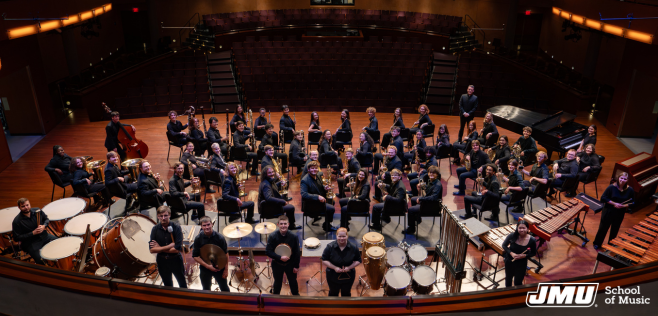
The JMU Wind Symphony, under the direction of Dr. Christopher Cicconi, is the premier woodwind, brass, and percussion ensemble at James Madison University. With an active performance schedule, the Wind Symphony is committed to performing the great works of the wind band’s core repertoire while also exploring the best of contemporary composition. The ensemble has hosted on-campus residencies with composers David Maslanka, John Mackey, Michael Daugherty, Joel Puckett, Steven Bryant, Donald Grantham, and JMU alumnus Brian Balmages. The ensemble has also presented premieres of faculty composers Jason Haney (Jetpack) and Eric Guinivan (Vicious Cycle), and consortium premiers of Maslanka’s Symphony No. 8, Puckett’s The Shadows of Sirius, Grantham’s Tuba Concerto, Turrin’s The Sounding of the Call, Stamp’s Divertimento, Plog’s Concerto 2010, and Balmages’ Portraits in Bluestone. As part of JMU’s annual Contemporary Music Festival, students have collaborated with composers such as Karel Husa, Joseph Schwantner, Don Freund, Donald Erb, John Harbison, Francis McBeth, Mark Camphouse, Samuel Adler, and Viet Cuong.
In addition to on-campus concerts, the Wind Symphony performed for the 2015 National Conference of the College Band Directors National Association (CBDNA) in Nashville, TN, the 2025 CBDNA Southern Division Conference in Tampa, FL, and the VMEA In-Service Conferences in 2022, 2015, and 2011. Throughout its tenure, the Wind Symphony has also previously performed at CBDNA regional conventions in New Orleans, Charlotte, Williamsburg, and Greensboro. Graduates of the Wind Symphony hold positions in several of the Washington-based military bands, military post bands, and symphony orchestras throughout the world, and numerous graduates are serving as noted educators and conductors throughout the country.
Thanks for our generous Friends of the Arts & Design scholarship donors whose support allows our students to continue to create, perform, and inspire.
Arts & Design Hero ($5,000+)
- Patricia Gould & Hasan Karsiloglu
- Ann & Mark Siciliano
- Richard & Sue Orem
- Joshua & Trish Weinstein
Arts & Design Champion ($1,500-$4,999)
- Beth Chandler Cahill & Jim Cahill
- Jonathan Fox
- Rubén Graciani & Matt Pardo
- Marilou Johnson
- Matthew & Sarah Von Schuch
Arts & Design Advocate ($500-$1,499)
- John & Susan Allemeier
- Jerry Benson & Martha Ross
- Nancy Davis
- Patrick & Stephanie Driscoll
- Holly Haney & Bob Kolvoord
- Quillon Hall & Karin Tollefson-Hall
- Gina & Tom Holden
- Thomas McKenzie
Arts & Design Ally ($250-$499)
- Sue Agranoff
- Ellen & George Aschenbrenner
- Charles Boepple
- Reginald Bryson & Souha Khawam
- Eric & Jess Guinivan
- MiKyoung Lee
- Amy & Sean Myers-Payne
- James & Virginia Newman
- Rebekah Noonan
- Cyndia & Dexter Taylor
- Heather & Theodore Tseng
- Bethany & Scott Vriesman
- Connie & Hugh Westfall
- Cecelia Wolf
- Diane & Leonard Young
Dear Patron,
Thank you for attending this School of Music performance; we appreciate your support! The JMU School of Music educates the most talented students from around the world to shape the fabric of society. We are ecstatic to showcase the talent and hard work of our students and faculty.
Scholarship contributions help young musicians blossom into mature artists. With your support, we will be able to offer our talented students more financial help in pursuing their goals. If you are interested in supporting our students' passion and dedication, please consider contributing to the Music Scholarship Fund at James Madison University by clicking the button below.