

Friday, October 2, 2026
7:30pm
Forbes Concert Hall
Please silence all electronic devices.
Unauthorized videotaping or any other recording of this production is strictly prohibited in adherence with Federal copyright laws.
Program
Liberty Fanfare - John Williams (b. 1932)/arr. Steve Sykes
Hook - John Williams/arr. Rieks van der Velde
Theme from "Schindler's List" - John Williams/arr. Frank Bernaerts
Taylor Lowry, cornet
The Forest Battle from "Star Wars Episode VI: Return of the Jedi" - John Williams/arr. Klaas van der Woude
Hymn to the Fallen from "Saving Private Ryan" - John Williams/trans. Philip Sparke
Connor Fink, soprano cornet
Imperial March from "Star Wars Episode V: The Empire Strikes Back" - John Williams/arr. Sandy Smith
Fanfare & Flying Theme from "E.T. The Extra-Terrestrial" - John Williams/arr. Steve Sykes
---INTERMISSION---
Riverdance - Bill Whelan (b. 1950)/arr. Ray Farr
Taylor Lowry, cornet; Allie Woodbury, flugelhorn
Ar Lan y Môr (On the Sea Shore) - Welsh Traditional/arr. Leigh Baker
Michael Baker, euphonium
Earth Rites - Robin Dewhurst
Jack Waters, trombone
The Ellis Island Lament - Traditional/arr. Robin Dewhurst
Taylor Lowry, cornet; Chloe Starling, tenor horn; Allie Woodbury, flugelhorn
Dundonnell from "Hymn of the Highlands" - Philip Sparke
Liberty Fanfare - John Williams/arr. Steve Sykes
Liberty Fanfare was written in 1986 to celebrate the centennial anniversary of the Statue of Liberty. It was premiered in June of 1986 by the Boston Pops under the baton of John Williams. Williams said of the piece that he "tried to create a group of American airs and tunes of my own invention that I hope will give some sense of the event and the occasion."
Hook - John Williams/arr. Rieks van der Velde
The music from Hook accompanied the 1991 American fantasy adventure film of the same name starring Robin Williams and written by James V. Hart and Malia Scotch Marmo. The film was a long-time passion project for director, Steven Spielberg, and told the story of a grown-up Peter Pan who was married, had children, and forgotten much of his adventurous life in Neverland. After Peter's kids are kidnapped in the night by the vengeful Captain Hook, it is up to Peter to reconnect with his legendary childhood self, save his children, and bring justice to the Pirates of Neverland.
Theme from "Schindler's List" - John Williams/arr. Frank Bernaerts
In November of 1993, the historical film Schindler's List and its accompanying musical score premiered to critical and historical acclaim. The film told the story of real-life World War II figure, Oskar Schindler, his time as the owner of a factory producing enamelware, and of his secret efforts to re-direct Jewish detainees from concentration camps to work in his factory and possibly save their lives. John Williams, who frequently collaborated with the film's director, Steven Spielberg, was amazed by the film, and felt that composing the score would be too challenging. According to legend, he said to Spielberg, "You need a better composer than I am for this film." And Spielberg responded with, "I know. But they're all dead." Itzhak Perlman, a famed violinst of Jewish heritage, performed the original solo for the main theme.
The Forest Battle from "Star Wars Episode VI: Return of the Jedi" - John Williams/arr. Klaas van der Woude
The Forest Battle is a concert suite with music from "Star Wars Episode VI: Return of the Jedi." It was released as a bonus track on the soundtrack for Episode VI, and though the actual music was not used in the movie, moments of music from this piece are featured in a more expansive and fleshed-out way.
Hymn to the Fallen from "Saving Private Ryan" - John Williams/arr. Philip Sparke
"Saving Private Ryan" is another cultural touchstone in the partnership between Steven Spielberg and John Williams. Hymn to the Fallen is the final piece of music in the film, appearing during the closing credits. The work is now used separate from the movie as a standard part of the repertoire for military bands across the United States, often used for funerals, ceremonies, and events involving a reverent attitude towards the sacrifices of the American veteran.
Imperial March from "Star Wars Episode V: The Empire Strikes Back" - John Williams/arr. Sandy Smith
The Imperial March, also called "Darth Vader's Theme," is a musical theme present throughout the Star Wars franchise. It was composed by Williams for "Star Wars Episode V: The Empire Strikes Back," and was premiered alongside "Yoda's Theme" on April 29, 1980, three weeks before the opening of the film, as a part of John Williams' first concert as official conductor-in-residence of the Boston Pops Orchestra. The march is one of the best-known symphonic movie themes; it is used as a leitmotif throughout the Star Wars franchise.
Fanfare and Flying Theme from "E.T. The Extra-Terrestrial" - John Williams/arr. Steve Sykes
"E.T. The Extra-Terrestrial" (or "E.T.") is a 1982 American science fantasy film produced and directed by Steven Spielberg, written by Melissa Mathison, and scored by John Williams. It tells the story of Elliott, a 10-year-old boy, and an extraterrestrial who has been stranded on Earth. Along with his friends and family, Elliott must find a way to help E.T. find his way home. The film's concept was based on an imaginary friend that Spielberg created after his parents' divorce. The film was a smash hit at the box office, surpassing "Star Wars" (1977) to become the highest-grossing film of all time, a record it held for eleven years until Spielberg's own "Jurassic Park" surpassed it in 1993.
Riverdance - Bill Whelan/arr. Ray Farr
Riverdance is a song by Irish musician Bill Whelan, originally recorded in March 1993, and first performed as the interval act for the Eurovision Song Contest 1994. In Ireland, the song spent a record-breaking 18 weeks at number one on the Irish Singles Charts and is the country's second best-selling single of all time. Riverdance also became a top-10 hit in the United Kingdom, where it reached number nine on the UK Singles Chart. The song's success inspired Whelan to use Riverdance as a springboard to conceive an album of similar material and the theatrical show of the same name, which would open in February 1995.
Ar Lan Y Môr (On the Sea Shore) - Welsh Trad./arr. Leigh Baker
Ar Lan y Môr or "On the Sea Shore" is a traditional Welsh folk love song. It was published with a single verse by the Welsh Folk Song Society in 1937.
Translated lyrics for the first verse:
On the seashore are red roses,
On the seashore are white lilies,
On the seashore is my love
Sleeping at night and rising in the morning.
Earth Rites - Robin Dewhurst
Earth Rites is a powerhouse trombone feature for brass band by Robin Dewhurst, drawing on the combined sonic palettes of Celtic music and jazz bands. Dewhurst is a prolific pianist, composer, arranger in the U.K., and he regularly features as a performer with big bands, small jazz groups, and brass bands. In 2007, Dewhurst was appointed to the prestigious role of Honorary Music Advisor to Her Majesty's Royal Marines Band Service. He is Composer-in-Residence for Stavanger Band (Norway) and has, for many years, been actively engaged as a Senior Lecturer in Music and Head of Performance at the University of Salford, England.
The Ellis Island Lament - Traditional/arr. Robin Dewhurst
Ellis Island, in Upper New York Bay, was the gateway for over 12 million immigrants to the United States as the nation's busiest immigrant inspection station for over sixty years from 1892 until 1954. Thousands of immigrants from Wales, Ireland, and Scotland passed through the gateway on their way to the United States as refugees and immigrants. The Ellis Island Lament is one of the many works telling the stories of these immigrants, and another notable work include Isle of Hope, Isle of Tears. It tells the story of the first person to enter America through Ellis Island—a young Irish girl named Annie Moore—and talks about leaving everything behind and starting over in a new place. It compares Ireland (the isle of tears) and the Isle of Manhattan (the isle of hope).
Dundonnell from "Hymn of the Highlands" - Philip Sparke
Dundonnell is the grand finale of Philip Sparke's "Hymn of the Highlands" collection. The composer describes the movement as starting "in martial mood" but soon breaking out "into a wild presto." Eventually, the bagpipe tune from the first movement of the Hymn collection returns before the presto crashes to a close. The movement is named for the village of Dundonnell, which is described as a charming place at the head of the Little Loch Broom which leads out to the ocean near Summer Isles.
Kevin Stees, conductor
Principal Cornet
Taylor Lowry
Soprano Cornet
Connor Fink
Solo Cornet
Micah Wingfield
Joshua Mobley
Liam Meadows
Noah Shea
Repiano Cornet
Chris Atkinson
Second Cornet
Dalton Bowling
Jamie Johnson
Third Cornet
Charlotte Connolly
Leah Petronella
Nathan Domine
Flugelhorn
Allie Woodbury
Solo Horn
Chloe Starling
First Horn
Ayden Suber
Second Horn
Victoria Buhl
First Baritone
Jake Cuppernull
Second Baritone
Bobby Galitz
First Trombone
Jack Waters
Second Trombone
Riley Rocket
Bass Trombone
Gavin Torrence
Euphonium
Michael Baker
Daisey Kludt
Eb Bass
Henry Taylor
Leo Lara
Bb Bass
Andy Helvey
Ben Campbell
Percussion
Radley Hofmann
Aiden Koehler
Zane Johnson
Tommy Crossley
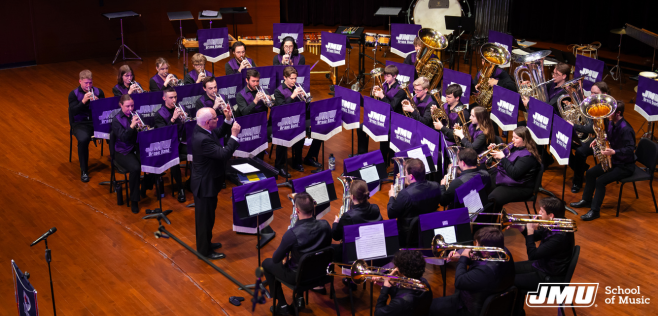
The JMU Brass Band is one of the most successful collegiate brass bands in the world. Formed by Professor Kevin Stees in the fall of 2000, the band quickly rose to prominence, winning the North American Brass Band Association (NABBA) 1st Section Championship in 2004 and 2005. They were also the NABBA Championship Section Runner-up six times between 2006 and 2022, before being crowned the NABBA Championship Section Champions in 2024.
The ensemble maintains an active schedule, performing regularly throughout the academic year. They are frequent guests at prestigious festivals and conferences, including the American Trombone Workshop, the Virginia Music Educators Conference, and the Great American Brass Band Festival.
In the summer of 2008, the band embarked on a concert tour of England, sharing the stage with the world-famous Cory Band. In 2009, they made history as the first brass band to perform a full-length concert at the Kennedy Center in Washington, D.C. Their international presence continued to grow with a 2012 performance in Linz, Austria, and a 2017 appearance in Manchester, England, where they became the first U.S. brass band featured at the Royal Northern College of Music Brass Band Festival. Most recently, they represented the United States at the 2022 World Music Contest in the Netherlands.
Always committed to showcasing new repertoire, the band has given the North American premiere of over a dozen major works. Currently ranked among the top brass bands worldwide, the JMU Brass Band continues to build on its history of excellence, focusing on high-quality performances and new musical challenges.
Kevin Stees
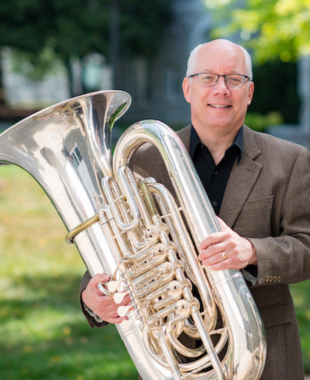 Kevin Stees, now in his 42nd year as Professor of Tuba and Euphonium at James Madison University, leads an active career as a soloist, chamber musician, conductor and music educator. He has studied with tuba artists Daniel Perantoni (Indiana University), Charles Daellenbach (Canadian Brass) and Jack Tilbury (U.S. Army Brass Quintet, ret.) and holds music degrees from University of Illinois and Arizona State University. He has been a finalist in several solo competitions and was a prize winner in the Second International Brass Congress Tuba Solo Competition.
Stees has presented solo and chamber music performances at numerous universities, conferences, music festivals and workshops, including the U.S. Army Band Tuba-Euphonium Conference, Southeast Regional Tuba-Euphonium Conference, International Tuba-Euphonium Conference and the Keystone Brass Institute. He has performed with a number of orchestras including the Roanoke Symphony Orchestra, Phoenix Symphony, Canadian Chamber Orchestra and the Calgary Philharmonic, and was a member of the Southwest Brass Quintet and the Skyline Brass.
Stees currently performs with the Madison Brass (quintet-in-residence at James Madison University) and the Shenandoah Valley Bach Festival Orchestra. In addition to performances on tuba, he is very active as the conductor of the internationally recognized James Madison University Brass Band, having led the ensemble in performances at the John F. Kennedy Center for the Performing Arts in Washington, D.C. and the Brucknerhaus Concert Hall in Linz, Austria, as well as music venues throughout England, Wales and Austria. Stees is also the conductor of the award winning Massanutten Brass Band. Additionally, he is on the Board of Directors of the North American Brass Band Association and a member of the International Tuba Euphonium Association.
Thanks for our generous Friends of the Arts & Design scholarship donors whose support allows our students to continue to create, perform, and inspire.
Arts & Design Hero ($5,000+)
- Patricia Gould & Hasan Karsiloglu
- Ann & Mark Siciliano
- Richard & Sue Orem
- Joshua & Trish Weinstein
Arts & Design Champion ($1,500-$4,999)
- Beth Chandler Cahill & Jim Cahill
- Jonathan Fox
- Rubén Graciani & Matt Pardo
- Marilou Johnson
- Matthew & Sarah Von Schuch
Arts & Design Advocate ($500-$1,499)
- John & Susan Allemeier
- Jerry Benson & Martha Ross
- Nancy Davis
- Patrick & Stephanie Driscoll
- Holly Haney & Bob Kolvoord
- Quillon Hall & Karin Tollefson-Hall
- Gina & Tom Holden
- Thomas McKenzie
Arts & Design Ally ($250-$499)
- Sue Agranoff
- Ellen & George Aschenbrenner
- Charles Boepple
- Reginald Bryson & Souha Khawam
- Eric & Jess Guinivan
- MiKyoung Lee
- Amy & Sean Myers-Payne
- James & Virginia Newman
- Rebekah Noonan
- Cyndia & Dexter Taylor
- Heather & Theodore Tseng
- Bethany & Scott Vriesman
- Connie & Hugh Westfall
- Cecelia Wolf
- Diane & Leonard Young
Dear Patron,
Thank you for attending this School of Music performance; we appreciate your support! The JMU School of Music educates the most talented students from around the world to shape the fabric of society. We are ecstatic to showcase the talent and hard work of our students and faculty.
Scholarship contributions help young musicians blossom into mature artists. With your support, we will be able to offer our talented students more financial help in pursuing their goals. If you are interested in supporting our students' passion and dedication, please consider contributing to the Music Scholarship Fund at James Madison University by clicking the button below.